

Tens of billions of dollars in international climate finance have been pledged this decade for a “just energy transition” in the Global South. Most of the money, promised by wealthy governments and banks, will be funnelled into infrastructure – mainly shuttering fossil fuel power plants or installing renewables.
But these investments in the shift to low-carbon economies affect workers and communities and therefore require their support. Without funding for social protection and participation, their backing is unlikely, putting the transition at risk, climate justice experts warn.
Several headline-grabbing “Just Energy Transition Partnerships” (JETPs) were announced in 2021 and 2022, including for South Africa at the UN climate conference in Glasgow and Indonesia at the G20 summit.
While there is a need for fair, green transitions across all economic sectors, from vehicle manufacturing to farming and health, it is energy that has attracted the most attention and money so far. The early results have been mixed, with progress on moving away from coal power in the countries with JETPs slower than hoped for.
-
Indonesia and Vietnam set for surge in coal use this decade despite transition deals
Rising demand in Southeast Asia and India is expected to prevent coal use from falling significantly this decade, the International Energy Agency predicts -
Big banks’ lending to coal backers undermines Indonesia’s green plans
Foreign banks involved in Indonesia’s $20-billion Just Energy Transition Partnership have also funded companies working on coal power expansion, a TBIJ and Climate Home News investigation reveals


Another challenge is that the vast majority of the JETP funding on offer is in the form of loans, with the grants needed to support local communities through the transition making up a tiny fraction.
Of the finance pledged to South Africa, Indonesia and Vietnam under their JETPs, grants accounted for just 4%, concessional below-market-rate loans for 53%, commercial loans for 25% and guarantees for 13%, according to a policy brief produced for the G20 in Brazil.
Spotting a major gap in the justice side of these partnerships, philanthropic foundations in 2023 established a $20-million fund to support community-based and non-governmental groups in JETP countries in their efforts to secure a fair deal for local people.
Philanthropies back community input
During three years of giving grants to 60 community organisations, unions and researchers, ClimateWorks Foundation – which set up the Global South Just Transition Fund with the IKEA and Laudes foundations – has learned what it takes to complement the JETPs.
“They are built to move money to energy projects, and our grants build the civic and governance infrastructure that lets that money land,” Justin Sylvester, just transition director at ClimateWorks Foundation, told Climate Home News.
The results achieved with the Fund’s backing include progress on a subnational Natural Resource Fund model in Indonesia backed by the finance ministry, which offers a route for districts to channel coal revenues into developing communities’ post-coal economies.
Comment: Santa Marta was a learning moment for how to shape inclusive just transitions
In South Africa, meanwhile, nonprofit INSPIRE has worked with solar developer Forethought Capital to build trust with community leaders and secure signed lease agreements for solar projects on protected communal land – a model that can be replicated.
One key lesson so far, Sylvester said, is the importance of building civil society’s economic, civic and cultural power – not just its capacity. Another is the need to get behind social ecosystems rather than isolated projects, and collaborate with other funders.
“Results come when a community group, a researcher, and a ministry work on the same issue at the local, regional, and national levels,” he said. “We see clear wins when communities can shape transition decisions rather than only react to them, with positive policy outcomes, court rulings, and public money moving.”
The missing finance category
Despite the importance of these early efforts to ensure an equitable green future for communities on the ground, no one knows how much money is going towards it. That is largely because, as an emerging category of climate action that has evolved only in the past few years, funding for just transitions is not yet being comprehensively measured or tracked.
Nor is there consensus on how much will be needed as the energy transition gathers speed. Estimated requirements for international support for developing countries range from a high-level climate finance panel’s $50 billion a year by 2035 to $242 billion a year from the Civil Society Equity Review. But these figures are hard to compare directly.
A new discussion paper on finance for just transition and how it fits with a new Just Transition Mechanism (JTM) due to be established at the upcoming COP31 climate summit in Antalya notes that it faces “a definitional, methodological and accounting challenge”.
It defines just transition finance as “finance coming primarily from public sources, above all grant-based, highly concessional and non-debt-creating, that supports the policies and measures needed to move economies away from extractive, carbon-intensive models while distributing costs and benefits fairly”.
Co-author Jodi-Ann Wang, a research fellow with the Just Transition Finance Lab at the Grantham Research Institute, told a webinar on the paper’s findings there is as yet no common tracker or shared taxonomy in place, nor oversight to monitor such flows.
“Opacity is… costing us a sound understanding of just transition finance,” she said.
This is where the “Belém-Antalya Just Transition Mechanism” – or BAM, as it’s known among the civil society groups that advocated strongly for it – comes in.
From Belém to Antalya – gains, gaps and challenges for a new Just Transition Mechanism
Resource mobilisation group under BAM
As part of its objectives, form and methods of working, which countries will begin to define at the COP31 negotiations in Türkiye, Climate Action Network (CAN) International, a coalition of hundreds of NGOs, is pushing for the JTM to include a “resource mobilisation group”.
This, the paper explains, could explore and develop ways to boost the quantity, quality and governance of finance for just transition around the world, with a view to making it more accessible and equitable.
More concretely, it could map available sources of support and funding gaps, inform the new JTM on financial realities and needs, and propose partnerships between financial institutions, donor countries and actors implementing just transition on the ground.
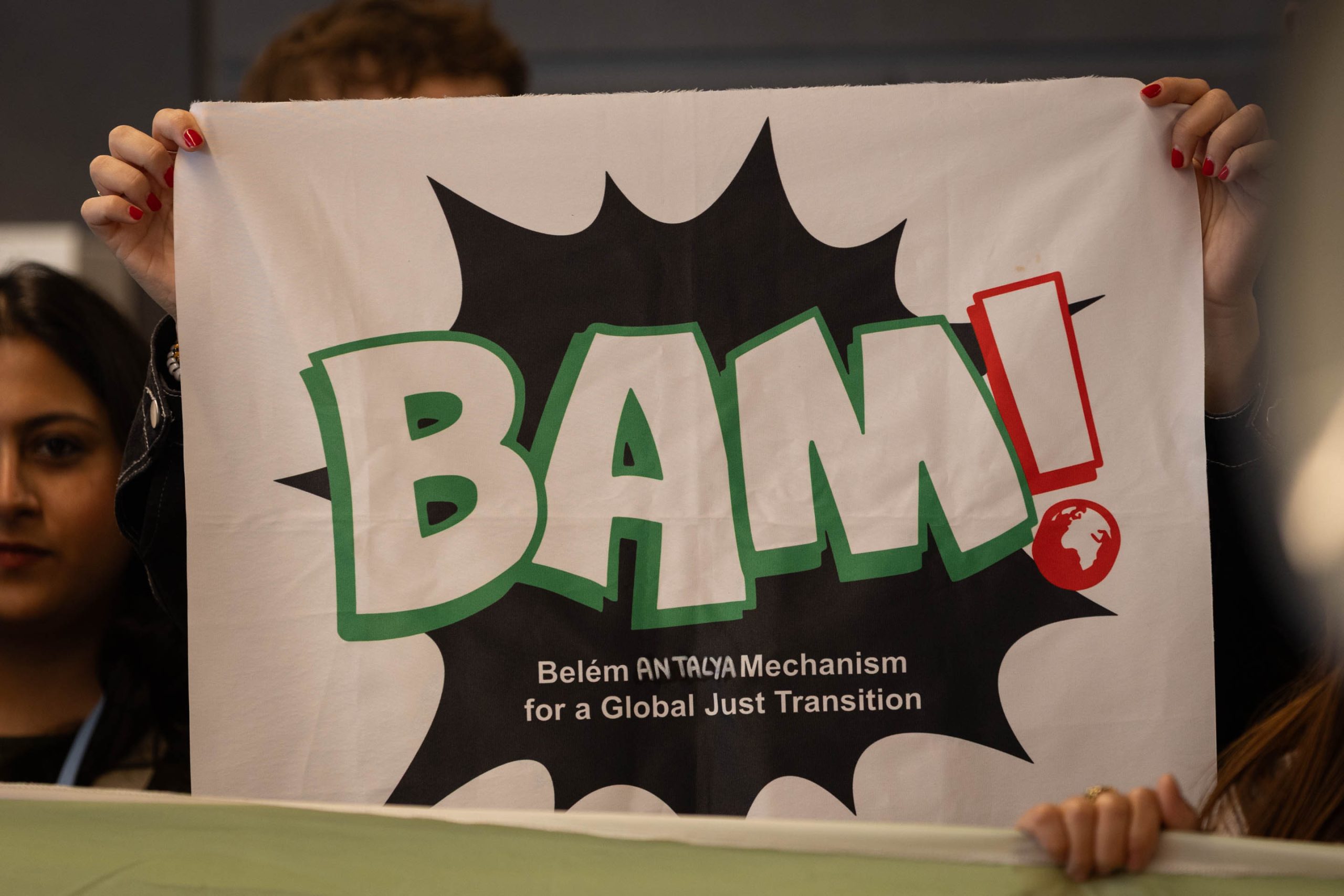
Rebecca Thissen, CAN’s global advocacy lead who co-authored the paper, emphasised that the aim is not to set up yet another UN climate fund – something donor governments are wary of. Instead, she described the role of a resource mobilisation group as “more agile and innovative”.
One of its first tasks would be raising awareness about just transition finance – not yet an established category of climate funding. Climate finance has traditionally fallen into two main categories: mitigation (measures that cut emissions, such as installing renewables) and adaptation (protecting people, infrastructure and livelihoods from climate change impacts).
A third pillar has recently emerged: loss and damage (responding to and minimising destruction and harm caused by climate-driven disasters and longer-term stresses).
Just transition finance here, there and everywhere
The time has come to add just transition into the finance mix, argued Thissen, explaining this could be done through two main approaches. The first is to ensure that the existing areas – mitigation, adaptation and loss and damage – have a strong justice component integrated into them.
The second is to identify specific just transition policies and measures that “fall through the cracks” of those three types of climate finance and show how they can be funded separately.
Examples given in the paper include Ireland providing a fuel allowance and tax rebates for low-income households to offset additional costs from its carbon tax, Romania offering retraining opportunities in its coal region, and Chile funding ecosystem restoration for polluted areas to recover from resource extraction.
Spain’s unions say just transition means renewing communities beyond jobs
Spain’s government, in addition, has been widely praised for funding formal pacts and just transition strategies in areas where coal mining and power has been phased out, based on tripartite consultations with national, regional and local administrations, unions and industry.
NDCs get serious about just transition
The emerging discussion around just transition finance comes as governments have begun incorporating the concept of just transition, and how to pursue it, into their national climate action plans (NDCs) in a far more meaningful way.
A report from the International Labour Organization, which covered 123 countries that had submitted updated NDCs by November 2025 – the third set of NDCs since 2015 – found that explicit references to “just transition” appeared in 79%, up from 50% in the second cycle.
It said many countries have moved beyond single mentions of just transition to multiple references or even dedicated sections, while around half of NDCs now reference follow-up mechanisms or institutional arrangements for just transition.
Mentions of explicit resources being allocated for just transition rose to 26% – whether in the form of financial commitments, budget lines or designated funding channels – compared with 2% in the previous round of NDCs.
The report also cast the net wider, showing that employment has become a common consideration when it comes to climate action, with 90% of the latest NDCs referencing employment and giving growing attention to green jobs and decent work. Social inclusion and equity, meanwhile, are also more prominent, appearing in over three-quarters of NDCs.
Labour rights lens puts focus on all workers
This broader lens on just transition fits with the perspective of the International Trade Union Confederation, which argues it must lead to quality jobs in renewables and other green industries, respect labour rights and be built on social dialogue, as well as compensate those who lose out in the shift to a low-carbon world using social protection systems.
All this has to be financed, emphasised Bert De Wel, the confederation’s global climate policy coordinator. His organisation argues that this can best be done by planning a fair deal for workers and people with lower incomes as economies go greener.
“It’s not always about having more money – more public money, more private money,” De Wel said. “It’s also about what is out there and how it’s being distributed – who is winning and who is losing?”
For example, when it comes to promoting sales of electric vehicles over petrol or diesel cars, government subsidies often end up going to richer families, while public transport used by those who can’t or don’t want to buy a car suffer from under-investment.

Similarly, just transition is often seen in rich countries as limited to helping workers in coal mines or oil fields find new green jobs. But this, De Wel said, is far too narrow an interpretation.
Key decisions at UN climate conferences make clear that just transitions are needed across multiple sectors and require “whole-of-society and whole-of-economy approaches”.
“All workers affected by climate change or by climate policies [should be] the subject of just transition policies, and the best way to deal with it is to give them decent jobs and good contracts, which means formal jobs or formalisation of informal workers,” De Wel said.
This is especially important in developing countries where informal work makes up a large share of economic activity and those who do it risk being left out of the just transition. So far, they have been largely left out of estimates of what will be needed to fund just transitions.
Narrowing the development gap
In addition to compensating workers who are negatively affected by climate policies, social protection and social welfare systems can also be an effective way of providing just transition support to vulnerable people who are hit by climate change impacts.
Back in 2021, record rainfall caused rivers to burst their banks on the border of Germany and Belgium, killing at least 170 people and causing many employees to be out of work for a few months until their companies could recover.
But, De Wel noted, they did not lose out financially because they were covered by national social security systems – unlike in developing countries such as Pakistan when people’s small businesses or fields are devastated by flooding and they have to rely on handouts.
For Indian women workers, a just transition means surviving climate impacts with dignity
Khaled Hashem, an Egyptian negotiator who coordinates the just transition track for the G77 and China group of developing countries at UN climate talks, said it is essential for the new JTM to take a broad view and work towards narrowing the development gap between rich and poor nations, so that the latter are in a position to take stronger climate action.
For example, just changing the energy source of a factory to solar requires a whole range of investments in infrastructure, the power grid, skilling of the labour force and even support for basic health and education services at the local level, he argued. Funding for all these different activities “can be considered as part of the just transition”, he added.
JTM can connect and coordinate
Given the scope of the challenge, CAN International proposes that a resource mobilisation group under the JTM could connect what is happening inside and outside of the UN climate process to coordinate the many existing and potential sources of funding and have them recognised as just transition finance with shared guidelines.
Currently, Thissen said, multilateral development banks are already working on just transition using their own sets of principles, but are starting to appreciate the value the new mechanism could offer in bringing funders together to discuss how to improve cooperation.
This would include UN climate funds, such as the Green Climate Fund which mentions just transition in its strategy but has so far funded few projects that directly address the issue.

“If [the JTM] is established… with the right function and modalities and principles, it could really set a very good precedent on how we articulate the COP discussion, while also including newcomers and new actors, but through defined standards and approaches that are still embedded in multilateral climate agreements,” Thissen said.
She suggested that the next Global Stocktake of national climate plans, due to conclude in late 2028, could evaluate and respond to countries’ progress on just transition and funding for it in the outcomes, which must be agreed by all governments.
The stocktake could be informed by the UNFCCC’s Standing Committee on Finance, which assesses climate finance needs for developing countries every four years, with its third such report due in 2028. While the committee has so far lacked data on just transition finance, this could be provided through the work of the new Just Transition Mechanism.
“That could be a clear connection [between] what actually already exists in the negotiations and… the added value of the BAM,” Thissen said.
The post Why COP31 needs to start talking about just transition finance appeared first on Climate Home News.
Why COP31 needs to start talking about just transition finance

Negotiations on finance at a key UN summit where governments are expected to ramp up “insufficient” nature conservation policies have reached a stalemate, as countries struggle to agree on where new sources of funding for biodiversity will come from.
Ahead of the COP17 nature summit taking place in Yerevan, Armenia, a UN assessment report showed that governments are off track to meet nearly all the 2030 targets in the Global Biodiversity Framework (GBF), often referred to as the ‘Paris Agreement for nature’.
In Yerevan, talks on increasing financial resources for biodiversity have remained gridlocked by an EU proposal to expand the list of potential government donors, so that emerging economies like China or Gulf states would also be able to contribute funding and have it counted towards a collective goal.
But some developing nations have fiercely opposed proposal. The group of Arab countries said at the summit’s opening plenary that it “rejects any attempt” to expand the list of donors or “reclassify” the development status of countries.
-
Tensions set to flare over trade at COP31 as China makes it a priority
After difficult talks in Belém last year, trade is likely to remain a sticking point at COP31 despite Brazil’s efforts to contain the issue to a series of dialogues -
Lula’s election win in Brazil raises hopes for zero deforestation drive
Lula’s re-election makes it more likely Brazil can meet a key goal to end forest loss in the Amazon and builds confidence in a new fund to protect the world’s rainforests, experts say -
National climate plans now promise half the emission cuts expected by UN
The US exit from the Paris Agreement and weak new pledges leave 2035 emissions just 6% below 2019 levels, against 12% projected last year


Ireland’s nature minister Christopher O’Sullivan, whose country holds the EU presidency, told journalists in Yerevan that EU member states “do feel very strongly about this”, adding “it is a position we will be holding”. “There are a lot of countries considered developing countries that obviously need to play their part,” he said.
Countries are meeting in Armenia for the first Global Review of Collective Progress – a similar process to the climate Global Stocktake – under which they are expected to adopt a “Yerevan Pathway” outlining ways to ramp up nature conservation policies and get on course to meet global nature goals.
Biodiversity finance falling short
The UN report on progress shows developed countries most likely failed to meet an interim target to channel $20 billion for nature protection by 2025, which developing countries say is necessary to implement a global target to protect 30% of the world’s land and ocean by 2030.
The group of African countries said in a statement at the COP17 opening plenary that the findings of the global review “serve as a serious warning” and “underscore the urgent need to strengthen” the delivery of public finance.
Brian O’Donnell from the non-profit Campaign for Nature told a Climate Home News webinar that public funding is key for developing countries – which are home to most of the world’s biodiversity – so that they can develop tools like spatial planning, incentives for local communities, institutional capacity and even simply signage within a protected area. “We’re asking a lot from those countries,” he added.
The GBF target also states that public biodiversity finance should be increased to $30bn by 2030, and that in total countries should mobilise $200bn from all possible sources – which includes the private sector and philanthropic funds – by the same date. In 2025, global biodiversity finance is estimated to have reached between $74.9 and $92.4 billion per year.

Speaking at the webinar, Steven Guilbeault, a former minister of environment for Canada and one of the architects of the GBF, said he has been hearing the idea of expanding the base of donors to increase available finance since the biodiversity COP1 in 1995, but added it’s not an “easy conversation” that will be solved in Yerevan.
“I wouldn’t want the progress that we’re seeing here, the progress that we can still make in the coming days, to be jeopardised by the entrenched position on this issue,” he said.
In a letter issued to governments, the Armenian presidency said it aimed to adopt the Global Review text this Wednesday, with two days of negotiations still to go. Observers told Climate Home News that this would be a way of detaching it from the thorniest negotiations on finance.
Reducing harmful subsidies as an alternative
Linda Krueger, director of biodiversity and infrastructure policy at The Nature Conservancy (TNC), said it is “no surprise” that the finance decisions will require guidance from ministers, but argued that the “heavy lift” to increase financial commitments will need to come from reforming subsidies.
When the GBF was adopted, countries identified a finance gap of $700bn a year by 2030. They agreed to address it by mobilising $200bn from all sources, but the bulk of this is due to come by redirecting $500bn in subsidies for activities that harm nature. This goal – contained in Target 18 of the GBF – is where governments have made the least amount of progress, according to the UN progress report.
The UN currently estimates that for every dollar invested in nature conservation and restoration, $30 are currently invested in its destruction. A report by Conservation International puts the cost of harmful subsidies at $11 trillion-$24.7 trillion a year, when also accounting for the nature loss they leave behind.
In Yerevan, the COP17 presidency has aimed to raise the profile of the target on subsidies by launching several voluntary initiatives, including the “Friends of Target 18”, a new platform led by Colombia and Finland which will help countries identify and find ways to redirect damaging subsidies.
Early speakers’ list suggests few powerful leaders will attend COP31
A group of over 130 business and financial institutions – among them French bank BNP Paribas, fashion retailer H&M, food giant Nestle and household products multinational Unilever – also issued an open letter calling on countries to accelerate incentive reform.
Speaking to the media on Monday, Kumi Kitamori, environment director at the Organisation for Economic Co-operation and Development (OECD), said much of the discussion focuses on winding down nature-negative incentives, but noted “it’s also equally about scaling up incentives tha