Carbon Footprint
RBC and Scotiabank Step Back on Climate Targets as Policy Support Weakens and AI Drives Energy Demand



Canada’s biggest banks are quietly resetting their climate ambitions. As reported by The Canadian Press, both Royal Bank of Canada (RBC) and Scotiabank have pulled back from key interim emissions targets, signaling a broader shift in how financial institutions are navigating the energy transition.
The move reflects a more complicated reality. Climate goals are colliding with policy uncertainty, geopolitical tensions, and a sharp rise in energy demand—especially from artificial intelligence. What once looked like a clear path to net zero is now far less predictable.
RBC Does a Reality Check on 2030 Targets
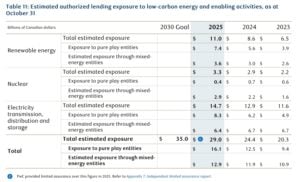
RBC had set clear 2030 targets in 2022. The bank aimed to reduce financed emissions across three high-impact sectors: oil and gas, power generation, and automotive. These interim goals were meant to guide its broader ambition of reaching net-zero financed emissions by 2050.
However, in its 2025 sustainability report, the bank acknowledged that the landscape has changed significantly. After reviewing policy shifts, global energy trends, and technology progress, the bank concluded that some of these targets are simply “not reasonably achievable.”
This is not a complete retreat. RBC is still committed to its long-term net-zero goal. But the bank is adjusting its expectations. It now emphasizes that success depends heavily on external factors—strong government policies, technological breakthroughs, and stable capital flows.
In simple terms, RBC is saying it cannot drive the transition alone.

- ALSO READ: Canada to Launch Sustainable Investment Taxonomy in 2026 to Guide Green and Transition Finance
Strategy Shifts Toward Flexibility
Instead of sticking to rigid targets, RBC is moving toward a more flexible approach. The bank will continue tracking emissions intensity in key sectors and reporting absolute emissions for oil and gas. At the same time, it is doubling down on financing the transition.
Its strategy now focuses on supporting clients through the shift to a low-carbon economy. This includes advising companies on decarbonization, investing in climate solutions, and scaling financing for clean energy. RBC is also working to manage its exposure to high-emission sectors while capturing opportunities in emerging technologies.
To support this transition, the bank is strengthening internal capabilities across its energy transition, sustainable finance, and cleantech teams. These efforts aim to align its business growth with long-term climate goals while remaining responsive to changing market conditions.
- MUST READ: Mark Carney Admits Canada Will Miss 2030 and 2035 Climate Targets as Policy Rollbacks Slow Progress
Scotiabank Goes Further: Net Zero Goal Dropped
While RBC has recalibrated, Scotiabank has taken a more decisive step. The bank has not only withdrawn its interim 2030 targets but also scrapped its goal of achieving net-zero financed emissions by 2050.
This marks a significant shift.
According to its sustainability report, the bank cited slower-than-expected progress in climate policy, rising global energy demand, and delays in key technologies such as carbon capture. It also pointed to major policy changes, including the rollback of parts of the U.S. Inflation Reduction Act and Canada’s removal of the consumer carbon tax.
Scotiabank said the assumptions behind its 2022 targets no longer reflect current realities. The transition, it noted, is not moving as quickly as expected.
Still, the bank continues to focus on managing climate-related risks and financing opportunities. It remains committed to mobilizing $350 billion in climate-related finance by 2030 and has already delivered over $200 billion since 2018.


Climate Momentum Slows Across Canada
The banks’ decisions reflect a broader slowdown in climate momentum across Canada.
Insights from RBC’s Climate Action 2026: Retreat, Reset or Renew show that, for the first time, the Climate Action Barometer has declined. This index tracks climate-related progress across policy, capital flows, business activity, and consumer behavior.
The drop was broad-based. Policy changes, including the removal of the consumer carbon tax and the reduction of electric vehicle incentives, weakened momentum. At the same time, economic uncertainty and trade tensions shifted focus toward affordability and job creation.
Energy policy also added friction. Restrictions on renewable energy development in Alberta slowed project pipelines. As a result, both businesses and consumers pulled back on clean energy investments.

Capital Flows Show Signs of Caution
Investment trends reinforce this shift. Climate-related investment in Canada has plateaued at roughly $20 billion per year. However, public funding continues to provide support, with nearly $100 billion in clean technology incentives planned through 2035. But private capital is becoming more cautious.
Investors are increasingly selective, particularly when it comes to early-stage climate technologies. Policy uncertainty is amplifying risks in sectors like renewable energy and clean manufacturing.
While some regions—such as Canada’s East Coast wind projects—continue to attract funding, overall growth has slowed.
AI and Energy Demand Complicate the Transition
Another major factor reshaping the transition is the rapid rise in energy demand from artificial intelligence.
AI systems require vast computing infrastructure, and data centers are expanding quickly. This surge in electricity demand is putting pressure on energy systems already trying to decarbonize.
For banks, this creates a difficult balancing act. They must support high-growth sectors like AI while also working to reduce emissions. This tension makes near-term climate targets harder to meet.
A Shift From Targets to Transition
The decisions by RBC and Scotiabank highlight a broader shift in strategy. Instead of rigid interim targets, banks are moving toward a more flexible, transition-focused approach.
They recognize that achieving net zero depends on factors beyond their control—policy support, technology development, and global energy demand. When those factors shift, strategies must adapt.
Rather than committing to targets that may become unrealistic, banks are focusing on financing solutions, managing risks, and supporting clients through the transition.
The Road Ahead
The rollback of interim targets signals a more cautious phase in the energy transition. It shows that progress is uneven and heavily dependent on policy alignment and market conditions.
RBC continues to hold its long-term net-zero ambition. Scotiabank, meanwhile, is prioritizing flexibility and risk management. Both approaches reflect a more complex and uncertain path forward.
Ultimately, achieving net zero will require stronger coordination between governments, industries, and financial institutions. Without that alignment, even the most ambitious climate plans will face significant hurdles.
For now, Canada’s largest banks are adjusting course—responding to a transition that is proving far more challenging than expected.
The post RBC and Scotiabank Step Back on Climate Targets as Policy Support Weakens and AI Drives Energy Demand appeared first on Carbon Credits.