Climate Change
Guest post: How extreme heat is ‘creeping’ from summer into autumn and spring
Extreme heat is one of the deadliest climate hazards, but no two heatwaves are the same.
Heat extremes that happen outside of the peak summer months are often more dangerous because they can catch people off guard.
Heatwaves that hit during the spring or the first heatwave of the summer are riskier because people’s bodies are not yet accustomed to the heat and cooling strategies, such as air conditioning or public cooling centres, might not be available.
On the other hand, heatwaves that happen in the autumn, after a long summer season of heat exposure, can place further strain on bodies and local infrastructure that are already under stress.
As the climate changes and global temperatures rise, research has shown that heatwaves are becoming more frequent, intense and lengthy.
Our study, published in AGU Advances, is the first to measure whether the timing of extreme heat during the calendar year is changing around the world.
We find that, in more than half of the world, extreme heat events are spreading into the “shoulder seasons”, but doing so unevenly – in other words, they tend to creep more into autumn or spring, depending on the location.
Defining heat seasons
Meteorological summer is often assumed to be the warmest three-month period of the year. It is simplistically defined as June to August in the northern hemisphere and December to February in the southern hemisphere.
However, extreme heat seasons vary from place to place and do not always neatly map on to these defined periods.
Our study, therefore, goes beyond traditional definitions of seasons and instead focuses on “local heat seasons”. We define these as the three consecutive months when extreme heat events happened most often in the 1980s.
From this starting point, our research looks at how extreme heat is creeping into the two-month periods before and after a local heat season. We call these periods “shoulder seasons”.
This flexible definition of heat and shoulder seasons allows us to measure how the timing of extreme heat has changed over time.
Specifically, we look at the percent of annual heat days that occurred in the heat season and shoulder seasons at each location on Earth and measure how those relative shares have shifted over the last 45 years.
For our analysis, we use climate data from 1980-2024 from the MERRA2 reanalysis dataset. To ensure our results were robust, we repeated the process using ERA5 reanalysis data.
We picked the 1980s as our baseline decade as it was the start of the common time period between the two reanalysis datasets. We compared this to climate data in the decade between 2015-24.
Comparing these two time periods – the opposite ends of our datasets – allowed us to register a larger magnitude change and account for cumulative effects of climate change.
We consider measures of both dry and humid heat, as each has distinct impacts. Dry heat tends to be more dangerous to plant and ecosystem health, while humid heat is more strenuous for humans.
We use the dry-bulb temperature and wet-bulb globe temperature as our measures of dry and humid heat, respectively.
Created in the 1950s by the US military, wet-bulb globe temperature has a long history as an international standard used for outdoor sports and occupational hazard monitoring. It combines measurements of temperature, humidity, wind speed and solar radiation.
Changing heat seasons
Our research finds that, in the 1980s, extreme heat around the world was closely confined to a single heat season. For example, some 93% of the world’s land area experienced more than 80% of extreme dry-heat days during its traditional dry-heat season.
Surprisingly, this was even true in the tropics, where there is much less of a seasonal swing in temperatures.
We also show that extreme dry- and humid-heat seasons are often different from one another, typically offset by one month. This is especially true in places influenced by monsoon systems, such as north-western Mexico and central India, where the extreme dry-heat season precedes the extreme humid-heat season.
But, the edges of these extreme heat seasons are starting to blur.
Extreme heat events are spreading out significantly in the calendar year in more than half of global land areas.
This extension of the extreme dry- and humid-heat seasons means that dangerous heat has started to creep into the shoulder seasons – but not equally so.
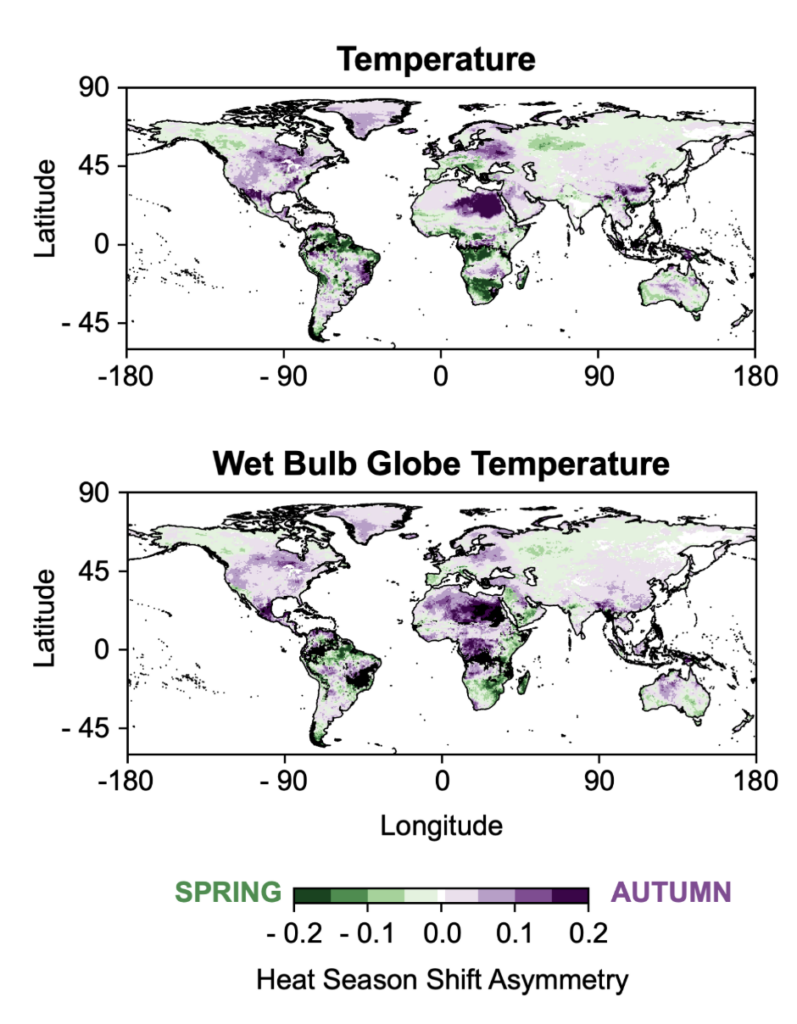
The maps below show how, in western Europe, southern Africa and north-western India, a larger fraction of each year’s extreme heat events are happening in the months before the historical dry- and humid-heat seasons. These regions are shaded in green.
On the other hand, in much of the US, eastern China, northern Africa and eastern Europe, extreme heat events are increasing in frequency in the months after the traditional heat seasons. These regions are shaded in purple.

Boosting existing seasons
It is possible that these observed changes have a straightforward – and somewhat simple – explanation.
In many regions, one shoulder season – spring or autumn – is warmer than the other. One hypothesis we explored was whether a simple step up in daily heat across the calendar year makes it more likely for extreme heat days to occur in one shoulder season over the other.
Our research shows that things are not so simple.
To investigate, we created a new, “synthetic” timeseries in order to identify the impact of annual average warming. To do this, we took the baseline 1980s timeseries and “shifted up” the data by the average change in local dry or humid heat between the first and last 10 years of our dataset (1980-89 compared to 2015-24).
We find that, in most locations, intensifying the baseline seasonality in a given location by warming evenly over the course of the year explains the changes in extreme heat timing within the traditional heat season.
However, annual average warming alone cannot explain the uneven changes in how extreme heat is occurring in the shoulder seasons.
As such, we conclude there must be other factors at play.
Long-term changes in seasonal precipitation and soil moisture – whether drying or moistening – could be contributing.
There could also be potential links to land-use changes, such as agricultural intensification or increased irrigation. Natural fluctuations in regional climates, caused by phenomena such as the Pacific Decadal Oscillation and Atlantic Multidecadal Oscillation, could also be playing an important role.
To tease out the contributions of each of these drivers, scientists will need to conduct more regionally-focused studies.
Managing hazards
The expansion of extreme heat events into the shoulder seasons indicates that key protections, such as heat early warning systems and the establishment of cooling centres, may be needed outside the traditional summer months.
Further research is also required to look into whether the overlap of extreme heat with other seasonal hazards is increasing.
For example, we find that, throughout much of the US, there is a larger expansion of the heat season into the autumn than the spring. In the western US, extreme heat which stretches later into the year could increase the overlap between the extreme heat and wildfire seasons.
Meanwhile, a similar extension of the heat season into the autumn in the eastern US could increase the overlap between the extreme heat and Atlantic hurricane seasons.
Understanding how the intersection of these seasonal hazards is changing is essential for developing targeted climate adaptation strategies, given that multiple hazards happening at once or in quick succession are much more dangerous than when they happen in isolation.
Ivanovich, C. et al. (2026) Extreme dry- and humid-heat seasons are changing asymmetrically, AGU Advances, doi:10.1029/2026AV002516
related

Guest post: Why tough methane cuts are crucial for keeping warming ‘well-below’ 2C

Guest post: France’s June heatwave caused more than 2,700 heat-related deaths
Guest post: Climate change has caused one-fifth of Pine Island glacier retreat

Q&A: What change of power in Colombia could mean for world’s fossil-fuel transition
The post Guest post: How extreme heat is ‘creeping’ from summer into autumn and spring appeared first on Carbon Brief.
Guest post: How extreme heat is ‘creeping’ from summer into autumn and spring