Green Living
Guest Idea: Green Bins Are Spreading Faster Than the Habit of Using Them

Editor’s Note: This is a sponsored posting.
Curbside food scrap collection has spread fast. BioCycle’s nationwide survey counted 14.9 million U.S. households with access to food waste collection in 2023, up 49 percent from 10 million two years earlier.
Getting those bins used is the harder part. Reported participation runs from near-universal in a handful of cities to under 30 percent in others. That gap matters. Food waste is about 24 percent of what U.S. municipal landfills take in, and the EPA estimates it accounts for 58 percent of the fugitive methane those landfills release. An unused green bin isn’t a neutral outcome.
Quick definition first, since the name varies. The green bin is the curbside cart for household organics: food scraps, plus yard trimmings and food-soiled paper depending on your program. It’s collected separately from trash and recycling and sent to a composting or anaerobic digestion facility instead of a landfill. It isn’t green everywhere. Toronto runs a Green Bin program, New York City uses brown ones, and elsewhere it’s the organics cart, the compost cart, or the food scraps cart. What matters is where the material ends up, not the color.
Why People Quit the Green Bin
Households opt out for a long list of reasons: confusion about what’s accepted, forgetting collection day, plain inconvenience. I’d add one that gets less attention because it’s unglamorous. The bin gets disgusting, cleaning it turns into a recurring chore, and eventually the chore wins.
I’ll be straight that this is a hypothesis, not a documented finding. I haven’t found a study that isolates bin cleaning as a reason people quit. What I’ve got is the pattern I hear from customers constantly. But there’s evidence that making the job less unpleasant moves the numbers.
In 2023–24, Essex County Council in the UK ran a year-long Food Recycling Project. It delivered a package to more than 375,000 households: a sticker for the general waste bin, an information leaflet, and a free roll of compostable liners. Food recycling tonnage rose an average of 21 percent against a control group in the first three months after delivery, more than double the council’s 10 percent target.
The liners were one piece of that package, running alongside a media campaign, so the case study can’t tell us how much of the gain they drove on their own. What it does show is that handing people a tool to keep the mess contained belongs in the mix alongside better signage. It also shows the limit. Free liner giveaways are a subsidy most households will never get.
So the question isn’t whether a cleaner, contained bin helps people stick with the program. Plainly it does. The question is how you get there when nobody’s handing out free bags. That’s the gap BagEZ fills.

Doing More With Less
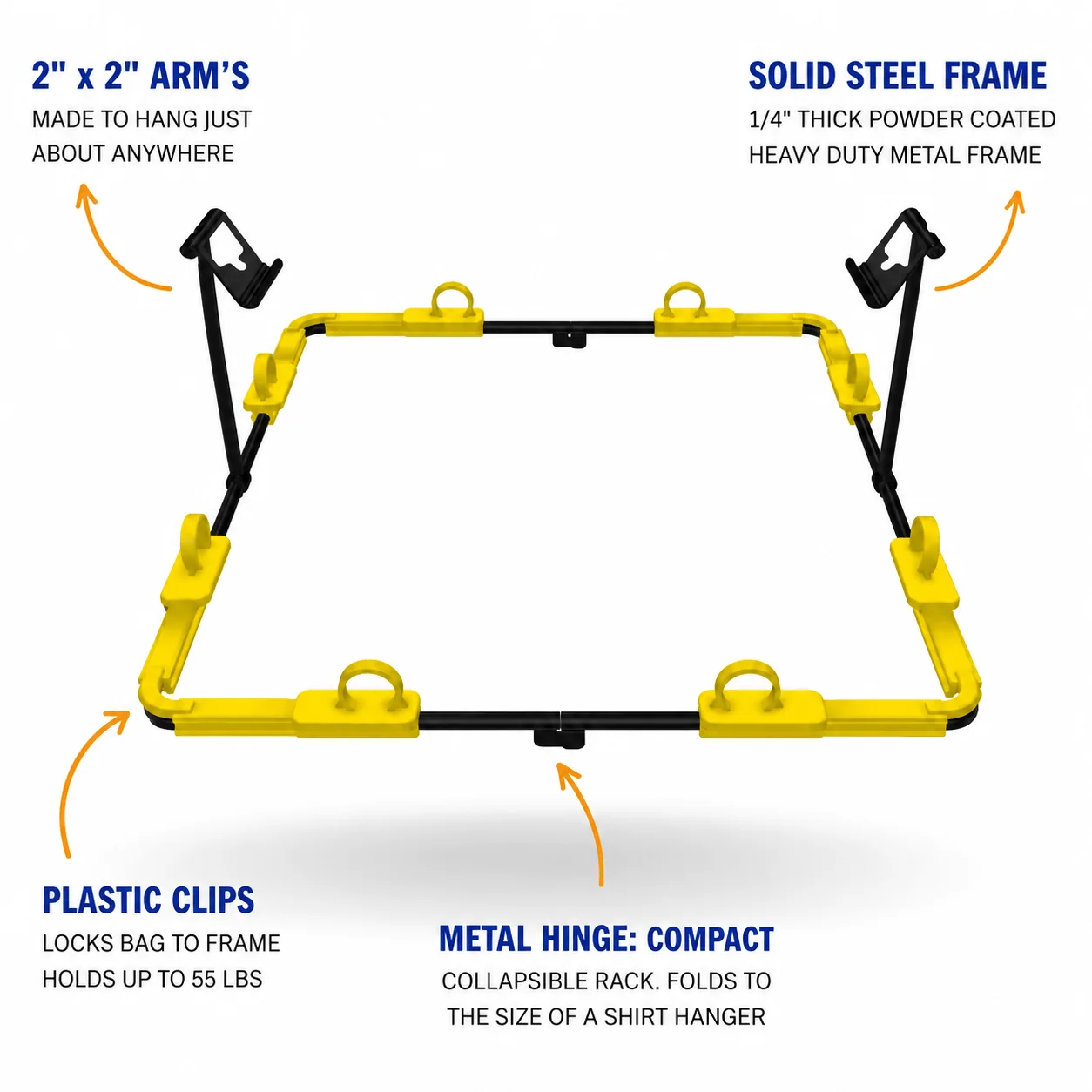
BagEZ holds a standard bag open inside the green bin, 13 gallons (49 liters) and up. Food scraps go into the bag, not against the cart. Everything stays contained, and the bin stays clean and dry. That’s aimed straight at the reason people give up: the cleaning.
It’s a folding steel rack with clips that lock the bag to the frame. The handles grip the bin’s rim and hold the bag open and suspended. On collection day you pull off the clips, seal the bag, and lift out the frame before setting the bin at the curb.
The size is up to you, and the data says most kitchens don’t need much. The MITRE-Gallup survey, the largest U.S. household food-waste study to date, surveyed nearly 10,000 households and put the average household’s food waste at 6.2 cups a week, or about 8.8 cups once you count peels, cores, and bones. That’s a bit over half a gallon. Even a household running well above average isn’t close to filling a big curbside cart with food scraps. So size the bag to your kitchen, not your bin. A 13-gallon bag is plenty for most households, it costs less than lining a full cart, and a right-sized bag is also what makes the odor tricks below work. Size up if your program takes yard trimmings too, or if collection runs every other week.
One caveat before you change anything: check what your program accepts. Liner rules vary a lot across North America. Some programs take certified compostable bags only, some want paper or newspaper, some want food scraps loose in the cart. A bag your hauler doesn’t accept can get your cart skipped and the whole load flagged for contamination. Earth911’s recycling search is a good place to start: earth911.com/recycling-search
After collection, a wipe with vinegar and water handles anything that’s built up. On a bin that’s stayed dry, that’s a seasonal job, not a weekly one, and you never have to drag out the hose.
The Green Bin Yuck Factor
Ever notice the puddle in the bottom of your countertop organics caddy after you pull the bag? That’s mostly moisture coming out of the food itself. Produce is largely water, and as it breaks down that water gets released.
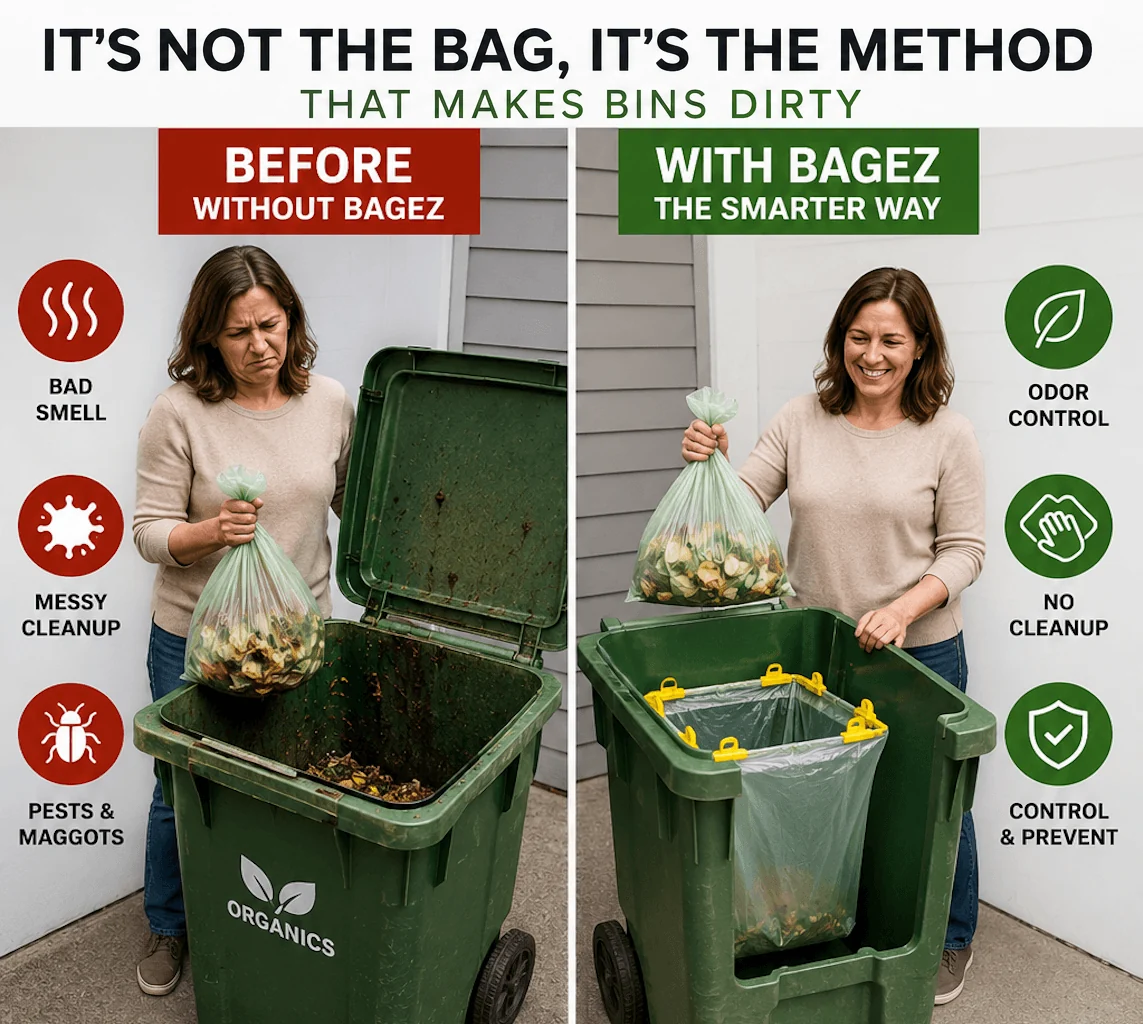
The same thing happens in the curbside bin, at a bigger scale. Bags of scraps keep releasing moisture as they sit, and when a bag rests against the bottom and sides of the bin, that liquid builds up into the sticky residue that smells and makes the bin dirty.
BagEZ works differently because the bag never touches the bin. The frame holds it up and lets air move all the way around: underneath, the sides, everywhere. Condensation on the outside of the bag has nowhere to pool. It evaporates instead of collecting at the bottom, and the walls stay dry.
A right-sized bag makes the odor tricks work better, too. A sprinkle of baking soda in the small contained space around the bag does more than the same sprinkle spread thin across a big empty floor. Less smell, fewer flies. Fewer flies, no maggots.
Some people use food-grade diatomaceous earth against fly larvae. DE works by drying insects out, and it stops working the moment it gets wet, so a dry bin is a precondition for it doing anything at all. Same story as the baking soda: it only earns its keep in a dry, contained gap.
Two more that help, cheap. A few sheets of newspaper under the bag catch drips if a bag ever fails. And a cloth sachet of peppermint and cloves tied to the outside of the bin throws off raccoons and rodents, which hunt almost entirely by smell. A bin that doesn’t smell like food stops being worth their trouble.
Why It Works
The infrastructure is already there. The bins are at the curb, the trucks run, and the environmental case, going by the numbers up top, isn’t in question. What’s been missing is a cheap, fast way to keep the bin clean enough that people don’t quietly give up on it.
A reusable steel frame that holds a bag open sounds too simple to matter. That’s sort of the point. The bin stays clean, the habit stays easy, and food scraps end up where they’re meant to.
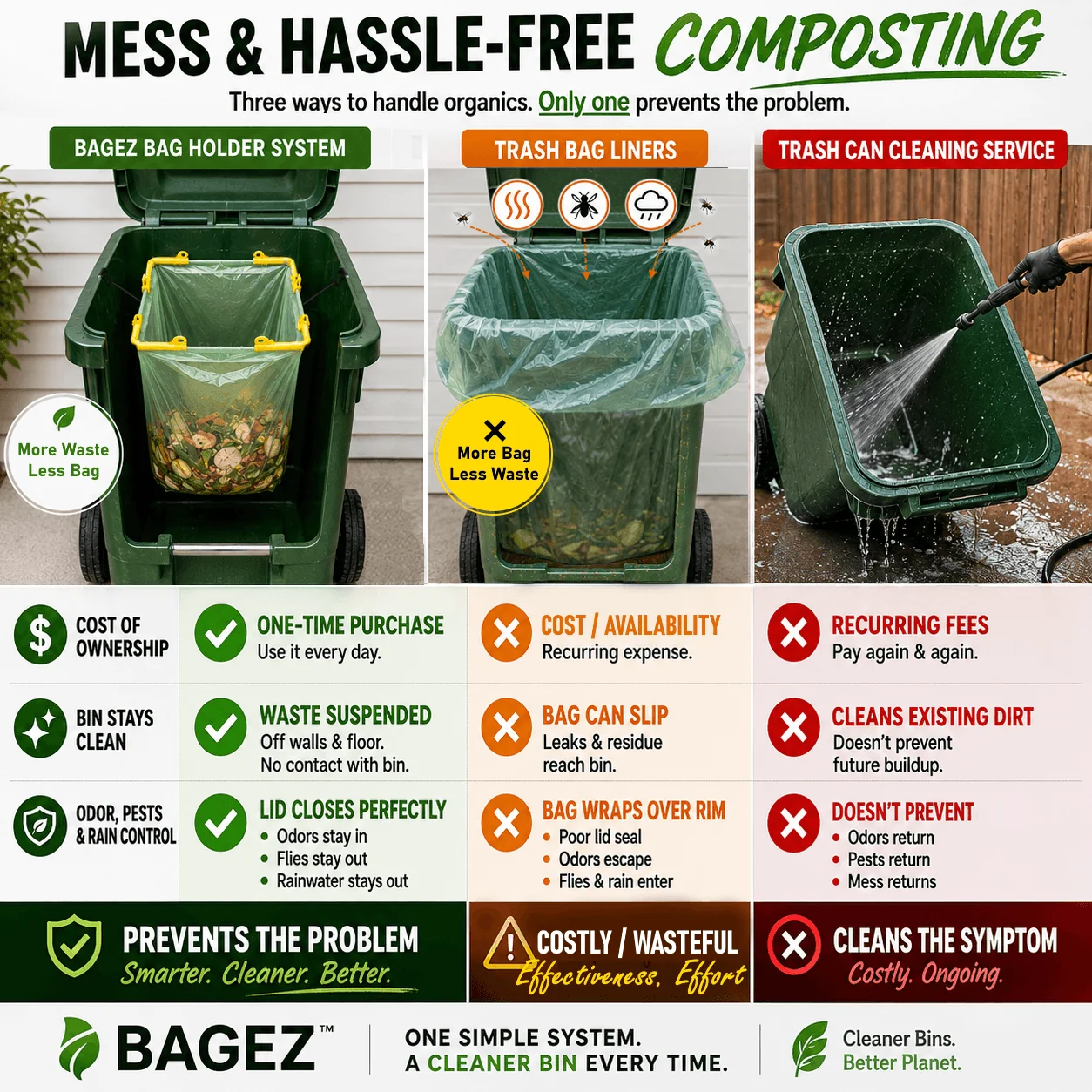
Set it next to the alternatives and the difference is in how each one works. Bin cleaning services deal with the problem after it happens, on a schedule, for a recurring fee. Full-size liners cost money every week and are sized to the bin, not to what you actually throw out. A frame is a one-time buy that works with the bag size your household already uses.
A green bin program only works if people keep using it, and people keep using what doesn’t gross them out. That’s the hinge the whole thing turns on. Take away the wet mess on the walls and most of the reasons to quit go with it: nothing pooling at the bottom, nothing to hose out, no smell pulling animals across the yard. The bin stays clean on its own, week after week, with a bag you were going to buy anyway.
Size it to your kitchen instead of your bin, clip it to the frame, and the green bin stops being the chore you avoid. Find it at bagez.com.
About the Author
This sponsored article was written by Sean Rana, the founder of BagEZ, a Canadian company behind the steel hanging bag frame that keeps garbage and green bins clean without special liners or ongoing costs, and works for waste and storage on the go.
The post Guest Idea: Green Bins Are Spreading Faster Than the Habit of Using Them appeared first on Earth911.
https://earth911.com/how-to-recycle/guest-idea-green-bins-are-spreading-faster-than-the-habit-of-using-them/