Climate Change
Canada, EU agree deeper cooperation on energy and cleantech supply chains
Canada and the European Union’s commitment to strengthen cooperation on energy security and the energy transition lays the foundation to put clean growth and climate priorities at the heart of their alliance, according to experts.
In a seven-page joint statement agreed at the end of a two-day summit in Montreal on Friday, both sides committed to work more closely on investment in critical minerals, green grids, energy sources, battery storage and the protection of energy infrastructure.
They agreed to assess opportunities for long-term energy connectivity across the Atlantic, including through a feasibility study on liquefied gas (LNG) exports to Europe. The statement also includes a pledge to “deepen targeted industrial cooperation” on technology value chains and “address bilateral trade barriers”.
“Canada and the European Union have sent a clear and unwavering signal that closer cooperation on decarbonisation and climate resilience will be central to their new strategic alliance,” said Canadian Climate Institute president Rick Smith. “The task now is to turn talk into action.”
Foundation for climate action
The EU and Canada’s “alliance for the future” aims to deepen their partnership across investment, trade and economic security to weather geopolitical tensions and global threats, including “the existential threat of the interdependent crises of climate change, biodiversity loss, ocean and land degradation, and pollution”.
These threats are “increasingly impossible to ignore as the impacts of extreme heat, wildfires, floods, and other disasters become more disruptive and expensive,” Smith said.
-
New Zealand accused of breaching EU trade deal over climate rollbacks
The EU’s climate trade rules face their first major test after a green group alleged New Zealand violated binding environmental provisions under its trade deal with the bloc -
Tensions set to flare over trade at COP31 as China makes it a priority
After difficult talks in Belém last year, trade is likely to remain a sticking point at COP31 despite Brazil’s efforts to contain the issue to a series of dialogues -
International trade linked to 20% of global emissions – but imports ignored
Researchers say governments should discuss how to tackle emissions linked to globally traded goods and services, especially in large importing countries



The statement reaffirms existing commitments established by the Canada-European Union Green Alliance, which both parties described as “our compass for advancing decarbonisation while also strengthening competitiveness, affordability, and economic security”.
Investment in critical minerals
During the summit, the European Investment Bank (EIB) announced a “new chapter” for its presence in Canada, beginning with accelerated investment in critical minerals.
“At a time when both sides of the Atlantic are working to reduce strategic dependencies, we want to turn our partnership into investment in real projects, from mining and processing to recycling,” EIB Vice-President Nicolas Beer said in a statement. “That is how we build supply chains that are not only more secure, but more competitive too.”
Joanna Kyriazis, director of policy and strategy at Clean Energy Canada, welcomed the EIB announcement as a “bright spot of the summit” and “one of the few tangible actions”.
“As the EU and Canada seek to advance a partnership anchored in ensuring mutual security and navigating an uncertain world, it is essential that electrification remains a north star… one of the greatest ways we can advance both short- and long-term affordability, competitiveness, and energy security,” she said.
Feasibility of Canadian LNG exports to the EU
In addition, the agreement calls for a joint long-term feasibility study on LNG exports to Europe, although no immediate investment was announced to support this.
A media briefing circulated by climate advocacy groups in advance of the summit had warned that a call for such a study would support Canada’s efforts to rebrand gas, a highly polluting fossil fuel, as a reliable, low-carbon energy source.
Yet, the agreement was interpreted by some observers as a Canadian concession following more than a year of rhetoric predicting a boom in Canadian gas exports to the EU and elsewhere.
-
National climate plans now promise half the emission cuts expected by UN
The US exit from the Paris Agreement and weak new pledges leave 2035 emissions just 6% below 2019 levels, against 12% projected last year -
Why COP31 needs to start talking about just transition finance
Funding that helps workers and communities navigate the clean energy switch remains overlooked, splintered and poorly tracked – a blindspot that could undermine climate goals -
Turkish giant sponsoring COP31 cut climate goals then cashed in on oil boom
COP31 sponsors should be screened for “climate integrity”. Yet Koç Holding has become a top partner while its oil refiner runs flat out and its climate targets slip


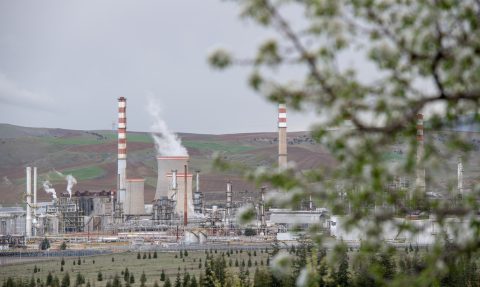
“What is clear is that the EU is reducing its gas consumption drastically,” Adrian Hiel, director of the Brussels-based Electrification Alliance, told the Globe and Mail. “The long-term trend is clear and by the middle of the next decade, Europe should be out of the LNG game.”
Last year, The Energy Mix and Berlin-based Clean Energy Wire reported on mounting doubts that serious European demand for additional gas supplies would ever materialise after Energy and Natural Resources Minister Tim Hodgson touted LNG exports to Germany in “as little as five years”.
Rapprochement on a ‘trade irritant’
In the lead-up to the summit, the Canadian Broadcasting Corporation reported that Canadian iron, steel, fertiliser and aluminium would not be exempt from carbon tariffs under the EU’s Carbon Border Adjustment Mechanism (CBAM), as it moves toward full implementation in 2034.
The CBAM is a trade tool designed to protect the continent’s domestic industries from competitors in countries with less stringent carbon controls.
Unlike other non-EU members like Switzerland, Norway, Iceland, and the UK, Canada is unlikely to be exempted from the CBAM because there are no plans to link its carbon market to Europe’s.
However, at the end of the Montreal summit, Canadian Prime Minister Mark Carney and EU Commission President Ursula von der Leyen told a press conference they had made progress on finding joint solutions to the issue, which von der Leyen described as a “trade irritant”.
Canada’s EU ambassador, Jonathan Wilkinson, formerly the environment and climate minister, said Canada sees it as a problem that the CBAM “did not acknowledge Canadian producers were doing their part to reduce their greenhouse gas footprint by paying an industrial carbon price”.
He “confirmed diplomatic talks are heading in the right direction but not resolved”, CBC reported.
A longer version of this story was originally published by The Energy Mix as part of its partnership with Small Change Fund.
The post Canada, EU agree deeper cooperation on energy and cleantech supply chains appeared first on Climate Home News.
Canada, EU agree deeper cooperation on energy and cleantech supply chains