

Jurema Werneck, Ruhat Sena Akşener and Samantha Klintworth are directors for Amnesty International in Brazil, Türkiye and Australia, respectively.
The climate crisis is also a human rights crisis – claiming lives and turning life upside down for countless communities across the world.
But while those profiting from fossil fuel expansion retain privileged access and influence over global climate negotiations, the people facing its harshest consequences, such as Indigenous peoples or those living in climate-vulnerable communities, remain largely shut out of the decision-making.
As directors of Amnesty International in Brazil, Türkiye and Australia, countries with a leading role in COP30 and COP31, we have seen how effective climate action depends on people being able to speak, organise, protest and participate.
-
Turkish giant sponsoring COP31 cut climate goals then cashed in on oil boom
COP31 sponsors should be screened for “climate integrity”. Yet Koç Holding has become a top partner while its oil refiner runs flat out and its climate targets slip -
Lula’s election win in Brazil raises hopes for zero deforestation drive
Lula’s re-election makes it more likely Brazil can meet a key goal to end forest loss in the Amazon and builds confidence in a new fund to protect the world’s rainforests, experts say -
Australia says COP31 co-presidency will work on a cover decision
Chris Bowen said the text could acknowledge the inevitable overshoot of 1.5C, while questions remain over the inclusion of the electrification goal


Last year in Belém, fossil fuel lobbyists outnumbered every national delegation except Brazil’s, exposing the imbalance of power within climate negotiations. COP31 should confront corporate capture and expand public participation. Instead, serious concerns have been raised over whether civil society will be able to speak freely and safely in Türkiye.
Rights curbs worsen climate breakdown
The human rights needed to confront the climate crisis and demand justice are being eroded.
Authoritarian practices are supercharging climate breakdown by restricting protest, silencing defenders and shielding fossil fuel interests from scrutiny. Attacks on women, LGBTI+ people and members of other marginalised communities divide societies, weaken collective action and divert public attention while fossil fuel expansion continues.
That is why the assault on civic space in Türkiye, the host of COP31, should alarm every government preparing to attend the summit.
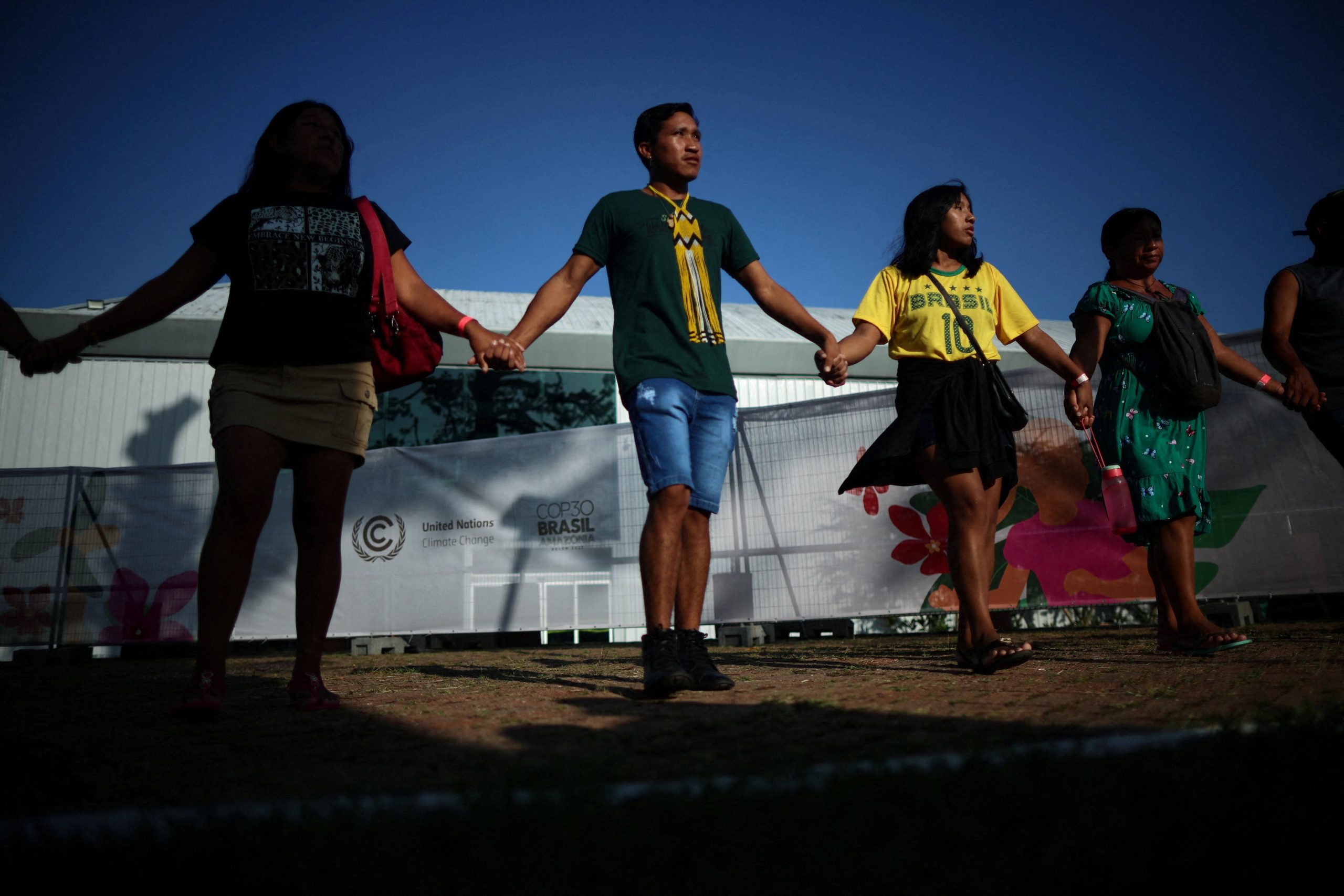
In September, Turkish authorities launched a nationwide operation targeting LGBTI+ organisations, activists and human rights defenders. Homes, venues and offices were raided, people were arrested and imprisoned, and social media accounts belonging to activists, journalists and human rights groups were restricted, including that of Amnesty International Türkiye.
This is part of a decade-long crackdown that has weakened judicial independence, ignored international judgements and restricted peaceful assembly, association and expression. Whoever is targeted, the effect is the same: dissent is silenced and fear spreads.
For COP31 to succeed, Türkiye must end its human rights crackdown.
Worrying signals from Türkiye
Against this backdrop, the agreement between Türkiye and the UN on hosting COP31 is alarming.
Article 11.11 requires participants to respect Türkiye’s laws and regulations and refrain from interfering in its “internal affairs”. Article 11.12 reintroduces language on waiving immunity that was omitted from Brazil’s COP30 agreement.
Turkish authorities are already invoking vague notions of “public morality” and “harm to the family” to investigate people and restrict expression. The agreement could therefore have a chilling effect on activists, defenders and journalists.
COP31 attendees told not to interfere in Türkiye’s “internal affairs”
Could criticism of Türkiye’s fossil fuel policies, its treatment of environmental defenders or its crackdown on LGBTI+ organisations be characterised as interference in “internal affairs”? Nobody attending a UN climate conference should have to ask.
Türkiye and the UN should publicly guarantee that participants can speak, organise, report and protest peacefully without discrimination, intimidation, surveillance, detention or reprisals. Governments ought to challenge the agreement’s flaws before arriving in Antalya.
Progress, not perfection, at Brazil’s COP
COP31 must build on Brazil’s approach. Its COP hosting agreement committed to an inclusive and non-discriminatory conference, while its presidency adopted a more open and participatory tone. COP30 saw record participation by Indigenous peoples, but access did not guarantee influence: many key decisions continued to be shaped behind closed doors.
Commitments made in Belém ultimately depend on domestic political choices, and Brazil’s October election results point to a legislature that may be less willing to uphold them. This could put the rights of Indigenous peoples, Quilombola and traditional communities at greater risk.
When protections at home weaken, international spaces become even more vital for affected populations to speak out, and hold decision-makers accountable. COP31 must guarantee freedom of expression and peaceful assembly outside the “Blue Zone” (the UN-protected area) and grant civil society greater access to negotiations.
Comment: Coal mines and hypocrisy must not be Australia’s COP31 legacy
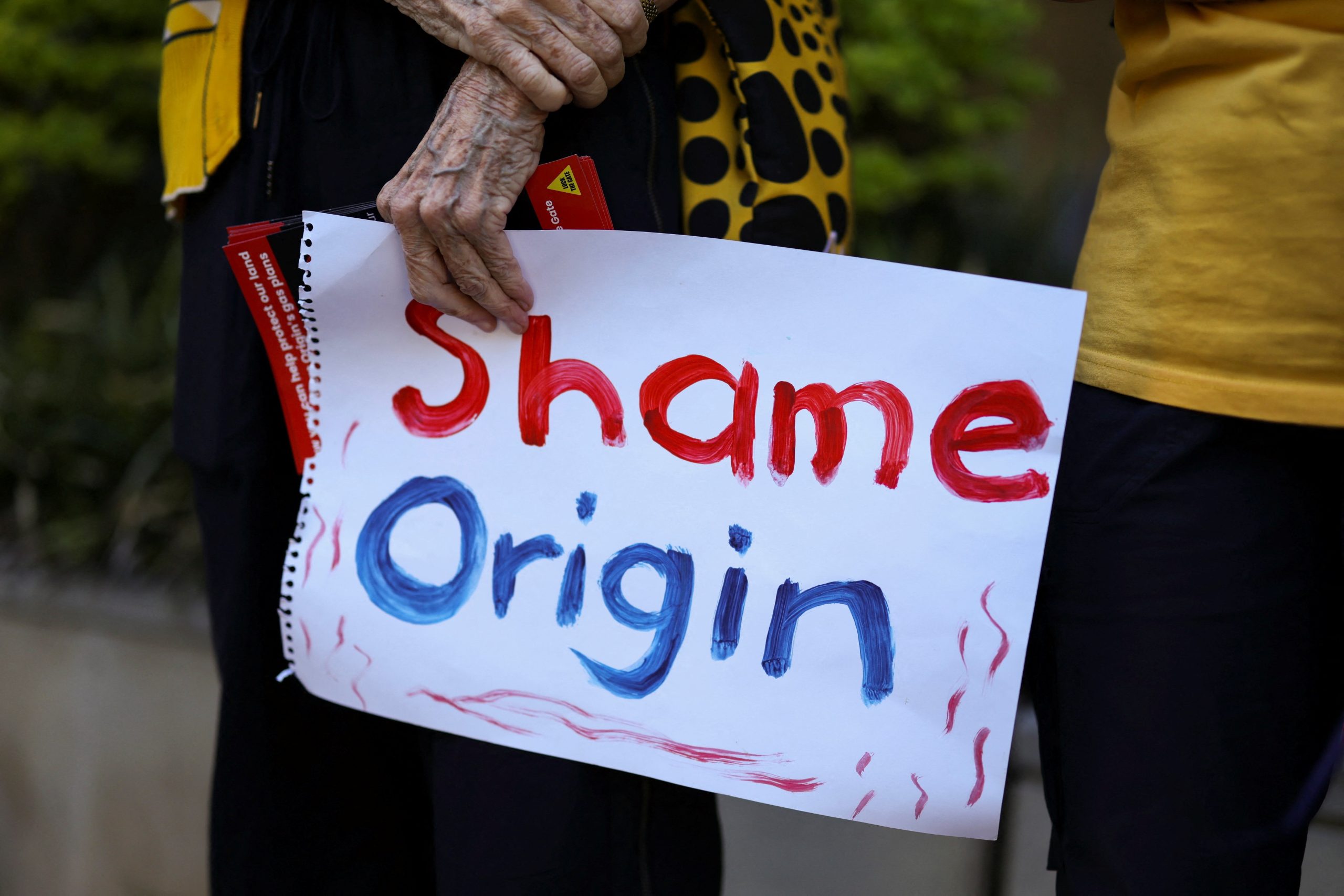
As documented by Amnesty International, communities resisting fossil fuel expansion and building fairer alternatives are facing harassment, surveillance, criminalisation, disinformation, violence and restrictions on peaceful protest. They include: First Nations people in Australia challenging offshore oil and gas exploration, artisanal fishers in Brazil’s Guanabara Bay fighting for environmental justice, and activists defending Akbelen Forest in Türkiye from coal mining expansion.
These communities are rights-holders, knowledge-bearers and political actors protecting territories and forging effective climate responses. Governments must protect them and ensure they have a meaningful say.
Confronting fossil fuel power
To defend human rights, governments must use COP31 to advance three urgent priorities.
First, they must end fossil fuel expansion and accelerate a full, fast, fair, funded and human rights-compliant transition away from fossil fuels. States most responsible must go further and faster, ending fossil fuel subsidies and redirecting public resources towards rights-respecting renewable energy.
Second, they must ensure the transition protects rights and leaves no one behind, including by making the new Just Transition Mechanism operational, funded and accountable.
And third, they must scale up public, grant-based climate finance for mitigation, adaptation and loss and damage, without pushing lower-income countries further into debt.
COP31 will not deliver these outcomes without the knowledge and expertise of frontline communities.
Brazil must defend the participatory progress made at COP30. Türkiye must reverse its crackdown and protect civic space. Australia, as president of negotiations for COP31, should secure an ambitious, human rights-centred outcome while confronting restrictions on peaceful climate protest at home.
The climate crisis cannot be solved behind closed doors. The doors must remain open, and people must have the power to shape what happens inside.
The post COP31 must amplify people power, not oil lobby voices appeared first on Climate Home News.

The UK has spent £12.8bn on climate aid for developing countries since 2021, according to official figures obtained by Carbon Brief.
Freedom-of-information (FOI) requests reveal how the UK has used its “climate finance” to support everything from solar projects in Mozambique to carbon offsets in the Amazon.
UK climate funding, which reached a record £4bn this year, has supported roughly 500 aid projects, climate funds and private-investment initiatives over the past five years.
With this spending, the UK has surpassed its £11.6bn climate-finance target for this period, although Carbon Brief analysis shows that it has partly relied on “questionable accounting”.
This target is part of the UK’s ongoing responsibility under UN climate treaties to financially support developing countries in their efforts to tackle climate change.
Despite being central to its international climate policy, the UK government does not routinely release data on progress towards its climate-finance goals.
Here, Carbon Brief has published the data in full for the first time and pulled out key trends since 2021.
The UK has supported around 500 climate projects since 2021
According to the FOI data obtained by Carbon Brief, at least 493 projects, funds and institutions received UK climate finance between 2021-22 and 2025-26.
These included £45m to help Ukraine curb its reliance on fossil fuels, £40m in cash transfers for Kenyans affected by drought and £30m to provide flood resilience in Nepal.
Larger sums were provided to projects spread across multiple countries, often with the stated goal of “mobilising” additional finance from the private sector.
For example, the UK channelled £198m into a World Bank-backed project to help Colombia, Cambodia and others create and sell “high-integrity” carbon offsets.
The UK also provided £229m to a group that uses foreign aid to attract private capital for projects in predominantly low-income nations, such as a solar farm in Uganda and a “sustainable aviation fuel” project in Pakistan.
All of the funded projects can be viewed in the interactive table below.
The UK has been criticised by campaigners and MPs for its lack of transparency around climate finance data.
In line with its international obligations, the government routinely releases its climate-finance figures to the UN – albeit with a two-year delay.
However, it does not publish this data broken down by financial year, making it impossible to accurately gauge progress towards the £11.6bn goal.
The data gathered by Carbon Brief is therefore the most comprehensive attempt to track this information to date. Carbon Brief has been periodically tracking this data since 2017.
UK climate aid has reached record levels – but is set to drop
The UK government committed in 2019 to spending £11.6bn of the nation’s aid budget on “climate finance”, between 2021-22 and 2025-26.
This is the nation’s contribution to an international goal to mobilise $100bn of climate finance a year between 2020 and 2025.
Developed countries are obliged under UN climate treaties to financially support developing countries, assisting their efforts to cut emissions and adapt to climate change.
However, alongside other major donors, such as the US, the UK has dramatically cut its aid budget, placing significant strain on the nation’s climate finance.
Despite this, FOI data shows that UK climate finance reached a record £4bn in 2025-26, as shown in the chart below.
Not accounting for inflation, this amounts to a tenfold increase from 2011-12, when the UK started providing climate finance.
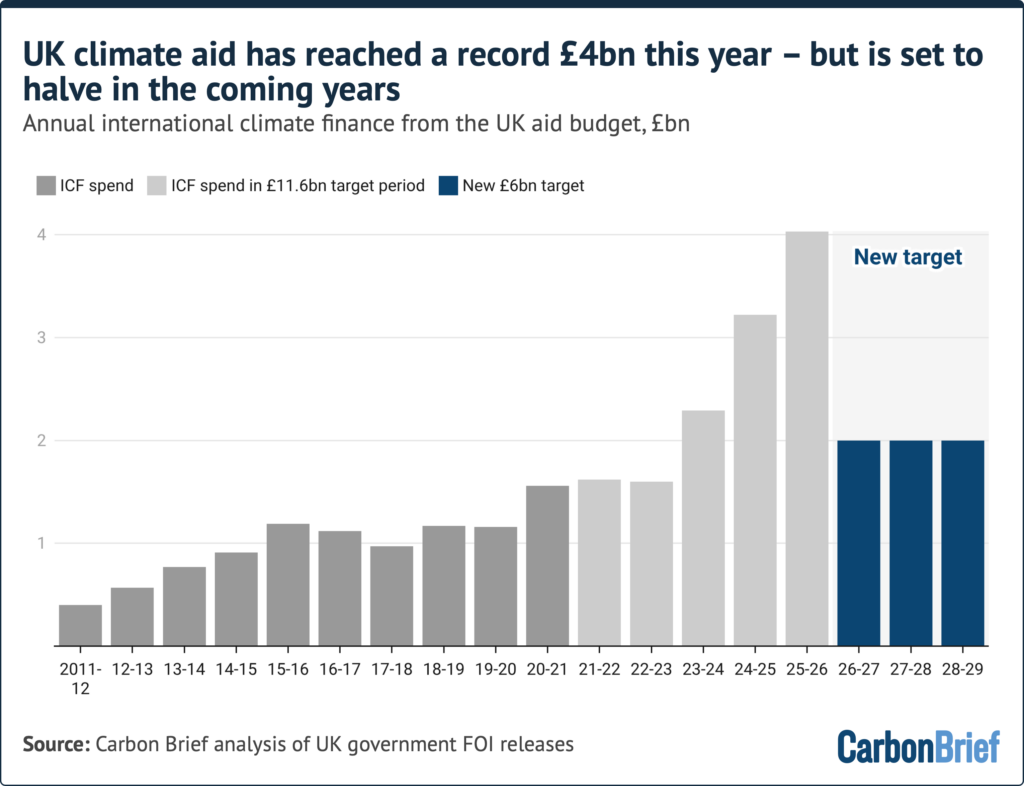
The £11.6bn target was met comfortably, with £12.8bn provided over the five-year period.
However, as separate Carbon Brief analysis shows, the target was only met due to the government reclassifying £2.2bn of existing foreign aid as climate finance, without spending any more.
Rather than setting a new five-year goal, in March 2026 the Labour government committed to spending “around £6bn” of UK aid as climate finance over the next three years. On average, this would mean £2bn in climate aid annually – roughly half the level achieved in the financial year 2025-26.