

Whatever oil and gas companies would have you believe, fossil gas has no useful role to play in the energy transition. In fact it’s dirty, expensive, and unnecessary
Renewables are not only better for the climate, they are cheaper and create more jobs. Pursuing the concept of a ‘gas-led recovery’ would deliver economic as well as environmental ruin.
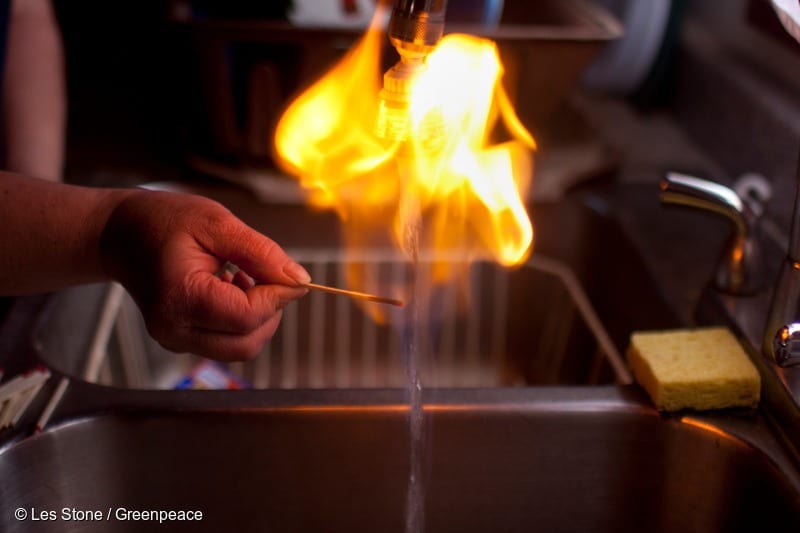
6 reasons gas is bad for the climate and the economy
- Burning known global oil and gas reserves, even without coal, would make limiting temperature rise to 1.5°C impossible: Burning existing proven and probable gas reserves alone would lead to 173 gigatonnes of greenhouse gas emissions, nearly half of the remaining post-2015 carbon budget for remaining below 1.5°C with 50% probability. In fact to meet the IPCC’s most realistic pathway to 1.5°C would require a reduction of not less than 39% in fossil gas consumption between 2018 and 2030.
- Gas may be as polluting as coal: Taking into account the greenhouse gas emissions associated with extracting, producing, and transporting gas to consumers, scientists are now concluding that across the entire lifecycle gas may be as polluting as coal, if not more: Not only is the process of liquefying and transporting gas energy intensive but the amount of methane, a greenhouse gas 86 times more potent than CO2 in the short term, routinely leaking from gas infrastructure has been severely underestimated.
- Investors are already overexposed to gas: Investing in new gas projects now will either lead to assets becoming stranded as global efforts to curb emissions gain momentum or they will cause climate action to fail, thereby contributing to the increased costs of climate damage. As of 2019 almost $5 trillion USD of investments have already been committed to new oil and gas fields that are incompatible with limiting warming to 1.5°C.
- Renewables are cheaper than gas: Since 2016, gas has been driving up energy prices for Australian households and businesses. According to the CSIRO, Lazard, and Bloomberg’s levelized cost of energy analyses, solar and wind have been the cheapest power generation technologies for new capacities in most major economies for some time and are now even competitive with installed coal.
- Fossil gas is not needed for grid reliability: Storage solutions and demand response technology are becoming competitive with gas peaker plants for balancing electricity grids. AEMO’s most recent draft Integrated System Plan shows no need for significant gas expansion in any scenario. And according to Wood MacKenzie batteries could soon replace all gas peakers. Electrifying transport and buildings is expected to further help meet grid reliability expectations.
- New fossil gas infrastructure would lock in emission increases for decades. Global gas production plans already in train are set to exceed the global carbon budget for 1.5°C by 70%. Approximately half of the existing fossil gas fleet was built after 2000. New fossil gas plants and infrastructure being built are either likely to operate and emit greenhouse gases for decades, shattering the earth’s carbon budget, or become stranded assets.


Climate Change
IPBES chair Dr David Obura: Trump’s US exit from global nature panel ‘harms everybody’
The Trump administration’s decision to withdraw the US from the intergovernmental science panel for nature “harms everybody, including them”, according to its chair.
Dr David Obura is a leading coral reef ecologist from Kenya and chair of the Intergovernmental Science-Policy Platform on Biodiversity and Ecosystem Services (IPBES), the world’s authority on the science of nature decline.
In January, Donald Trump announced intentions to withdraw the US from IPBES, along with 65 other international organisations, including the UN climate science panel and its climate treaty.
In an interview with Carbon Brief, Obura says the warming that humans have already caused means “coral reefs are very likely at a tipping point” and that it is now inevitable that Earth “will lose what we have called coral reefs”.
A global goal to halt and reverse biodiversity loss by 2030 will not be possible to achieve for every ecosystem, he continues, noting that a lack of action from countries means “we won’t be able to do it fast enough at this point”.
Despite this, it is still possible to reverse the “enabling drivers” of biodiversity decline within the next four years, he adds, warning that leaders must act as “our economies and societies fully depend on nature”.
The interview was conducted at the sidelines of an IPBES meeting in Manchester, UK, where governments agreed to a new report detailing how the “undervaluing” of nature by businesses is fuelling biodiversity decline and putting the global economy at risk.
- On US leaving IPBES: “Any major country not being part of it harms everybody, including themselves.”
- On reversing nature loss by 2030: “We won’t be able to do it fast enough at this point.”
- On the value of biodiversity: “Nature is really the life support system for people. Our economies and societies fully depend on nature.”
- On coral reefs: “We will lose what we have called coral reefs up until this point.”
- On nature justice: “The places that are most vulnerable don’t have the income, or the assets, to conserve biodiversity.”
- On IPBES’s latest report: “One of the key findings is all businesses have impacts and dependencies on nature.”
- On the next UN nature summit: “We need acceleration of activities and impact and effectiveness, more than anything else.”
Carbon Brief: Last month Trump announced plans for the US to exit IPBES and dozens of other global organisations. You described this at the time as “deeply disappointing”. What are your thoughts on the decision now and what will be the main impacts of the US leaving IPBES?
David Obura: Well, part of the reason that I’ve come to IPBES is because, of course, I believe in the multilateral process, because we bring 150 countries together, we’re part of the UN and the multilateral system and we’re based on knowledge [that provides] inputs to policymaking. We have a conceptual framework that looks from the bottom up on how people depend on nature. I’m also doing a lot of science on Earth systems at the planetary level, how our footprint is exceeding the scale of the planet. We have to make decisions together. We need the multilateral system to work to help facilitate that. It has never been perfect. Of course, I come from a region [Kenya] that hasn’t been, you know, powerful in the multilateral process.
But we need countries to come together, so any major country not being part of it harms everybody, including themselves. It’s very important to try and keep pushing through with the knowledge and keep doing the work that we’re doing, so that, over time, hopefully [the US will] rejoin. Because, in the end, we will really need that to happen.
CB: This is the first IPBES meeting since Trump made the announcement. Has it had an impact so far on these proceedings and is there any kind of US presence here?
DO: This plenary is like every plenary that we have had. The current members are here. Some members are not. And, of course, we have some states here as observers working out if they’re going to join or not. And then we have a lot of private sector observers and universities and so on. The impact of a country leaving – the US in this case – has no impact on the plenary itself, because they’re not here making decisions on the things that we do.
We, of course, don’t have US government members attending in technical areas, but we do have institutions and universities and academics here attending as they have in the past. So, in that sense, the plenary goes on as it goes on – the science and the knowledge is the same. The decision-making processes we have here are the same. And, as I said earlier, what has an impact is the actual action that takes place afterwards, because a lot of the recommendations that we make are based on enabling conditions that governments put in place, to bring in place sustainability actions and so on. When governments are not doing that, especially major economic drivers, then the whole system suffers.
CB: When you were appointed as chair of IPBES more than two years ago, you said that your aim was to strengthen cohesion and impact and also get the findings of IPBES in front of more people. So how would you rate your progress on this now that it’s been about a couple of years?
DO: Well, like any intergovernmental process, we have a certain amount of inertia in what we do and it takes a few years to consult on topics for assessments and then to do them and to improve them and get them out.
One of the main things we’re discussing right now is we have had a rolling work programme from when IPBES started until 2030 and we need to decide on the last few deliverables and how we work in that period. We are asking for a mandate to spend the next year really considering the multiple options that we have in proposing a way forward for the last few years of this work programme. I feel that the countries are very aligned. We have done a lot of work, produced a lot of outputs. It is challenging for governments and other stakeholders to read our assessments and reach into them to find what’s useful to them. They make constant calls for more support, in uptake, in capacity building and in policy support.
The second global assessment in 2028 will be our 17th assessment [overall]. We would like to focus on really bringing all this knowledge together across assessments in ways that are relevant to different governments, different stakeholder groups, different networks to help them reach into the knowledge that’s in the assessments. And I think the governments, of course, want that as well, because many of them are calling for it. Many of the governments that support us financially, of course, want to see a return of investment on the money that they have put in.
CB: Nations agreed to halt and reverse biodiversity loss by 2030. Back in 2023 we had a conversation for Carbon Brief and you said that you were “highly doubtful” this goal could be achieved for every ecosystem by that date. Where do you stand on this now?
DO: I work on coral reefs and part of the reason I’ve come to IPBES platform is because the amount of climate change we’re committed to with current fossil fuel emissions and the focus on economic growth means that corals will continue to decline 20, 30, 40 years into the future. I think of that there’s no real doubt. The question is how soon we put in place the right actions to halt climate change. That will then have a lag on how long it takes for corals to cope with that amount of climate change.
We can’t halt and reverse the decline of every ecosystem. But we can try and bend the curve to halt and reverse the drivers of decline. So, that’s some of the economic drivers that we talk about in the nexus and transformative change assessment, the indirect drivers and the value shifts we need to have. What the Global Biodiversity Framework [GBF, a global nature agreement made in 2022] aspires to do in terms of halting and reversing biodiversity decline – we absolutely need to do that. We can do it and we can put in place the enabling conditions for that by 2030 for sure. But we won’t be able to do it fast enough at this point to halt [the loss of] all ecosystems.
We’re now in 2026, so this is three years plus after the GBF was adopted. We still need greater action from all countries and all stakeholders and businesses and so on. That’s what we’re really pushing for in our assessments.
CB: Biodiversity loss has historically been underappreciated by world leaders. As the world continues to be gripped by geopolitical uncertainty, conflict and financial pressures, what are your thoughts on the chances of leaders addressing the issue of biodiversity loss in a meaningful way?
DO: What are the chances of addressing biodiversity loss? I mean, we have to do it. It’s really our life support system and if we only focus on immediate crises and threats and don’t pay attention to the long-term threats and crises, that only creates more short-term crises down the line, we make it harder and harder to do that. I hope that what I’m hoping we get to understand better through IPBES science, as well as others, is that we’re not just reporting on the state of biodiversity because it’s nice to have it, but it’s [because] diversity of nature is really the life support system for people. Our economies and societies fully depend on nature. If we want them to prosper and be secure into the long-term future, we have to learn how to bring the impact and dependencies of business, which is a focus of this assessment, in line with nature. And until we do that, we will just continue to magnify the potential for future crises and their impacts.
CB: You mentioned already that your expertise is in coral reefs. A report last year warned that the world has reached its first climate tipping point, that of widespread dying of warm water coral reefs. Do you agree with that statement and can you discuss the wider state of coral reefs across the world at this present moment?
DO: The report that came out last year in 2025 was a global tipping point report and it’s actually in 2023 the first one of those [was published]. I was involved in that one and we basically took what the IPCC [Intergovernmental Panel on Climate Change] has produced, which [is] compiled from the [scientific] literature [which said] that 1.5-2C was the critical range for coral reefs, where you go from losing 70-90% to 90-99% of coral reefs around the world. [It is] a bit hard to say exactly what that means. What we did was we actually reduced that range from 1.5C-2C to 1-1.5C, based on observations we’ve already made about loss of corals. In 2024, the world was 1.5C above historical conditions for one year. The IPCC number requires a 20-year average [for 1.5C to be crossed]. So, we’re not quite at the IPCC limit, but we’re very close. Also, with not putting in place fast enough emission reductions, warming will continue.
Coral reefs are very likely at a tipping point. And, so, I do agree with the statement. It means that we lose the fully connected regional, global system that coral reefs have been in the past. There will still be some coral reefs in places that have some natural protection mechanisms, whether it’s oceanographic or some levels of sedimentation in green water from rivers can help. And there’s resilience of corals as well. Some corals will be able to adapt somewhat, but not all – and not all the other species too. We will lose what we have called coral reefs up until this point. We’ll still continue to have simpler coral ecosystems into the future, but they won’t be quite the same.
It is a crisis point and my hope is that, in coming out from the coral reef world, I can communicate that this is, this has been a crisis for coral reefs. It’s a very important ecosystem, but we don’t want it to happen to more and more and more ecosystems that support more [than] hundreds of millions and billions of people as well. Because, if we let things go that far, then, of course, we have much bigger crises on our hands.
CB: Something else you’ve spoken about before is around equity being one of the big challenges when it comes to responding to biodiversity loss. Can you explain why you think that biodiversity loss should be seen as a justice issue?
DO: Well, biodiversity loss is a justice issue because we are a part of biodiversity and – just like the loss of ecosystems and habitats and species – people live locally as well. People experience biodiversity loss in their surroundings.
The places that are most vulnerable and don’t have the income, or the assets, to either conserve biodiversity, or need to rely on it too much so they degrade it – they feel the impacts of that loss much more directly than those who do have more assets. Also, the more assets you have, the more you can import biodiversity products and benefits from somewhere else.
So, it’s very much a justice issue, both from local levels experiencing it directly, but then also at global levels. We are part of it [biodiversity], we don’t own it. It’s a global good, or a common public good, so we need to be preserving it for all people on the planet. In that sense, there are many, many justice issues that are involved in both loss of biodiversity and how you deal with that as well.
CB: How would you say IPBES is working towards achieving greater equity in biodiversity science?
DO: One of the headline findings of our values assessment in 2022, which looked at multiple values different cultures have and different worldviews around the planet, [was that] by accommodating or considering different worldviews and different perspectives, you achieve greater equity because you’re already considering other worldviews in making decisions.
So, that’s an important first step – just making it much more apparent and upfront that we can’t just make decisions, especially global ones, from a single worldview and the dominant one is the market economic worldview that we have. That’s very important.
But, then, also in how we do our assessments and the knowledge systems that are incorporated in them. We integrate different knowledge systems together and try and juxtapose – or if they can be integrated, we do that, sometimes you can’t – but you just need to illustrate different worldviews and perspectives on the common issue of biodiversity loss or livelihoods or something like that.
We hope that our conceptual framework and our values framework really help bring in this awareness of multiple cultures and multiple perspectives in the multilateral system.
CB: When this interview is published, IPBES will have released its report on business and biodiversity. What are some of the key takeaways from this?
DO: Our assessments integrate so much information that the key messages are actually, in retrospect, quite obvious in a way. One of the key findings it will say is that all businesses have impacts and dependencies on nature.
Of course, when you think about it, of course they do. We often think, “oh, well ecotourism is dependent on nature”, but even a supermarket is dependent on nature because a lot of the produce comes from a natural system somewhere, maybe in a greenhouse or enhanced by fertiliser, but it still comes from natural systems. Any other business will have either impacts on the nature around it, or it needs tree shade outside so people can walk in and things like that.
So, that’s one of the main findings. It’s not just certain sectors that need to respond to biodiversity loss and minimise their impacts. All sectors need to. Another finding, of course, is that it’s very differentiated depending on the type of business and type of sector.
It’s also very differentiated in different parts of the world in terms of responsibilities and also capabilities. So small businesses, of course, have much less leeway, perhaps, to change what they’re doing, whereas big businesses do and they have more assets, so they can deal with shifts and changes much better.
It’s a methodological assessment, rather than assessing the state of businesses, or the state of nature in relation to businesses [and] they pull together a huge list of methodologies and tools and things that businesses can access and do to understand their impacts and dependencies and act on them. Then [there is] also guidance and advice for governments on how to enable businesses to do that with the right incentives and regulations and so on. In that sense, it helps bring knowledge together into a single place.
It has been fantastic to see the parallel programme that the UK government has organised [at the IPBES meeting in Manchester]. It has brought together a huge range of British businesses and consultancies and so on that help businesses understand their impacts on nature. There’s a huge thirst.
To some extent, I would have thought, with so much capacity already in some of these organisations, what would they learn from our assessments? But they’re really hungry to see the integration. They really want to see that this really does make a big difference, that others will do the same, that the government will really support moving in these directions. There’s a huge amount of effort in the findings coming out and I’m sure that that will be felt all around the world and in different countries in different ways.
CB: As we’re speaking now, you’re still in the midst of figuring out exactly what the report will say and going through line-by-line to figure this out. Something we’ve seen at other negotiations…has been these entrenched views from countries on certain key issues. And one thing I did notice in the Earth Negotiations Bulletin discussion of yesterday’s [4 February] negotiations was that it said that some delegations wanted to remove mentions of climate change from the report. Has this been a key sticking point here or have there been any difficulties from countries during these negotiations?
DO: The nature of these multilateral negotiations is that the science is, in a way, a central body of work that is built through consensus of bringing all this knowledge together. It’s almost like a centralising process. And, yes, different countries have different perspectives on what their priorities are and the messages they want to see or not.
We still, of course, deal with different positions from countries. What we hope to do is to be able to convene it so that we see that we serve the countries best by having the most unbiased reporting of what the science is saying in language that is accessible to and useful to policymakers, rather than not having language or not having mention of things in in the agreed text.
How it’ll work out, I don’t know. Each time is different from the others. I think one of the key things that’s really important for us is that you do have different governance tracks on different aspects of the world we deal in. So, the [UN] Sustainable Development Goals, as well [as negotiations] on climate change – the UNFCCC, the climate convention, is the governing body for that. There’s two goals on nature – the Convention on Biological Diversity and other multilateral agreements are the institutions that govern that part.
We have come from a nature-based perspective, with nature’s contributions to a good quality of life for people…We start in the nature goals, but we actually have content that relates to all the other goals. We need to consider climate impacts on nature, or climate impacts on people that affect how they use nature. The nexus assessment was, in a way, a mini SDG report. It looked at six different Sustainable Development Goals.
We try and make sure that while on the institutional mechanisms, certain countries may try and want us to report within our mandate on nature, we do have findings that relate to climate change that relate to income and poverty and food production and health systems [and] that we need to report [outwardly] so that people are aware of those and they can use those in decision-making contexts.
That’s a difficult discussion and every time it comes out a little bit differently. But we hope we move the agenda further towards 2030 in the SDGs. We have an indivisible system that we need to report on.
CB: The next UN biodiversity summit COP17 is taking place later this year. What are the main outcomes you’re hoping to see at that summit?
DO: The main outcomes I would hope to see from the biodiversity summit is greater alignment across the countries. We really need to move forward on delivering on the GBF as part of the sustainable development agenda as well. So there will be a review of progress. We need acceleration of activities and impact and effectiveness, more than anything else.
That means, of course, addressing all of the targets in the GBF. Not equally, necessarily, but they all need progress to support one another in the whole. We work to provide the science inputs that can help deliver that through the CBD [Convention on Biological Diversity] mechanisms as well. We hope they use our assessments to the fullest and that we see good progress coming out.
CB: Great, thank you very much for your time.


The post IPBES chair Dr David Obura: Trump’s US exit from global nature panel ‘harms everybody’ appeared first on Carbon Brief.
IPBES chair Dr David Obura: Trump’s US exit from global nature panel ‘harms everybody’
The hot, dry and windy weather preceding the wildfires that tore through Chile and Argentina last month was made around three times more likely due to human-caused climate change.
This is according to a rapid attribution study by the World Weather Attribution (WWA) service.
Devastating wildfires hit multiple parts of South America throughout January.
The fires claimed the lives of 23 people in Chile and displaced thousands of people and destroyed vast areas of native forests and grasslands in both Chile and Argentina.
The authors find that the hot, dry and windy conditions that drove the “high fire danger” are expected to occur once every five years, but that these conditions would have been “rarer” in a world without climate change.
In today’s climate, rainfall intensity during the “fire season” is around 20-25% lower in the areas covered by the study than it would be in a world without human-caused emissions, the study adds.
Study author Prof Friederike Otto, professor of climate science at Imperial College London, told a press briefing:
“We’re confident in saying that the main driver of this increased fire risk is human-caused warming. These trends are projected to continue in the future as long as we continue to burn fossil fuels.”
‘Significant’ damage
The recent wildfires in Chile and Argentina have been “one of the most significant and damaging events in the region”, the report says.
In the lead-up to the fires, both countries were gripped by intense heatwaves and droughts.
The authors analysed two regions – one in central Chile and the other in Argentine Patagonia, along the border between Argentina and Chile.
For example, in Argentina’s northern Patagonian Andes, the last recorded rainfall was in mid-November of 2025, according to the report. It adds that in early January, the region recorded 11 consecutive days of “extreme maximum temperatures”, marking the “second-longest warm spell in the past 65 years”.
Dr Juan Antonio Rivera, a researcher at the Argentine Institute of Snow Science, Glaciology and Environmental Sciences, told a WWA press briefing that these weather conditions dried out vegetation and decreased soil moisture, which meant that the fires “found abundant fuel to continue over time”.
In the northern Patagonian Andes of Argentina, wildfires started on 6 January in Puerto Patriada and spread over two national parks of Los Alerces and Lago Puelo and nearby regions. These fires remained active into the first week of February.
The fires engulfed more than 45,000 hectares of native and planted forest, shrublands and grasslands, including 75% of native forests in the village of Epuyén, notes the study.
At least 47 homes were burned, according to El País. La Nación reported that many families evacuated themselves to prevent any damage.
In south-central Chile, wildfires occurred from 17 to 19 January, affecting the Biobío, Ñuble and Araucanía regions.
They started near Concepción city, the capital of the Biobío region, where maximum temperatures reached 26C. In the nearby city of Chillán, temperatures reached 37C.
From there, the fires spread southwards to the coastal towns of Penco-Lirquen and Punta Parra, in the Biobío region.
The event left 23 people dead, 52,000 people displaced and more than 1,000 homes destroyed in the country, according to the study.
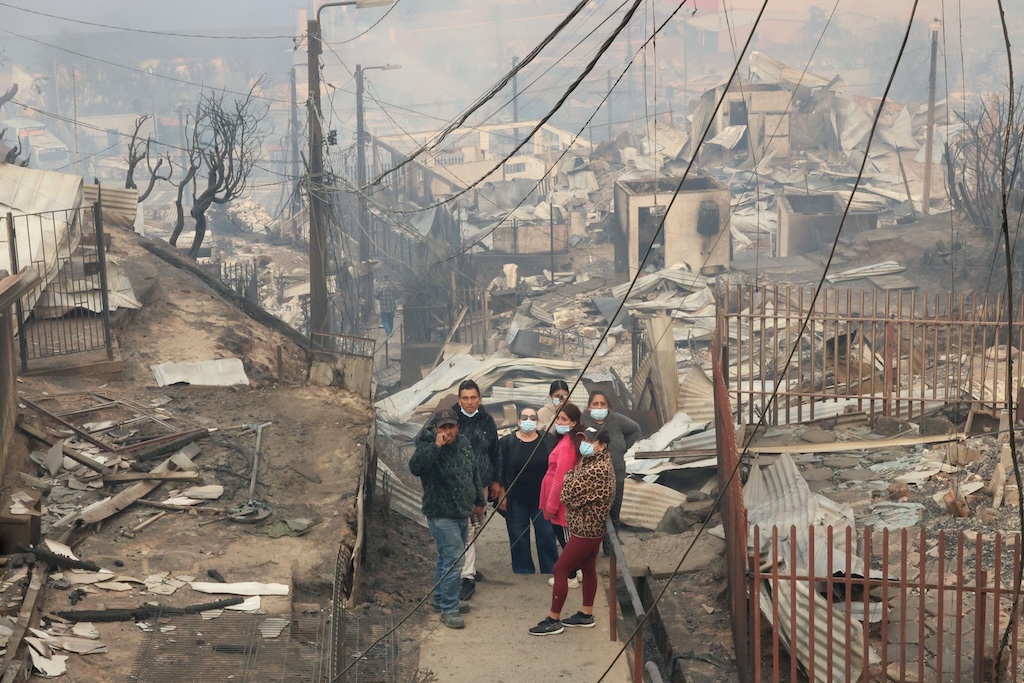
These wildfires burnt more than 40,000 hectares of forests, “tripling the amount of land burned in 2025” across the country, reported La Tercera.
The study adds that more than 20,000 hectares of non-native forest plantations, including Monterey pine and Eucalyptus trees, were consumed by the blaze and critical infrastructure was affected.
A WWA press release points out that the expansion of non-native pines and invasive species “has created highly flammable landscapes in Chile”.
Hot, dry and windy
Wildfires are complex events that are influenced by a wide range of factors, such as atmospheric moisture, wind speed and fuel availability.
To assess the impact of climate change on wildfires, the authors chose a “fire weather” metric called the “hot dry windy index” (HDWI). This combines maximum temperature, relative humidity and wind speed.
While this metric does not include every component that could contribute to intense wildfires, such as land-use change and fuel load data, study author Dr Claire Barnes from Imperial College London told a press briefing that HDWI is “a very good predictor of short-term, extreme, dry, fire-prone conditions”.
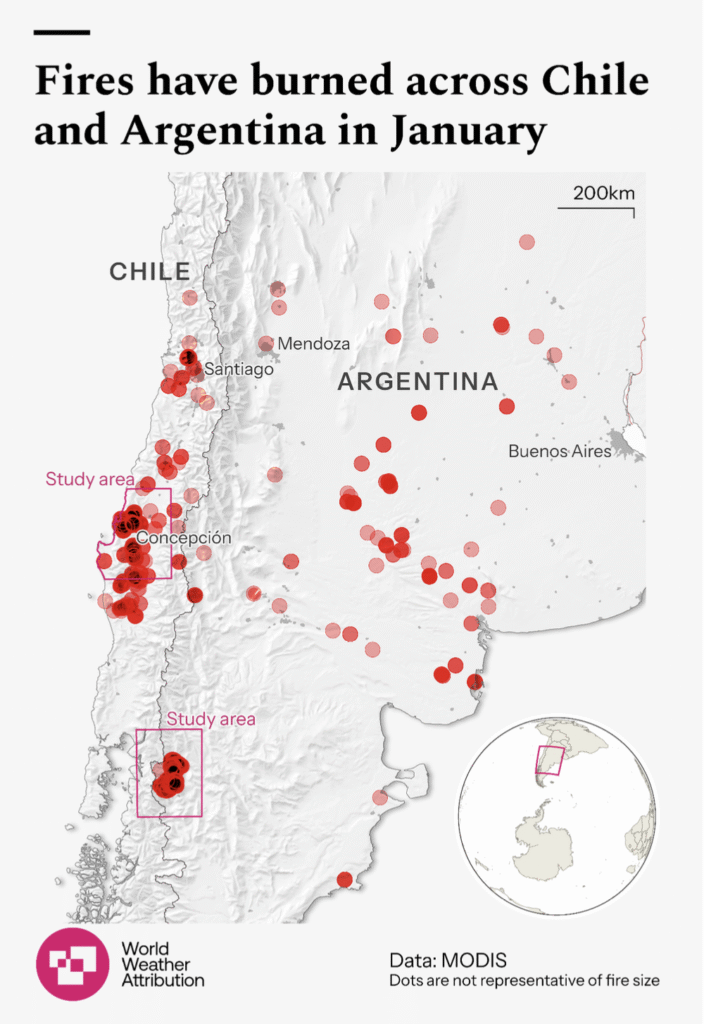
The authors chose to analyse two separate regions. The first lies along the coast and the foothills of the Andes around the Ñuble, Biobío and La Araucanía regions in central Chile. The second sits across the Chilean and Argentine border in Patagonia.
These regions are shown on the map below, where red circles indicate the wildfires recorded in January 2026 and pink boxes represent the study areas.
The authors also selected different time periods for the two study regions, to reflect the “different lengths of peak wildfire activity associated with the fires in each region”.
For the central Chilean study area, the authors focus their analysis on the two most severe days of HDWI, 17-18 January. For the Patagonian region, they focus on the most severe five-day period, which took place over 2-6 January.
To put the wildfire into its historical context, the authors analyse data on temperature, wind and rainfall to assess how HDWI over the two regions has changed since the year 1980.
They find that in both study regions, the high HWDI recorded in January is not “particularly extreme” in today’s climate and would typically be expected roughly once every five years. However, they add that the event would have been “rarer” in a world without climate change, in which average global temperatures are 1.3C cooler.
The authors also use a combination of observations and climate models to carry out an “attribution” analysis, comparing the world as it is today to a “counterfactual” world without human-caused climate change.
They find that climate change made the high HDWI three-times more likely in the central Chilean region and 2.5-times more likely in the Patagonian region.
The authors also conduct analysis focused solely on November-January rainfall.
Both study regions experienced “very low rainfall” in the months leading up to the fires, the authors say. They find that fire-season rainfall intensity is around 25% lower in the central Chilean region and 20% lower in the Patagonia region in today’s climate than it would have been in a world without climate change.
Finally, the authors considered the influence of climatic cycles such as the El Niño-Southern Oscillation (ENSO), a naturally occurring phenomenon that affects global temperatures and regional weather patterns.
They find that a combination of La Niña – the “cool” phase of ENSO – combined with another natural cycle called the Southern Annular Mode, led to atmospheric circulation patterns that “favoured the hot and dry conditions that enhanced fire persistence and severity in parts of the region”.
However, they add that this has a comparably small effect on the overall intensity of the wildfires, with climate change standing out as the main driver.
(These findings are yet to be published in a peer-reviewed journal. However, the methods used in the analysis have been published in previous attribution studies.)
Vulnerable communities
The wildfires affected native forests, national parks and small rural and tourist communities in both countries.
A 2025 study conducted in Chile, cited in the WWA analysis, found that 74% of survey respondents did not have appropriate education and awareness on wildfires.
This suggests that insufficient preparedness on early warning signs, response measures and prevention can “exacerbate the severity and frequency of these events”, the WWA authors say.
Aynur Kadihasanoglu, senior urban specialist at the Red Cross Red Crescent Climate Center, said in the WWA press release that many settlements in Chile are close to flammable pine plantations, which “puts lives and livelihoods at risk”.
Additionally, the head of Chile’s National Forest Corporation pointed to “structural shortcomings” in fire prevention, such as lack of regulation in lands without management plans, reported BioBioChile.
In Argentina, the response to the fires has been hampered by large budget cuts and reductions in forest rangers, according to the WWA press release. Experts have criticised Argentina’s self-styled “liberal-libertarian” president Javier Milei for the cuts and the delay to declaring a state of emergency in Patagonia.
According to the Associated Press, “Milei slashed spending on the National Fire Management Service by 80% in 2024 compared to the previous year”. The service “faces another 71% reduction in funds” in its 2026 budget, the newswire adds.
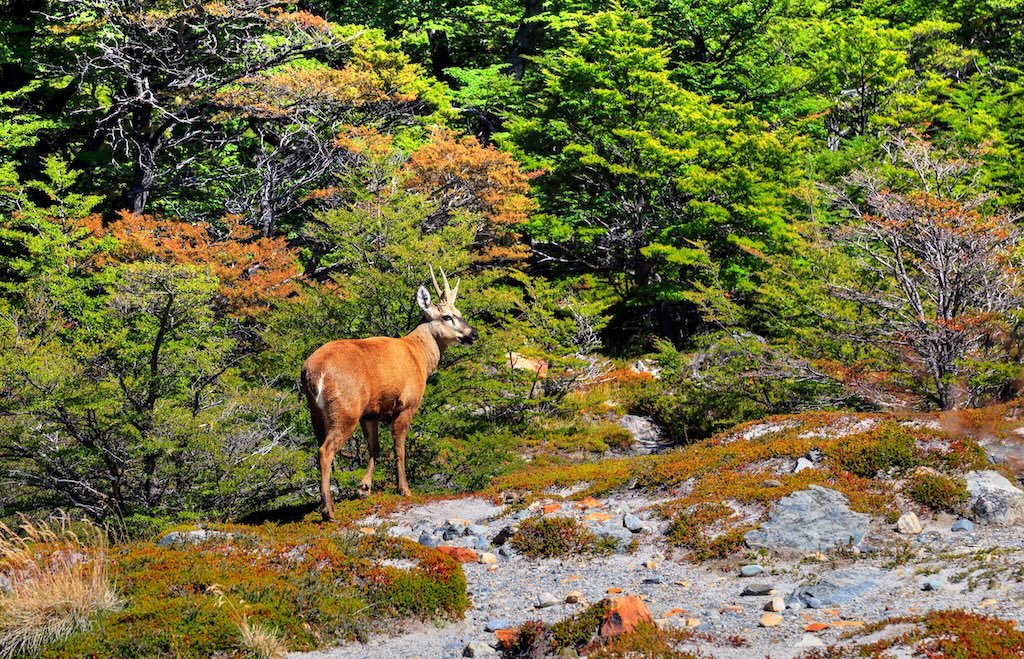
Argentinian native forests and grasslands are experiencing “intense pressure” from wildfires, according to the study. Many vulnerable native animal species, such as the huemul and the pudú, are losing critical habitat, while birds, such as the Patagonian black woodpecker, are losing nesting sites.


The post Climate change made ‘fire weather’ in Chile and Argentina three times more likely appeared first on Carbon Brief.
Climate change made ‘fire weather’ in Chile and Argentina three times more likely
Activists say the decision is the latest sign of growing grassroots opposition to the industry in the U.S.
A Pennsylvania county on Tuesday rejected a plan to rezone land so a data center could be built there, becoming the latest locality to push back against an electricity-hungry industry growing rapidly nationwide.
Pennsylvania County Denies Rezoning Plan That Would Have Allowed a Data Center


Cropped 11 February 2026: Aftershocks of US withdrawals | Biodiversity and business risks | Deep-sea mining tensions
Nuclear’s Next Chapter: newcleo Raises $88M to Scale SMR Powered by Nuclear Waste

A Loss for Environmentalists, and Humanity as a Whole
Guest post: Why China is still building new coal – and when it might stop
Guest post: Why China is still building new coal – and when it might stop
Bill Discounting Climate Change in Florida’s Energy Policy Awaits DeSantis’ Approval
-
Greenhouse Gases6 months ago
Guest post: Why China is still building new coal – and when it might stop
-
Climate Change6 months ago
Guest post: Why China is still building new coal – and when it might stop
-
Climate Change2 years ago
Bill Discounting Climate Change in Florida’s Energy Policy Awaits DeSantis’ Approval
-

 Greenhouse Gases2 years ago
嘉宾来稿:满足中国增长的用电需求 光伏加储能“比新建煤电更实惠”
-
Climate Change2 years ago
Spanish-language misinformation on renewable energy spreads online, report shows
-

 Climate Change2 years ago
嘉宾来稿:满足中国增长的用电需求 光伏加储能“比新建煤电更实惠”
-
Climate Change Videos2 years ago
The toxic gas flares fuelling Nigeria’s climate change – BBC News
-
Renewable Energy2 years ago
GAF Energy Completes Construction of Second Manufacturing Facility