

Whatever oil and gas companies would have you believe, fossil gas has no useful role to play in the energy transition. In fact it’s dirty, expensive, and unnecessary
Renewables are not only better for the climate, they are cheaper and create more jobs. Pursuing the concept of a ‘gas-led recovery’ would deliver economic as well as environmental ruin.
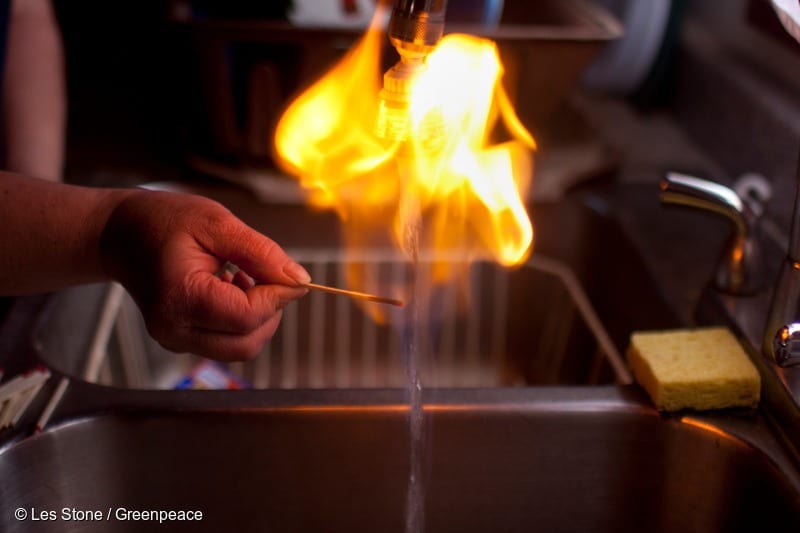
6 reasons gas is bad for the climate and the economy
- Burning known global oil and gas reserves, even without coal, would make limiting temperature rise to 1.5°C impossible: Burning existing proven and probable gas reserves alone would lead to 173 gigatonnes of greenhouse gas emissions, nearly half of the remaining post-2015 carbon budget for remaining below 1.5°C with 50% probability. In fact to meet the IPCC’s most realistic pathway to 1.5°C would require a reduction of not less than 39% in fossil gas consumption between 2018 and 2030.
- Gas may be as polluting as coal: Taking into account the greenhouse gas emissions associated with extracting, producing, and transporting gas to consumers, scientists are now concluding that across the entire lifecycle gas may be as polluting as coal, if not more: Not only is the process of liquefying and transporting gas energy intensive but the amount of methane, a greenhouse gas 86 times more potent than CO2 in the short term, routinely leaking from gas infrastructure has been severely underestimated.
- Investors are already overexposed to gas: Investing in new gas projects now will either lead to assets becoming stranded as global efforts to curb emissions gain momentum or they will cause climate action to fail, thereby contributing to the increased costs of climate damage. As of 2019 almost $5 trillion USD of investments have already been committed to new oil and gas fields that are incompatible with limiting warming to 1.5°C.
- Renewables are cheaper than gas: Since 2016, gas has been driving up energy prices for Australian households and businesses. According to the CSIRO, Lazard, and Bloomberg’s levelized cost of energy analyses, solar and wind have been the cheapest power generation technologies for new capacities in most major economies for some time and are now even competitive with installed coal.
- Fossil gas is not needed for grid reliability: Storage solutions and demand response technology are becoming competitive with gas peaker plants for balancing electricity grids. AEMO’s most recent draft Integrated System Plan shows no need for significant gas expansion in any scenario. And according to Wood MacKenzie batteries could soon replace all gas peakers. Electrifying transport and buildings is expected to further help meet grid reliability expectations.
- New fossil gas infrastructure would lock in emission increases for decades. Global gas production plans already in train are set to exceed the global carbon budget for 1.5°C by 70%. Approximately half of the existing fossil gas fleet was built after 2000. New fossil gas plants and infrastructure being built are either likely to operate and emit greenhouse gases for decades, shattering the earth’s carbon budget, or become stranded assets.


A number of tools can help you understand localized climate risks. But it’s still a lot to navigate.
Trying to buy a home comes with a seemingly endless list of things to consider: What’s the commute to work like? Can you qualify for a mortgage? Will the small kitchen drive you crazy?
Choosing the Right Home Is Tough. Climate Change Is Making It Harder.
Climate and security experts say the plan is outdated and could place the U.S. at a competitive disadvantage.
President Donald Trump plans to announce an executive order on Wednesday directing the U.S. Department of Defense to buy electricity from coal-fired power plants.
Donald Trump’s designs on Venezuela and Greenland have sent shock waves around the world. Canadian premier Mark Carney said they have created a “rupture in the world order”, as political alliances that have held for over 80 years are thrown aside.
And as the US seeks to carve out a Western Hemispheric sphere of influence, questions about the dollar’s future as the lynchpin of the global economy are growing louder. Many other parts of the world are switching to green energy sources as renewable energy becomes cheaper than fossil fuels, and countries forced to pay back loans in dollars are eyeing alternative currency options to free themselves from the penalty of fluctuating exchange rates amid unpredictable policy shifts.
As a result, the continued relevance of the petrodollar system – in which oil is traded in dollars and guarantees demand for US currency – may be less than assured.
What is the petrodollar system?
The petrodollar system was established in the 1970s following the collapse of the Bretton Woods system and is one of the most consequential monetary arrangements in modern history.
In 1944, the Bretton Woods agreement made the US dollar the anchor of the global monetary system, pegged to gold and with other currencies fixed to the dollar. The framework aimed to provide global financial stability following the economic fragmentation of the Second World War and cemented the dollar as the world’s reserve currency.
US President Richard Nixon abandoned the gold standard in 1971 to curb inflation after foreign central banks – increasingly reluctant to hold depreciating dollars – began converting their dollar reserves into gold. The petrodollar system emerged as an alternative means of keeping the dollar as the backbone of international transactions.
The petrodollar system refers to the pact that Gulf Cooperation Council (GCC) states – including Kuwait and Saudi Arabia – made with the US, agreeing to price oil in dollars and to recycle revenues into US Treasury securities in return for military protection and sales of advanced weaponry.
-
Vanuatu pushes new UN resolution demanding full climate compensation
The Pacific island nation wants the UN General Assembly to enforce last year’s landmark court decision on states’ climate responsibility, a first draft shows

Andrés Arauz, former Ecuadorian minister and central bank director, told Green Central Banking that ramifications for the global economy were immense: “So oil and gas [are traded in dollars], but then also downstream with all the derivatives, but then also all the chemical elements derived from the oil industry and petrochemical industry. And then likewise, upstream with all the technology and inputs required to extract the oil, [it] created a dollar-denominated value chain with global and international repercussions.”
Arauz also notes that international accounting standards set by institutions like the IMF reinforce the system by requiring central banks and organisations to report reserves in dollars, solidifying the greenback as the default unit of account.
For decades, this system delivered guaranteed demand for dollars, recycled oil revenues into safe-haven US debt markets, and provided outsized geopolitical leverage to the US Federal Reserve given the need of other countries to accumulate dollars to conduct global transactions.
Fadhel Kaboub, associate professor in economics at Denison University, explains how this “exorbitant privilege” distorted the global economy in the US’s favour. “All countries operate … within a system where they have to accumulate reserves not in gold anymore but in dollars and countries that have debt, their debt is denominated in dollars. So that created a locked-in system that gives the US dollar a privilege as the dominant payment system and gives the opportunity to weaponise this system.”
The petrodollar system has also encouraged and amplified US consumption of fossil fuels and its contribution to greenhouse gas emissions. Kaboub, who is also a member of the United Nations High-Level Advisory Board on Economic and Social Affairs, says the system has “rewired” the global economy into an extractive model that promotes environmentally destructive industries.
But as decarbonisation accelerates and renewable energy displaces fossil fuel value chains, the petro-lynchpin of dollar dominance faces unprecedented strain.
Is the petrodollar in decline?
Signs of discontent are increasing, placing the dollar’s decades-long dominance under unprecedented pressure.
BRICS countries are discussing new financial mechanisms that will make trading within the bloc easier but may also reduce reliance on existing dollar-dominated channels. Both India and Brazil have denied that linking BRICS digital currencies is part of moves towards de-dollarisation, but such a move will likely cause concern in the US.
Meanwhile, European Central Bank President Christine Lagarde made headlines in May 2025 with her blunt assessment that the current global landscape presents a significant opportunity for a “global euro moment”, as investors “unsettled by unpredictable US economic strategies” increasingly reduce their exposure to dollar-denominated assets.
These developments reflect deeper structural shifts. The dollar’s share of global reserves has declined from 71% to 56.3% since 2008, with central banks purchasing over 1,000 metric tons of gold annually for three consecutive years. China slashed its US Treasury holdings from US$1.3tn in 2013 to just $682bn by November 2025, while simultaneously expanding yuan-based trade across Asia.
Africa records fastest-ever solar growth, as installations jump in 2025
This shift was triggered by what Arauz describes as “eroding trust” in US financial systems.
“Perhaps the most serious element that has accelerated this diversification has been the weaponisation of the hegemonic banking system,” Arauz said. “[Through] sanctions, through asset freezes, through confiscation of international reserves in many countries … [these] have definitely stirred things up and made countries reflect about the reliance on this previously thought of neutral system that is now, on the other hand a threat, to their national sovereignty and economic policies.”
The climate crisis is also acting as a catalyst. As the world transitions away from fossil fuels, structural strain is placed on the demand for dollars, and the more the US clings to fossil fuel dependency in order to maintain monetary dominance, the deeper the cracks become.
Gulf states have long-term plans to diversify away from oil and reinvest a substantial portion of their oil revenues in green value chains, challenging the core pact which upholds the petrodollar system that US currency dominance has long depended on.
And while economists expect the dollar to remain the primary reserve currency in the near term, it has also been noted that once transitions to a new system are underway, they can happen very quickly. Speaking at the World Economic Forum in Davos in January, Jeffry Frieden, political science professor at Columbia University, warned of “an erosion of confidence in the dollar” amid mounting doubts about the safety of US Treasuries as “the most important financial asset in the world”.
‘US pulling itself out of the picture’
The Trump administration’s response to a shift away from the dollar has been to double down on arms sales and fossil fuel infrastructure – what Kaboub calls a “long-term strategic failure” that fundamentally misreads the changing dynamics of global power.
Trump’s recent $142bn arms deal with Saudi Arabia aims to tether Gulf revenues to the dollar through military exports. However, economists like Maya Senussi at Oxford Economics and John Sfakianakis of the Gulf Research Centre warn that financing such deals alongside decarbonisation projects will strain GCC budgets, and Bloomberg estimates it will require oil prices to be at least $96 a barrel just to break even. Brent oil prices currently hover around $67-68.
And in the Global South, higher oil prices may inadvertently threaten dollar dominance by exacerbating debt burdens by increasing repayment costs, pushing countries towards cheaper (and greener) energy systems. America’s transition to net fossil fuel exporter status means higher oil prices now strengthen rather than weaken the dollar, creating a triple blow for dollar-indebted countries in Latin America and Africa: higher energy costs, escalating debt servicing and constrained fiscal space.
The very mechanism designed to strengthen dollar ties – expensive arms deals premised on elevated oil prices – accelerates the search for alternatives among countries holding critical transition minerals like lithium, copper and cobalt. This pushes the US further from the green value chains of the future.
“The US is pulling itself out of the picture, it’s divesting from the green technologies and green industries. Which means it’s moving away from its interest in critical minerals,” says Kaboub. “So the remaining big player is China, and it’s a friend of the Global South.”
Today, China controls 85-90% of global rare earth processing and offers renewable energy equipment that remains attractive to the GCC despite US and EU tariffs. This is thanks to competitive pricing and comprehensive infrastructure approaches that western competitors have largely failed to match.
‘America needs you’: US seeks trade alliance to break China’s critical mineral dominance
Kaboub says that Trump’s minerals-for-security deals, such as in Greenland and elsewhere, may secure short-term market access but erode global trust in US foreign policy, a cornerstone of confidence in the dollar. “The isolated backwards technology bloc is going to be the United States,” he says.
As Lagarde observed, investors increasingly seek “geopolitical assurance in another form” by directing investments toward regions perceived as “dependable security allies” – but this no longer automatically defaults to the US as its government criticises its one-time allies and jeopardises the future of NATO.
Yet the petrodollar system faces challenges that extend far beyond the geopolitics of sanctions; climate change has introduced structural pressures making the core foundations of dollar dominance increasingly untenable.
However, given Trump’s bellicose stance on Venezuela and Greenland, there is a risk that American policymakers will not recognise this new reality until it is too late.
This article was originally published by Green Central Banking.
The post Explainer: What is the petrodollar and why is it under pressure? appeared first on Climate Home News.
Explainer: What is the petrodollar and why is it under pressure?


Gas is Just Another Dirty Fossil Fuel
Choosing the Right Home Is Tough. Climate Change Is Making It Harder.

Murders Committed by ICE Are OK, According to What We See Here
Guest post: Why China is still building new coal – and when it might stop
Guest post: Why China is still building new coal – and when it might stop
Bill Discounting Climate Change in Florida’s Energy Policy Awaits DeSantis’ Approval
-
Greenhouse Gases6 months ago
Guest post: Why China is still building new coal – and when it might stop
-
Climate Change6 months ago
Guest post: Why China is still building new coal – and when it might stop
-
Climate Change2 years ago
Bill Discounting Climate Change in Florida’s Energy Policy Awaits DeSantis’ Approval
-

 Greenhouse Gases2 years ago
嘉宾来稿:满足中国增长的用电需求 光伏加储能“比新建煤电更实惠”
-
Climate Change2 years ago
Spanish-language misinformation on renewable energy spreads online, report shows
-

 Climate Change2 years ago
嘉宾来稿:满足中国增长的用电需求 光伏加储能“比新建煤电更实惠”
-
Climate Change Videos2 years ago
The toxic gas flares fuelling Nigeria’s climate change – BBC News
-
Renewable Energy2 years ago
GAF Energy Completes Construction of Second Manufacturing Facility