

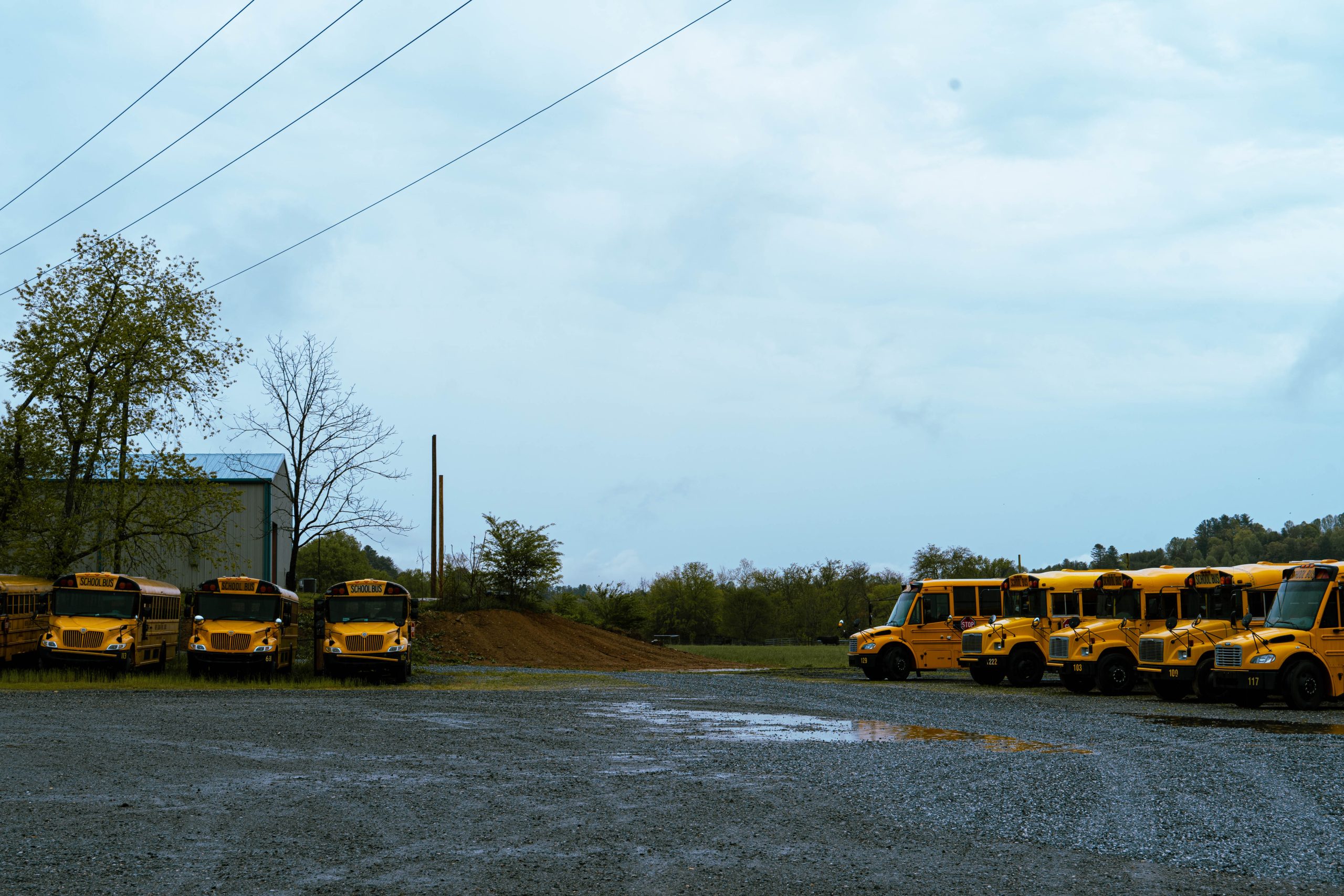
Transylvania County, NC is known as the “Land of Waterfalls” due to the 250 waterfalls scattered throughout the lush greenery of the Blue Ridge Mountains. Brevard, the county seat, is the kind of small town where the elementary school principal is also the bus driver. It’s also a place of technological innovation. Every afternoon, Ben Alexander, assistant principal at Pisgah Forest Elementary, climbs into the driver’s seat of an electric school bus and sets out on his route.
Alexander’s dual role isn’t just a quirk of staffing—it’s emblematic of a community where people wear many hats and do what needs to be done.
“They asked in the interview if I’d be willing to drive a bus,” he recalled. “I thought they were joking… I wanted the job, so I said sure.”
Driving an electric school bus wasn’t part of the original plan, but Alexander was all in once the district brought one on board. As a longtime hybrid vehicle owner himself, he saw both practical and philosophical benefits.
“I have a Chevy Volt… I wanted to try and find ways of saving money on gas, but also just have a cleaner car,” he said. “So when we got the electric bus, I said, you know, I’ll try it.”
It didn’t take long for him to prefer it.
“Pulling out onto a highway, it just has a lot more power to get up to speed than a traditional bus, and it also just has a better turning radius, which is helpful in certain situations. In a traditional bus, I have to back up on certain spots, and with the electric bus, I can just kind of zoom around.” – Ben Alexander, Assistant Principal, Pisgah Forest Elementary
But beyond the convenience, Alexander sees deeper value in the switch. “When the kids get on the bus, the exhaust is not blowing out on the students,” Alexander said. Alexander’s pre-trip inspection is quicker because the electric bus has no exhaust system, reducing the risk of leaking exhaust to zero.
For students, the change is just as noticeable. “They would prefer to be on the electric bus than the diesel, and maybe it’s because it’s a newer bus, I don’t know, but they seem to like the electric bus more so than the older bus, the diesel bus,” he said. And while he hasn’t looked at health data yet, Alexander says he’d choose the electric bus for his own child without hesitation. “The buses are built really safe in general… They’re pretty much like tanks,” Alexander said.
“If I had to have my child on a bus, I’d rather them be on the electric bus,” Ben Alexander, Assistant Principal, Pisgah Forest Elementary
This transition could have met resistance in a region where diesel engines and winding mountain roads are still the norm. But it’s been surprisingly smooth for the team keeping the buses running.
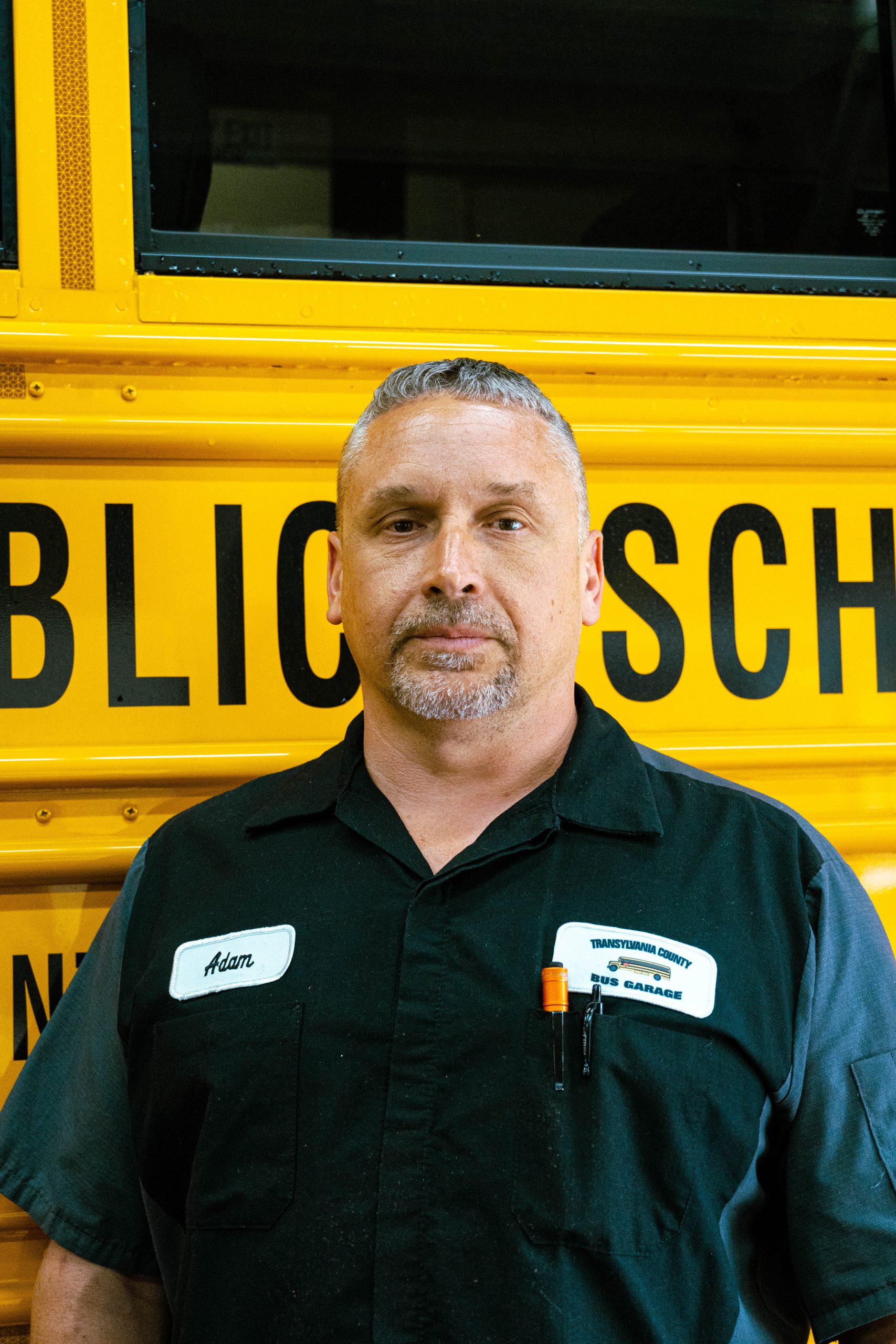
Adam Holcomb has been a technician at Transylvania for over a decade.
Adam Holcomb, a bus technician for Transylvania County Schools, has worked on every part of a school bus—from brakes and tires to engines and seats—for over a decade. He says working on the electric model is surprisingly painless.
“There’s maintenance once a year. It’s pretty simple. It takes about four hours to do. Other than that, brakes and tires just like a diesel bus,” Holcomb said.
As for concerns among fellow mechanics? Holcomb has a message: “There’s really nothing to be scared of. They teach you everything you need to know to make it safe before you work on it.” Through a day-long course offered by Carolina Thomas, the state’s electric bus provider, Holcomb learned the basics and was outfitted with safety gear. “Tools are the same… Gloves and some eye covering,” he said.
Electric school buses in this corner of Appalachia weren’t a political statement or a flashy initiative—they were a practical choice that turned out to be something more. “It just makes the whole process a lot quicker and faster for the driver, and the students seem happier,” Alexander said. “For me, it’s a no-brainer.”
In a county better known for waterfalls and small-town charm than innovation, the quiet success of electric school buses proves that rural towns can lead in sustainability and do it on their own terms. With more funding, Alexander says he’d love to see the fleet grow.
“Just knowing that the cost for fuel is going up in the future, it just makes sense to have an electric bus,” he said.
The post Electric School Buses Find an Unexpected Home in the Blue Ridge Mountains appeared first on SACE | Southern Alliance for Clean Energy.
Electric School Buses Find an Unexpected Home in the Blue Ridge Mountains

 Truck drivers are spending large amounts of their own money to drive into traffic-ridden Washington D.C., flying American flags, the banner that has been usurped by the MAGA right, to protest Trump’s nonsensical war in Iran that has pushed diesel prices through the roof.
Hmmm. I’m suspicious.
 At left we see yet one more reminder of the disaster taking place in the United States.
Our Founding Fathers made huge sacrifices for us, and we’ve seen fit to elect an insane dictator to run roughshod over our beloved Constitution.
We hear that democracies do not descend into authoritarian regimes overnight. That’s true, but what’s happened here has been quite rapid indeed.
As shown at left, American voters have to make a decision, one that is based the credibility of various people, including the president of the United States.
This country finds itself in a terrible position, all based on its citizens’ inability to make even the most basic assessment of Trump’s character.



-
Climate Change1 year ago
Guest post: Why China is still building new coal – and when it might stop
-

 Greenhouse Gases2 years ago
嘉宾来稿:满足中国增长的用电需求 光伏加储能“比新建煤电更实惠”
-
Greenhouse Gases1 year ago
Guest post: Why China is still building new coal – and when it might stop
-

 Climate Change2 years ago
嘉宾来稿:满足中国增长的用电需求 光伏加储能“比新建煤电更实惠”
-

 Renewable Energy11 months ago
Sending Progressive Philanthropist George Soros to Prison?
-
Climate Change2 years ago
Bill Discounting Climate Change in Florida’s Energy Policy Awaits DeSantis’ Approval
-
Greenhouse Gases1 year ago
嘉宾来稿:探究火山喷发如何影响气候预测
-

 Climate Change2 years ago
Analysis: China’s CO2 falls 1% in Q2 2024 in first quarterly drop since Covid-19