Green Living
What is Slow Fashion, Really?
Slow fashion is a growing movement of fashion professionals, consumers, and citizens who are actively working to slow down the industry in an age of fast fashion and overconsumption.
It’s a movement I joined about a decade ago and have become so passionate about, that I’ve dedicated my career and business to educating people on slow fashion.
As a branch of the slow movement, slow fashion has a lot of similarities with the overall slow lifestyle approach and with the other slow movement domains.
For example, slow food focuses on regionality, organic production, and sustainable practices. Similarly, slow fashion is associated with closer supply chains or in-house production, use of quality natural materials, and a focus on sustainability.
Slow fashion could be described as the opposite of fast fashion. But while the movement rose in opposition to fast fashion (just like slow food was borne from a campaign against fast food), slow fashion is so more more than what it is not.
What Does Slow Fashion Mean?
Kate Fletcher — a research professor, author, consultant, and design activist — is widely credited with coining the term slow fashion. The author wrote in 2007 that “slow fashion is about designing, producing, consuming, and living better.”
Fletcher also explains that despite the adjective slow, slow fashion is really more about better quality than just slowing down production. (Though quality does take time.)
And as a sustainability thought-leader, Fletcher is clear that slow fashion considers the impacts of the industry on ecosystems as well as on workers and communities. It’s not just about slowing down for the sake of it.
In my experience, slow fashion has come to mean mindfulness throughout the entire lifecycle of a garment. But what does this all mean in practice?
Examples of Slow Fashion Practices
Again, slow fashion is more than not fast fashion!
Slow fashion is also much more than buying from certain brands, though that can be an important part of it if you’re able to get involved in that way.
Really, slow fashion is a mindset. It’s about building a long-term relationship with our wardrobe and valuing our clothes. While this can sometimes be associated with “investment pieces”, I believe that it’s important to value our clothes beyond their price tag.
Even if a garment was cheap to buy — for example a thrift store find or old fast fashion piece — that item of clothing still involved human labor and ecological resources.


For example, as a consumer and advocate, you could…
- Find your personal style rather than just following the latest trend cycles (PSA: this does not mean you have to dress in a “classic” style or in neutral colors, unless that is your preferred style.)
- Shop your closet through practices like creating outfits by using your style words
- Take good care of your clothes to extend the life of the garments in your closet and either mend them or get them repaired when needed
- Become a fashion activist and campaign for a better industry
- Push for for public change through sustainable fashion legislation
- Buy less, but better by learning how to identify high quality clothes
- Prioritize pre-loved: thrift locally, join or host a clothing swap, or browse online secondhand stores
- Discover slow fashion brands and fair trade fashion brands that embody practices in alignment with your values
- Talk about slow fashion with your friends and family
- Deepen your education and stay informed on slow fashion through podcasts, documentaries, and newsletters
- Learn how to make or modify your own clothes
And as a fashion brand or professional, you could…
- Understand fashion’s environmental impact and what your role could be in reducing it
- Ensure all workers in your brand’s supply chain are paid a true living wage
- Build genuine partnerships with suppliers, artisans, and farmers to create a traceable, ethical supply chain and ideally removing as many “middlemen” in the process as possible
- Explore alternative sustainable fashion business models
- Design intentionally, prioritizing quality over quantity of pieces
- Source more sustainable fabrics and materials
- Integrate circular fashion practices
- Go beyond sustainability with regenerative fashion practices
- Educate the next generation on slow and sustainable fashion
A holistic approach to slow fashion overlaps with ethical fashion and sustainable fashion. Slow fashion is not only about making less or slower, but also about considering the livelihoods and ecosystems involved along the way.
Slow Fashion vs. Fast Fashion
Although slow fashion is more than just anti-fast fashion, there are many key differences that stand out between slow fashion and fast fashion. Slow fashion…
Is more intentional
In a survey conducted by VICE of individuals between ages 18 and 24, 23% of respondents said that they sometimes wear an item just once before throwing it out. Eight percent of respondents said they buy more than ten items a month from online fast-fashion retailers.
A slow fashion approach understands the environmental impact of each garment and prioritizes buying less, but often better pieces. This doesn’t have to mean more expensive — you can find high quality secondhand garments, after all — but it may take more time.
The same philosophy goes for slow fashion brands. A true slow fashion brand will put quality before quantity, often producing just a few collections or only one collection the entire year.
There are even ultra-slow fashion brands that have a permanent collection that have decided to refine and perfect their designs, fit, and quality instead of constantly churning out new designs.
Has a lower environmental footprint than fast fashion
The history of fast fashion shows us that modern-day fashion brands were not the start of the industry’s social and environmental woes.
However the decades-long race to the bottom has taken the issues in the fashion industry to new lows with widespread labor exploitation, ecological degradation, and an exponential increase in waste.
Fast fashion — and really the fast fashion-ification of the entire industry — has created a waste crisis and environmental disaster.
Clothing production doubled from 2000 to 2015 while clothing utilization decreased 36%. An estimated 92 million tons of textile waste is created by the fashion industry each year.
Fast international shipping also has a massive impact — the climate group Stand.Earth reports that shipping an item by air freight can produce 80x more carbon than shipping it by sea or truck. In fact shipping by air is a leading cause of fashion’s rising emissions, the group has reported.
Values quality over quantity

Most fast fashion brands churn out new styles weekly, or even daily, and such quick turnaround times inherently mean that corners need to be cut. It’s typical for fast fashion brands to skip the fitting process, for example, leading to a worse fit, higher return rates and more post-consumer clothing waste.
Slow fashion values quality in the form of fabric choice, fit, feel, and in the lives of the people who made that piece. These brands often produce in small batches and some even produce on a made-to-order basis.
Similar to the slow food movement, when done right, slow fashion is also about improving the quality of our lifestyles too.
I have found that when I am more deeply connected to what I wear and appreciate what I have in my closet rather than always chasing the next trend, trying to look like someone else, and on the rollercoaster of dopamine shopping, I feel more satisfied overall.
It may sound strange, but I have a deeper relationship to the pieces in my closet too. I will always treasure the dress I mended with my grandma; I treat the sweater I’ve worn 200 times as a comfort blanket on a tough day; I can rely on a certain pair of well-loved shoes to give me a confidence boost.
Contrast this with my former constant trips to the mall, always looking for a bit of a dopamine hit from finding a good deal — and then coming home to realize that I don’t even like the garment all that much.
Puts people before profit
While profit is part of all for-profit businesses, including even small conscious fashion brands, the goal is not profit at all costs. Slow fashion values sustainable practices and paying people fairly, which means that it costs more. This is the true cost of clothing.
Contrast that with fast fashion which resorts to forced labor, not paying workers their owed wages, and use of toxic chemicals in clothing that impact both workers and wearers.
And as a “consumer” — or individual that buys clothing — following slow fashion values also involves a level of care for the people who made our clothes.
This could mean looking for ethical brands. But it also holds true even if we bought an item secondhand or are wearing a fast fashion garment already in our closets. By caring for our clothes, we are valuing the people who made them.
Another way that slowing down our fashion consumption impacts people is the end of life of our garments. Donating our clothes is often seen as an easy, more ethical way to clear our clutter and make space for the new. But what happens to our donated clothes is not always pretty.
The influx of massive quantities of low-quality clothes has destroyed local textile economies in the Global South, polluted waterways, and left many resellers in precarious financial positions.
What Are Slow Fashion Brands?
Here are some elements to look for when you’re searching for a slow fashion brand.
- Offers longer-lasting collections designed intentionally rather than pushing out new styles constantly.
- Produces in small batches or on a made-to-order basis. Relatedly, a brand is producing intentionally simply can’t produce as much. If you see a brand coming out with hundreds of styles each month, that’s a red flag.
- Creates high quality garments. If a brand is serious about quality, they will tell you and show you. Look at the fabric content, check the seams, observe the hand-feel or look at close-up photos, try on the product or look at online reviews.
- Manufactures sustainably. Check if the brand is using sustainable fabrics and dyes, takes steps to minimize or eliminate waste through zero waste fashion practices, and is minimizing their pollution and carbon emissions through green shipping, renewable energy use, and/or other initiatives.
- Has transparency and traceability of their supply chains. If a brand is producing intentionally, they’ll be able to track each step of the production process and ideally have direct relationships with the suppliers or artisans they work with. The best case scenario is when a brand produces in-house either in a facility or just in their studio if they are a micro fashion brand. This enables maximum transparency.
Cheatsheet: Our guide to slow fashion brands
Slow Fashion is Nothing New!
As outlined in detail by Sofi Thanhauser in the book Worn: A People’s History of Clothing, before the Industrial Revolution, most garments were handmade in small batches slowly and relatively locally to the customer.
Slow clothing was the default way we engaged with what we wore for much of human history!
The introduction of textile machinery in England in the 18th and 19th centuries meant that fabric and garments could be produced in larger quantities at cheaper prices — and with lower quality standards.
While mass production made clothing more affordable for the masses, the industrialization of fashion also made fashion more homogenous, and it impacted the livelihoods of artisans and craftspeople. Instead of a fashion economy of small-batch makers, independent designers, skilled weavers and expert tailors, the fashion economy shifted to one of mechanized factories with profit-seeking factory owners and underpaid laborers.
This is important to point out because fast and exploitative fashion does not have to be the default and it’s not our only option.
While we may not be able to (or want to) reverse industrialization and the many conveniences it has brought us, we can look to the past to inspire a better fashion future.
The Future of Slow Fashion
So what is the future of fashion? Is slow fashion our future? I would like to hope so!
While I’m absorbed in the slow fashion bubble and am exposed to it far more than the average person, I do see several encouraging signs in the broader economy and culture.

- The global secondhand market is predicted to reach $350 billion by 2028 according to thredUP’s resale report.
- The same report shows that secondhand apparel is growing 3X faster than the overall apparel market.
- UK department store Selfridges wants to transform the way we shop and have half of transactions be resale, repair, rental, or refills by 2030. Repair service SOJO has a permanent space in Selfridges.
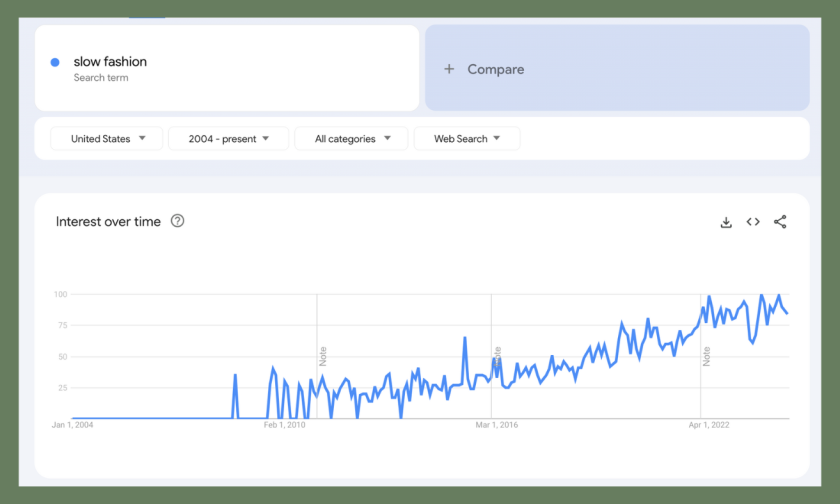
- Searches for “slow fashion” on Google in the United States have been on the rise, according to Google Trends (see image above).
- The EU has been taking several steps to make the fashion industry more sustainable, partially by slowing down production. For example, the EU aims to stop overproduction and overconsumption of clothing through the Waste Framework Directive and the EU’s design requirements will ensure textiles are easier to repair and that they last longer.
- While the United States is behind Europe on sustainable fashion legislation, the proposed Americas Act Bill does include provisions to propel domestic circularity in textiles. (The goal here isn’t necessarily to slow down the industry’s production, but it could help support the secondhand and repair economies, which are part of the slow fashion movement.)
We’re still very much in the nascent stages of the slow fashion movement, but large-scale changes like a younger generation that looks secondhand first and governmental bodies that take textiles-related legislation seriously could be instrumental in making slow fashion practices the new norm.
For more educational resources, read What is Sustainable Fashion? and What is Ethical Fashion?
The post What is Slow Fashion, Really? appeared first on Conscious Life & Style.