Climate Change
Under US pressure, World Bank says it will back gas “where appropriate”
The World Bank president said on Friday his organisation will continue to support some gas projects in developing countries alongside renewables, nuclear and hydropower, despite criticism from climate campaigners who say fossil gas is expensive and polluting.
“Homes, mines, factories, farms, and growing cities – what do they need? Reliable, affordable baseload power,” Ajay Banga told the bank’s annual meeting in Bangkok on Friday. “Our approach is balanced by design – a full mix of renewables, hydro, gas where appropriate, nuclear when it makes sense, transmission, grids, storage – the whole thing.”
His comments come in a week during which he faced pressure from the US to finance more gas projects and from climate campaigners to stop funding fossil fuels altogether, part of a tightrope he has walked on the bank’s climate policy since Donald Trump’s re-election in 2025.
The bank ended its support for coal around ten years ago and last year, for the first time, funded no oil projects. It has ended support for gas exploration but still backs some projects to do with transporting and using gas, such as a $140-million project to help Benin, Côte d’Ivoire and Togo in West Africa to import liquefied natural gas (LNG).

While its overall support for fossil fuels wanes, the bank’s support for clean energy has been at historic highs over the last few years, with funding of just under $10 billion a year in 2023, 2024 and 2025 – compared to under $1.5 billion a year for fossil fuels.
On Monday, the head of Pakistan’s Indus Consortium, Hussain Jarwar, asked Banga at a civil society townhall meeting why the bank is supporting a “volatile” energy source like LNG, which is pushing economies and consumers into debt “when real renewable energy solutions like solar [are] available and supporting communities and industries for clean, accessible and affordable energy source”. Global LNG prices hit record highs earlier this year as the Iran war squeezed supplies.
Banga replied that the bank is working with countries to source “baseload productive power” and that “if Pakistan wants to build an energy system that is more self-reliant by going further on different forms of baseload plus top-up energy, we’re more than happy to work with it”. “We’ve got no biases in the system – our job is that electricity and water are human rights,” he added.

His answer did not satisfy climate campaigners. Sunil Acharya, just transition lead at Recourse, an NGO that works on sustainable development finance, said in a statement that the bank is moving in the wrong direction and Banga’s “framing of wind and solar as a ‘top-up’ to nuclear, hydropower and gas misses the opportunity to transform energy systems”.
“Fossil gas is bad economics – it exposes countries to volatile global markets and debt while locking public resources into costly infrastructure,” the Nepali campaigner said. “The World Bank must stop reproducing the extractive development model of the fossil fuel era and redirect public finance towards 100% renewable economies that deliver energy for all, protect people and nature, and put people’s priorities before private profit.”
US pressure from Scott Bessent
On Wednesday, however, Banga was pressured from the other direction. US Treasury Secretary Scott Bessent, who skipped the Bangkok meeting, issued a statement praising the bank for “beginning to refocus on its core mission of reducing poverty and raising economic growth” after what he called “years of mission creep”.
He said the bank should “formally retire its prohibition on financing” gas and oil exploration and production as it “cannot credibly invoke country ownership while categorically excluding upstream projects before their development merits are even assessed”. He argued that supporting gas projects would help extend electricity access in Africa.
The US is a major gas exporter and analysts are warning its gas companies will struggle to sell their product abroad in the coming years, as US LNG production expands while buyers in Europe and Asia move away from gas to cleaner sources of electricity.
-
World Bank’s climate work can endure without finance target, experts say
Even though the global lender has ditched a headline goal for its financing with climate benefits, it has decided to continue its climate action plan in the face of US pressure -
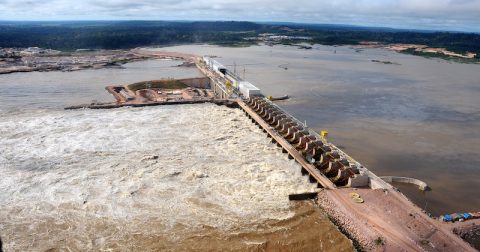
In a major reversal, the World Bank is backing mega dams
Despite opposition, the bank has approved the first of five big dam projects expected to get its support in the coming months -
Countries urged to ramp up “insufficient” nature policies at COP17
A major UN report that will inform biodiversity negotiations in Armenia shows countries have made some progress but are still off track for a landmark goal to protect 30% of land and oceans by 2030





In July, under US pressure, the World Bank scrapped its target for 45% of its finance to go to climate projects. But, with support from a broad majority of countries, it renewed its climate change action plan. The compromise “could have been a lot worse”, E3G climate policy advisor Danny Scull said at the time.
Other multilateral development banks that have the US as a major shareholder, like the Inter-American Development Bank and Asian Development Bank, are now expected to face pressure to scrap their climate finance targets too.
In June 2025, the World Bank ended its ban on support for nuclear power – a move that was welcomed by the US. In his speech on Friday, Banga said the bank would support nuclear retrofits – the modernisation of existing nuclear power stations – alongside the International Atomic Energy Agency, noting that this was “the first such work in 50 years for the bank”.
The post Under US pressure, World Bank says it will back gas “where appropriate” appeared first on Climate Home News.
Under US pressure, World Bank says it will back gas “where appropriate”