Climate Change
UN sets out narrow path back to 1.5C warming after inevitable overshoot
Governments must slash emissions further and faster, and keep every climate promise they have made for the planet to be able to return to 1.5C of warming by the end of the century after an inevitable overshoot, a group of prominent climate scientists has said.
In a flagship new report sketching out a way not to lose the most ambitious Paris Agreement goal, the scientists said that global temperatures need to peak at no higher than 1.8C above pre-industrial levels to give the world “a fighting chance” to reverse course. They added that plans to suck carbon dioxide out of the atmosphere can only play a limited role in this effort and cannot substitute for emissions cuts.
A return to the 1.5C warming limit will only be reached in an optimistic scenario that sees governments turn their full national climate plans – known as NDCs – into reality and meet their additional, more ambitious targets to reach net zero emissions, said the report published by the UN Environment Programme (UNEP).
Actual government policy is far off that track. Current measures to cut emissions that are funded and in force put the world on course for around 2.8C of warming by 2100, UNEP has previously found.
Joeri Rogelj, professor of climate science and policy at Imperial College London and one of the report’s authors, said it is necessary to keep the temperature peak as low as possible as there are limits to how fast the world can reverse global warming.
That is because the scale of carbon dioxide removal (CDR) interventions that can be implemented sustainably and in a just way will otherwise not be sufficient and some measures, such as tree-planting or forest management, will be less effective at higher temperatures, he added.
Commenting on the report, UN Secretary-General António Guterres called for the 1.5C overshoot to be “as small and short as possible”. This, he added, “demands an overshoot of ambition”, involving accelerating the phaseout of fossil fuels and pursuing the renewables revolution, slashing methane pollution, and protecting land, forest and oceans.
“Governments must over-deliver on national climate plans, net-zero commitments, and beyond,” he urged in a video message. “The fight for 1.5 degrees is the fight for humanity.”
Overshoot, peak and decline
The report comes out nearly a year after the UN conceded for the first time that it is inevitable that global warming will exceed 1.5C temporarily and the world should focus on making that overshoot as small and short as possible.
UNEP’s Executive Director Inger Andersen told journalists that 1.5C remains the key goal, but “we now need a different approach from above”, while stepping up efforts to adapt to a warming world.
“A return to 1.5C is not assured,” she added. “But limiting the magnitude, duration and consequences of overshoot, while preserving the possibility of bringing temperatures back down, is the best remaining option to protect vulnerable people, reduce losses and secure a livable future for all.”
Battle over cleaning up shipping set to resume at London talks
Scientists warn in the report that warming above 1.5C should not be seen as safe or acceptable. Climate risks above that threshold intensify with every additional fraction of a degree of warming, they said. The report paints a grim picture of expected climate impacts: glaciers could lose more than a quarter of their remaining mass by 2100 and global food production could fall by as much as 14% by 2050 without effective adaptation.
Some small island developing states and low-lying coastal cities could be partially or completely submerged, while damaged ecosystems could further accelerate climate change.
“This report is a ‘fork in the road’ moment for the planet,” said Surangel Whipps, Jr., president of the Pacific island nation of Palau. “It is a further glimpse into a perilous future that has already arrived. To continue to have a fighting chance, calls for greater ambition are no longer enough – we need to see an urgent and unprecedented increase in political will and investment in a climate-safe future.”
Cut emissions first, remove carbon after
The authors call for a three-phase approach to bringing temperatures back down: an “immediate response” of deep and rapid emissions cuts and urgent protection for the most vulnerable as warming approaches and passes 1.5C; a “coping and containment” phase focused on reaching net-zero emissions and building resilience as temperatures peak; and a “long-term resilience” phase of net-negative emissions through carbon dioxide removal (CDR) and lasting adaptation as temperatures eventually decline.
Richard Betts, who leads climate impact research at the UK Met Office, said CDR is not a “get-out-of-jail-free card” and should only be additional to emission reductions that need to be achieved with “even more urgency than before”.
-
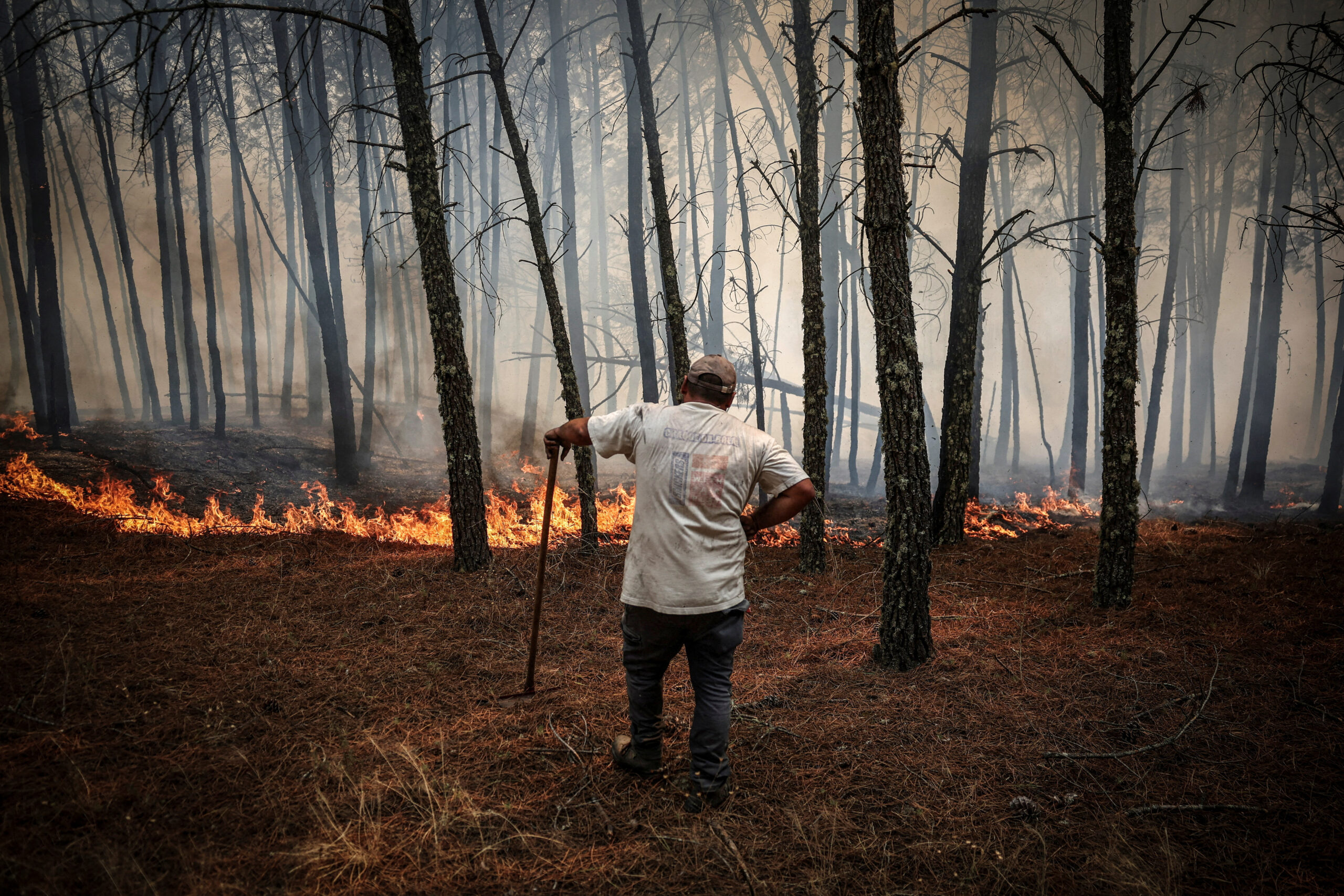
From firefighting to future-proofing: Preventing wildfires must be the priority
While many countries remain locked in a reactive cycle of disaster response, public policy can shift investment upstream to build resilience and cut risks -
Despite African walkout, fractious land COP ends without drought deal
A strong push for a drought protocol by African countries failed in contentious talks, with negotiations postponed for another two years

Critics of CDR have long pointed to the technology’s record of overpromising and underdelivering, and warn it has been exploited by the fossil fuel industry and some oil-producing states to try to delay the clean energy transition.
Not everyone was fully convinced by the UNEP overshoot report. Veteran climate scientist Bill Hare from Climate Analytics said it “does a good job of describing the hole we’ve dug ourselves into” but “a poor job of showing us that there is a way out”. He argued that its thin treatment of the need for a fossil fuel phase-out and ambitious mitigation pathways to cut emissions risk “turning it into a call to apathy rather than a call to arms”.
“Host of challenges” with CDR
Debra Roberts, honorary professor at the University of KwaZulu-Natal in South Africa, told journalists that limiting global warming to around 1.8C is needed to give the world “a realistic and fighting chance” of returning to the 1.5C limit because of the “questionable” feasibility of interventions above that threshold.
CDR comes with “a whole host of challenges”, she added, including the impacts on food and water security of rolling out large-scale programmes and the unanswered questions of whether newer technologies will work at scale and who will foot the bill.
“It’s going to happen in a very, very complex decision-making space where the risks and impacts are dramatically becoming more complex and interrelated,” she said. “That’s why the pressure there is keep those emissions as low as possible because they give us the greatest fighting chance of the return to 1.5C in a more equitable and just way.”
The post UN sets out narrow path back to 1.5C warming after inevitable overshoot appeared first on Climate Home News.
UN sets out narrow path back to 1.5C warming after inevitable overshoot