Climate Change
UK cuts support for climate action abroad to fund military instead

The UK will cut overseas climate spending by more than 10% to fund higher defence budgets, despite agreeing to a global pledge to triple climate finance for developing countries by 2035.
Foreign secretary Yvette Cooper told the British parliament on Thursday that the UK will “aim to spend around £6 billion ($8bn)” on international climate finance over the next three years, covering emissions reductions, adaptation and nature.
This amounts to around £2 billion ($2.66 billion) a year in the next three years, about 13% less than the £2.3 billion ($3.05 billion) a year pledged by the previous Conservative government for the period from 2021-22 to 2025-26.
The move places the UK alongside several other European countries that have recently cut aid budgets, despite a COP29 agreement to mobilise $300 billion a year in climate finance by 2035. In the United States, President Trump has gone further, cancelling most overseas aid programmes, with climate projects among the hardest hit.
The UK cuts were slammed by climate campaigners and some opposition politicians as “brutal”, a “betrayal” of the government’s election promises to be a climate leader, and a failure to recognise that development and climate spending protect the UK’s national security.
The UK will also aim to deliver an additional £6.7 billion ($8.9 billion) in “UK backed climate and nature investments” and to mobilise billions more in private finance, Cooper said. She added that those investments would include measures to help countries to recover when disasters hit, for example, as risk insurance in Jamaica enabled rapid payouts following Hurricane Melissa.
Jamaica set for post-Melissa payout but experts warn of limits to hurricane insurance
Cooper said that the cuts were a “hugely difficult decision” and “not ideological”. But, she added, they were necessary “to deliver the biggest increase in defence spending since the Cold War”.
She reiterated Labour’s commitment to restore development spending to 0.7% of gross national income “when fiscal circumstances allow”, but did not provide a timeline when pressed by an opposition member of parliament (MP). UK aid was reduced from 0.7% to 0.5% by the previous Conservative government in 2021, and is now set to fall further to 0.3%.
Cooper told the sparsely-attended parliament session that “allies such as Germany, France and Sweden have made similar choices” to cut aid to fund defence. The US has also cut almost all of its climate finance.
Cuts open to legal challenge?
These cuts come despite governments agreeing at the COP29 climate summit in 2024 to aim for $300 billion a year of climate finance by 2035, up from the $100 billion a year target for 2025.
Last year, the International Court of Justice advised that developed countries must provide climate finance “in a manner and at a level that allow for the achievement of” the Paris Agreement’s 1.5°C target temperature limit, language that campaigners say could underpin future legal challenges.
Reaction to Cooper’s announcement in parliament was mixed. Scottish National Party MP Chris Law called the aid cuts “the steepest, deepest and most brutal of any G7 country”, even “astonishingly” going further than the Trump administration.
-
Congress rescues aid budget from Trump’s “evisceration” but climate misses out
While the package sidelines dedicated climate programmes, restored funding for nature, agriculture and health could still indirectly support climate action -
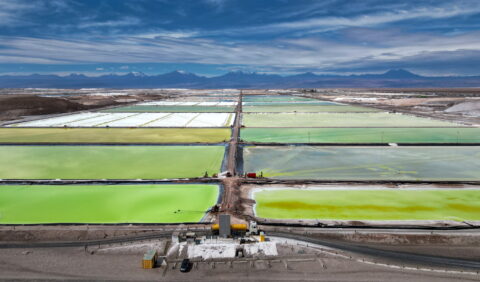
Landmark deal to share Chile’s lithium windfall fractures Indigenous communities
A pioneering accord meant to give Indigenous communities more of a say over lithium mining sites has left the people of the Atacama desert divided like never before



Sarah Champion, an MP from Cooper’s Labour Party but who is not in government, said she had seen a yet-to-be-published equalities impact assessment. These assesments determine how different demographic groups – like women and disabled people – will be affected.
“When that comes into the public domain, we’ll then have the information that we can maybe have an informed debate on”, she said, adding that pitching defence against international development was a “false dichotomy”.
“If you ask any military person, they will tell you the best line of prevention and first defence is our development money,” she added.
Liberal Democrat and Green MPs echoed the argument, describing climate change as a central threat to global and UK security.
Conservative Party development spokesperson Wendy Morton questioned why Cooper had labelled climate change be a priority given “the country faces serious fiscal constraints”.
“Should not our first priority be economic resilience and national security, including global health security?”, she asked.
MPs from Reform UK, which is leading the national polls, did not speak in parliament. But, in November, they proposed cutting the aid budget by about 90% to £1 billion ($1.3bn) a year.
Campaigners slam “betrayal”
Climate campaigners were critical of the government’s cuts. Hannah Bond and Taahra Ghazi, co-CEOs of ActionAid UK, said cuts to climate finance were “a huge betrayal for women and girls on the frontline of the climate crisis”.
Catherine Pettengell, head of Climate Action Network UK, said that “the government promised the UK public in its manifesto to be a climate leader and create a world free from poverty on a liveable planet – but today’s announcements leave those promises entirely unfilled”.
Gareth Redmond-King of the Energy and Climate Intelligence Unit argued the decision runs counter to warnings from security and food system experts.
He added that climate finance is an investment in the UK’s national security given that “we import two-fifths of our food from overseas, and worsening climate change impacts hitting farmers at home and abroad are leading to shortages and higher prices on our supermarket shelves”.
The post UK cuts support for climate action abroad to fund military instead appeared first on Climate Home News.
UK cuts support for climate action abroad to fund military instead