Climate Change
Two to tango: How governments can unlock private investment for national climate goals

Even the most ambitious national climate plans aimed at cutting emissions to meet the 1.5C global warming goal in the Paris Agreement often lack a vital ingredient for success: private investment.
With governments facing fiscal and political pressures, attracting private capital will be crucial for accelerating climate action in the coming years.
Yet many Nationally Determined Contributions (NDCs) still do not have the sector-specific plans, economic incentives, policy certainty, infrastructure investment and ongoing dialogue needed to break silos between the public and private sectors and bring more businesses on board.
“If you just have the high-level (NDC) target from the government in a vacuum, it’s not going to spur much business action,” said Greg Briner, senior manager for policy at the We Mean Business Coalition, which works with companies pushing for stronger climate action.
“But that target combined with … more specific policies and measures that get put in place as a result of that target-implementing process, or as a result of the NDCs, is where the magic starts happening,” he explained.
NDCs: late and inadequate
NDCs are voluntary climate action plans created by countries under the Paris Agreement. They include commitments such as expanding renewable energy, reducing fossil fuels, halting deforestation and other measures to cut greenhouse gas emissions and limit global warming.
First submitted in 2015 for the Paris Agreement, NDCs should be updated with more ambitious targets every five years, although some governments have not stuck to this timetable.
Last year, most countries missed an initial February deadline to finalise the latest round of plans, known as “NDCs 3.0” – and at least 50 countries, mainly developing nations, have still not done so.
Paris Agreement committee snubbed over missing NDC climate plans
Although these national plans have helped drive emissions reductions in some sectors – including falling deforestation rates and greater investments in renewables – climate experts say progress remains far too slow to meet the Paris goals and urgent action is now needed.
Last November, the UN climate body projected that global emissions would fall by around 12% from 2019 levels by 2035, based on a preliminary assessment of new NDCs announced by countries that produce nearly 70% of the world’s greenhouse gases.
The Intergovernmental Panel on Climate Change has said countries should cut emissions far more rapidly, with a 60% drop by 2035 needed to limit global warming to 1.5C.
But for developing economies especially, the multi-billion-dollar costs associated with transitioning to greener energy systems and curbing their emissions are still a major barrier. Climate experts say governments and businesses need to move in step if NDC targets are to be achieved.
“There are positive actions going on but we need a significant ramping up. It’s not happening quickly enough,” said Briner. “It’s (about) building on these foundations that are being put in place.”
Nurturing the conditions for private investment
Last September, consumer goods giant Unilever published a report, entitled Bold Plans, Real Impact, examining how corporate climate transition plans and NDCs can support each other.
Among its recommendations, the report called for governments to provide clearer roadmaps for private-sector engagement. It also highlighted the need for stronger regulatory frameworks, market incentives, sector-specific transition pathways and integrated, economy-wide planning.
For businesses, the report recommended aligning their transition plans with national climate priorities, collaborating more closely with industry peers, strengthening monitoring and verification systems, and unlocking finance through public-private partnerships.
Comment: The missing piece in COP climate talks – market signals for adaptation
A year earlier, the We Mean Business Coalition published a similar report, Time to Deliver: Business Call to Action for Ambitious and Investible NDCs.
This report urged governments – particularly in the G20 economies – to unlock private investment through sectoral targets, clean energy expansion, energy efficiency measures, fossil fuel phase-outs and commitments to halt deforestation.
It also stressed the importance of translating climate targets into concrete policies, backed by national implementation strategies and coordination across ministries.
Another key recommendation was the need for more transparent and inclusive dialogue with businesses throughout the NDC process. Early consultation with companies, the report said, should be embedded into the development and implementation of NDCs to ensure that climate plans reflect commercial realities.
Briner of We Mean Business said the economics of decarbonisation have changed dramatically over the past two decades.
“Ten to 20 years ago, decarbonising and investing in clean energy and electrification was seen as nice-to-have and a more expensive option, but these days, it simply makes business sense,” he said, referring to recent geopolitical events in the Middle East that have roiled oil and gas markets, pushing up fossil fuel prices.
However, upfront costs for clean energy infrastructure remain a major hurdle. Governments therefore need to complement climate policies with investments, concessional loans, grants, subsidies and tax incentives to help reduce risks, Briner added.
“Globally, there are still significant subsidies going to fossil fuels in different forms,” he said. “If we could redirect some of those current incentives away from fossil fuels and into clean electrification and clean energy, then that would certainly help.”
-
The vote that stopped a data center: US communities query resource-hungry AI
Concerns are growing about the high energy, water and land demands of artificial intelligence tech hubs, while benefits for local people remain unclear


Brazil’s sector-specific climate planning
Brazil’s NDC targets include expanding renewable energy – which already accounts for nearly 45% of its energy mix – ending illegal deforestation and reaching net-zero emissions by 2050.
According to Briner, Brazil’s climate strategy – known as Plano Clima – offers an example of how governments can provide businesses with clearer implementation guidance.
Years in development, the initiative sets out how Brazil intends to meet its climate goals through a series of sectoral plans covering areas such as energy, transport and land use.
“They’ve put together some pretty detailed, impressive plans,” Briner said. “Those are the types of things that will influence business models and business decisions. It’s this more detailed second layer of setting out national plans which is of interest to business.”

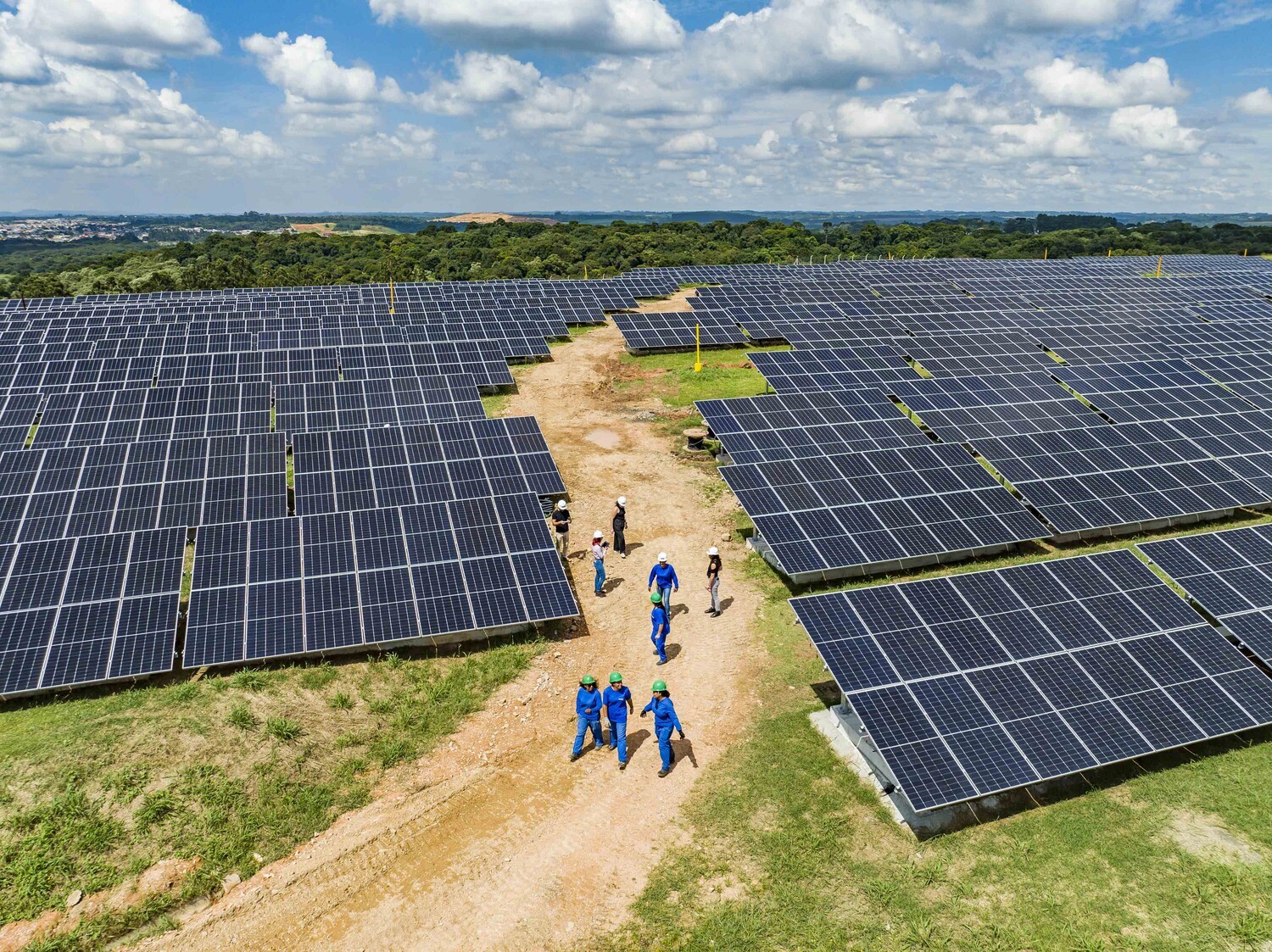
Last year, a transport coalition of more than 50 associations, companies and academia put forward a plan to help reduce the sector’s emissions and attract more than $600 billion in green investments in Brazil.
The previous year, 55 companies operating in Brazil, including Natura, Nestle, Itau and Unilever, called for more ambitious NDCs and clearer implementation policies, as well as encouraging climate-friendly investment and private-sector involvement.
Unilever, for example, has a global goal to create a deforestation-free supply chain and is partnering with a leading supplier in Brazil to ensure that soybean oil used at its factory there is not linked to forest loss.
Cheaper capital, high-quality projects
Although Brazil has relatively sophisticated capital markets, high interest rates still make long-term, low-carbon investments difficult, said Natalie Unterstell, president of the Talanoa Institute, a Brazilian environmental think-tank.
To address this challenge, Brazil is scaling up Fundo Clima – its National Climate Change Fund – as a central part of its implementation strategy by offering cheaper financing at scale.
But Unterstell said the private sector also needs to demonstrate that it can develop and deliver high-quality, low-carbon projects.
“Making Brazil’s policies investable is about making sure cheaper capital meets a pipeline of real, high-quality projects,” she said by email.
Brazilian firm behind SAF plan found growing oil palm on deforested Amazon land
While many companies have announced climate commitments, investment decisions have not always followed, she added.
“What companies can do better is move from targets to investment: adopt robust transition plans, and integrate carbon risk into core financial decisions,” Unterstell said.
On the government side, the priority is to “fix the signals”, she added. That means ensuring Brazil’s regulated carbon market – which is due to start in 2027 for sectors including iron and steel, cement, and oil and gas – operates with clear rules, credible enforcement and no delays, while aligning public finance with climate goals and providing long-term policy certainty.
“At the moment, both sides are waiting for stronger signals from the other, hence breaking that co-ordination problem is key,” she said.
Indonesia’s challenge: bridging the finance gap
Like Brazil, Indonesia is home to large areas of rainforest, but its energy mix relies far more heavily on fossil fuels, with coal providing about a third of supply. In its NDCs, Indonesia has pledged to reduce emissions by 31.9% by 2030 compared with business-as-usual levels, or by 43.2% with international support, on the way to reaching net zero by 2060.
Yet despite being promised more than $20 billion in international financial support from donor governments and investors under its Just Energy Transition Partnership, Jakarta has decided to row back on a plan to close a key coal power station early, saying it will focus on shuttering older and dirtier plants first.
To attract private investment to help achieve its emissions goals, Indonesia must provide policy clarity and long-term certainty, said Fabby Tumiwa, executive director of the Institute for Essential Services Reform, an Indonesian think-tank.
Comment: Indonesia’s failing Just Energy Transition Partnership is a cautionary tale
“Any investor wants to understand the long-term risks of the country so that they can assess the risks properly and come up with a risk mitigation strategy. Uncertain policies basically make investors unable to mitigate the risks,” Tumiwa told Climate Home News.
“To make Indonesia’s climate policies investable for the private sector, the core task is to convert climate ambition into bankable, enforceable, risk-adjusted projects,” he said. “Investors do not only need targets; they need predictable revenue, credible off-takers, permits, grid access, currency-risk management and policy durability.”
Indonesia has estimated the investment needed to meet its NDC goals at more than $400 billion but has yet to clearly outline how businesses can directly contribute, said Egi Suarga, senior manager for climate at World Resources Institute Indonesia, a research organisation.
He said climate action should be framed as an investment opportunity rather than an economic burden.
Evolving policies and regulations
Over 100 Indonesian companies have adopted net-zero and are ready to ramp up decarbonisation given clear national guidance, according to the We Mean Business Coalition.
Indonesia’s Indika Energy is making heavy investments in renewable energy such as solar, while cement company Solusi Bangun Indonesia is also investing in cleaner energy, fuel efficiency and pushing better biodiversity management.
Meanwhile, Unilever’s climate transition plan states that the company is working with local government and environmental NGOs in Indonesia to protect and restore forests in Aceh and North Sumatra. It is also switching from natural gas to biomethane at its Indonesian sites.


One positive development, Suarga noted, is the creation of carbon pricing regulations aimed at attracting private finance, with an initial focus on the forestry sector.
“It can create a good climate for investors,” he said. “It doesn’t directly mention that this is for achieving the NDCs but there is no trade-off between development financing with environmental protections – so that’s a good start.”
Indonesia also needs stronger incentives and regulations for renewable energy, he added.
“We also have to think about other sectors now – like the energy sector and renewables,” Suarga said. “How can the government provide more incentives or facilitating regulations that can be more profitable to create a level playing field for renewables and fossil fuels?”
Ambition loop to drive action
Like Tumiwa, Suarga stressed the need for greater dialogue between the government and businesses so companies can understand better how they can contribute to Indonesia’s emissions targets.
“They know about sustainability because of the market and demands of the market… [but] I’m not sure whether [they] really understand about Indonesia’s target to achieve a certain amount of emissions reductions in the NDCs,” he said.
Currently, the government and private sector are largely working separately, Suarga added. The challenge lies in bringing them together to set targets, plan implementation and monitor emissions reductions. “It will need two to tango. The government should engage more with the private sector,” he emphasised.
Big banks’ lending to coal backers undermines Indonesia’s green plans
For the We Mean Business Coalition’s Briner, what is ultimately needed is an “ambition loop” in which businesses lead on emissions reductions while governments create policies that accelerate private-sector action.
“It really helps governments when they have a strong voice from business calling for policy action. It helps move things forward,” he said.
Without stronger policies and incentives, achieving NDC goals will become increasingly difficult to achieve and costly, experts say.
“It’s really a case of all hands-on deck right now,” Briner said. “We need all sides of this equation working together and trying to get this done because there isn’t an alternative.”
The post Two to tango: How governments can unlock private investment for national climate goals appeared first on Climate Home News.
Two to tango: How governments can unlock private investment for national climate goals