Ocean Acidification
The Biodiversity Data Gap We Rarely Talk About

When I attended the OBIS Data Mobilization Workshop in the Azores (Thanks to the Air Center) this year, one observation immediately caught my attention: compared with countries such as the United States, Europe still appears surprisingly fragmented and underinvested in biodiversity data mobilization. The issue is not necessarily a lack of biodiversity research. European scientists produce enormous amounts of ecological data. The challenge is that publishing biodiversity observations into global infrastructures such as MBON/GBIF often remains an additional task rather than an integral part of funded research. In the United States, biodiversity data publication is frequently embedded in funding mechanisms and institutional mandates. Data management, curation, and dissemination seem to be recognized research activities. In much of Europe, including Denmark, researchers often mobilize data on top of their existing responsibilities, with limited dedicated funding for long-term stewardship.
I asked myself how is Denmark performing compared with its Nordic and neighboring countries?
Denmark is not lagging behind, but neither is it leading
The numbers reveal a mixed picture.
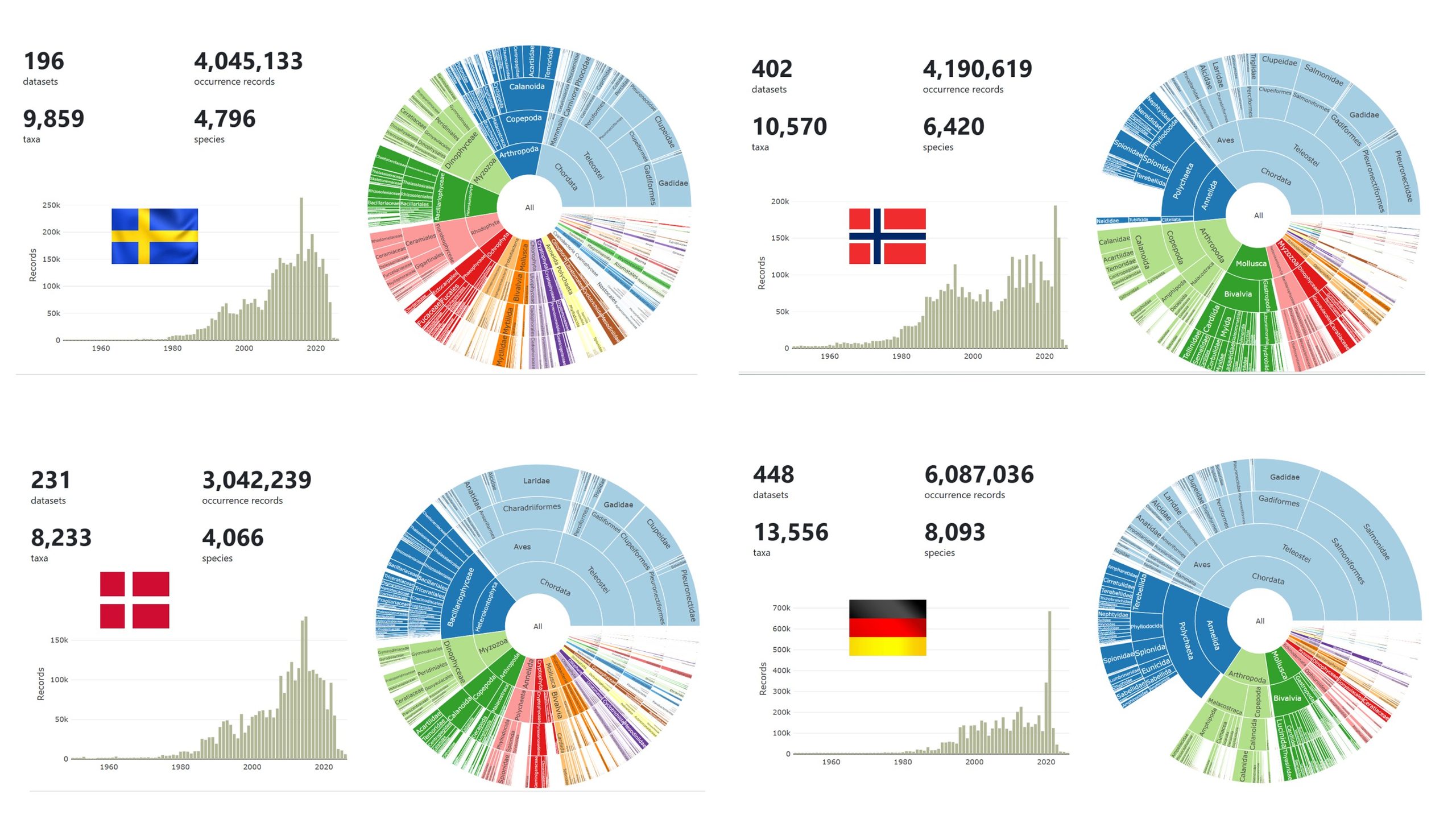
Germany clearly stands out as the regional leader, with both the highest number of datasets and the highest taxonomic coverage. Denmark has the lowest number of occurrence records and species represented among the four countries, despite having a very active biodiversity research community. What is striking is that Denmark does not fall dramatically behind in dataset numbers. Rather, the difference appears in scale and breadth. Danish datasets tend to contain fewer records and cover fewer taxa than those from Germany, Norway, and Sweden.
Different countries tell different biodiversity stories
The taxonomic breakdowns are equally revealing. Denmark should appreciate its fish and birds’ activists. Large portions of the records belong to Gadidae (cod family), Clupeidae (herring family), Laridae (gulls), and other marine vertebrates. This reflects Denmark’s historical strengths in fisheries monitoring, marine ecology, and seabird observations. However, many invertebrate groups, microorganisms, and less visible components of biodiversity remain comparatively underrepresented in global data sets despite active programs like national Program like MONIS.
Norway shows stronger contributions from invertebrate sides such as polychaetes, bivalves, copepods, and marine benthic fauna. The Norwegian data landscape appears heavily influenced by aquaculture sectores, long-term marine monitoring programs and offshore environmental surveys. There is greater representation of marine invertebrates, which are often critical indicators of ecosystem change.
What stood out in Sweden’s data profile is the relatively large contribution from copepods, diatoms, dinoflagellates, and macroalgae. These groups are often overlooked in biodiversity databases because they require specialized expertise and monitoring programs. Sweden’s contribution suggests sustained investment in aquatic ecosystem monitoring beyond commercially important species. Well done Sweden!
Germany’s profile appears the most diverse. While fish and vertebrates remain important, there are strong contributions from polychaete worms, molluscs, arthropods, plankton in general term and benthic organisms. Germany not only contributes more records but also appears to mobilize a wider variety of biodiversity data types. You made me proud Germany 

The real gap may be invisible biodiversity
One lesson from the workshop was that biodiversity databases often reflect what is easiest to observe, identify, and fund. Fish, birds, and mammals are well represented almost everywhere. The groups that drive ecosystem processes, such as jellyfish, zooplankton, benthic invertebrates, phytoplankton, and microbial communities, remain far less visible. This is particularly relevant for marine ecosystems. Some of the most important ecological changes currently occurring in our seas involve gelatinous zooplankton, plankton communities, and benthic assemblages, yet these groups remain underrepresented in many biodiversity repositories. For someone working with jellyfish and marine food webs, this raises an important question:
Are we documenting the biodiversity that is easiest to count, or the biodiversity that is most important for understanding ecosystem change?