Carbon Footprint
Tesla Tests Driverless Robotaxis in Austin While Analysts Predict 1 Million by 2035 Growth, Sending Stocks Up


Tesla (TSLA) is making big progress in testing driverless robotaxis on public roads and attracting attention from analysts and investors. The company started testing its self-driving cars in Austin, Texas, on December 15. No human safety monitor was on board. This was a milestone that Tesla’s leaders said would happen by year’s end. This shift represents a key part of the EV giant’s long‑term strategy for autonomous vehicles and future mobility services.
At the same time, Wall Street firms, including Morgan Stanley, are issuing forecasts about Tesla’s robotaxi plans and their potential impact on the company’s future. Analysts calculate the scale of robotaxi fleets and potential valuation effects over the next decade.
These changes have kept Tesla’s stock in the spotlight for investors and the market, even with challenges in electric vehicle sales growth.
Driverless Robotaxis Hit Austin Streets
Tesla (TSLA stock) began testing its self-driving cars on public roads in Austin, Texas. There were no human drivers or safety monitors in the front seats. CEO Elon Musk confirmed that fully driverless tests are happening. He sees this as an important step toward commercial operation.
Earlier in 2025, Tesla had already launched a limited robotaxi service in Austin using modified Model Y vehicles. Initially, these vehicles included a human safety monitor in the passenger seat to observe system performance.
Over the months, Tesla grew its service area and fleet size. By December 2025, reports showed about 31 active robotaxis operating in the city.
Recent tests without monitors show progress. However, they are still for internal validation, not for daily commercial use. Tesla confirmed that tests aren’t open to paying customers yet. The company hasn’t provided a specific date for when fully autonomous rides will be available to the public.
The Technology Behind Tesla’s Autonomous Effort
Tesla’s autonomous driving push relies on its Full Self‑Driving (FSD) software and onboard sensors. The FSD system can manage various driving situations. It uses cameras, radar inputs, and neural network processing. This differs from some competitors that rely on additional sensors such as LiDAR for redundancy.
In June 2025, Tesla shared its Q2 tech update. The company boosted AI training by adding tens of thousands of GPUs at its Gigafactory in Texas. This expansion supports improvements in FSD, where the company reported its first autonomous delivery. A Model Y drove itself without human help for 30 minutes.
Vehicles with FSD software need regulatory approval to drive on their own. In the Austin pilot, removing physical safety monitors marks progress toward that goal. Achieving fully reliable, unsupervised autonomy is still a challenge. This is true, especially when it comes to safety standards and different road conditions.
- SEE MORE on TESLA:
- Tesla Rolls Out Full Self-Driving (FSD) in Australia & New Zealand: What Drivers and Investors Need to Know
- TSLA Stock Slides After Tesla Unveils ‘Affordable’ Model Y and Model 3 — Investor Confidence Wavers
- Tesla (TSLA Stock) Sparks $2.1B Samsung Battery Deal as Global EV Demand Charges Ahead
Wall Street Eyes Tesla’s Robotaxi Potential, Sending Stock Near Record Highs
Tesla’s autonomous ambitions are closely watched by financial analysts. Morgan Stanley just shared forecasts that say Tesla could greatly grow its robotaxi presence in the next 10 years.
The bank says Tesla might have 1 million robotaxis on the road by 2035. These will operate in various cities as part of its autonomous fleet plan.
Morgan Stanley’s analysis sees active robotaxi units growing in 2026. However, the first fleets will be small compared to the long-term plan. The forecasts show the possible size of the autonomous vehicle market. They also highlight Tesla’s role in this growth. However, there are uncertainties tied to technology and regulations.
Stock markets have reacted to these developments. Tesla’s stock price nearly hit record highs. It rose almost 5% during trading sessions. Investors were excited about progress in driverless testing and the promise of future autonomous revenue. Analysts say Tesla’s value might go up more if its autonomous services and AI products perform well.


Tesla’s Vision for Autonomous Mobility Services
Tesla’s robotaxi initiative fits into its broader vision of mobility services and artificial intelligence (AI)‑driven transport. The company plans to launch purpose-built autonomous vehicles, like the Cybercab. These vehicles won’t have traditional controls, such as steering wheels or pedals. They aim for mass production in April 2026.
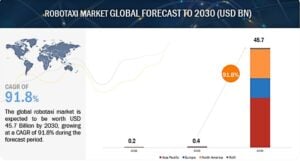
Tesla sees a future where owners can add their cars to a decentralized robotaxi network. This could boost fleet availability and usage. This strategy could shift parts of Tesla’s revenue profile away from vehicle sales toward recurring service revenues if adopted at scale. The global robotaxi market could reach over $45 billion in 2030, as shown below.

Analysts say that major technical, regulatory, and safety issues still stand in the way of robotaxis operating widely and making a profit. Building public trust, meeting varied local regulations, and demonstrating consistent safety across different road environments will be key factors in future deployment.
Tesla vs Competitors and Safety Regulations
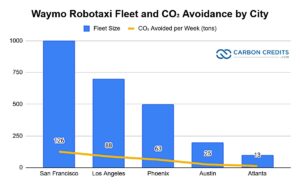
Tesla is not alone in the autonomous vehicle race. Other companies, such as Alphabet’s Waymo, owned by Alphabet, have been operating fully autonomous services in multiple cities for several years and continue to expand.
The company operates about 2,500 robotaxis across multiple cities. Waymo has logged millions of paid autonomous rides and already meets higher autonomy standards in some regions. In comparison, Tesla operates around 31 robotaxis in Austin, with plans to expand to several major U.S. cities by 2026.

Tesla chose camera-centric sensors over multi-sensor arrays. This decision shows their focus on scalability and cost. Critics and some experts argue that adding LiDAR or other sensors could improve safety and performance under challenging conditions.
Regulators also play an important role. In some states, pilot autonomously driven services are permitted under special testing allowances. Widespread commercial use needs approval from both state and federal agencies. This ensures that vehicles meet safety and operational standards.
What’s Next for Tesla’s Driverless Fleets
Tesla’s move to test robotaxis without onboard safety monitors in Austin marks a clear technical milestone, though it is not yet a commercial service. The company’s next steps will likely focus on scaling test fleets, improving software robustness, and navigating regulatory approvals to allow expanded operations in other cities in 2026 and beyond.
Morgan Stanley and other analysts think robotaxis might play a big role in Tesla’s growth. They could boost service revenue as traditional vehicle sales slow down. However, forecasts at this stage remain based on long‑range assumptions about adoption, pricing, and regulatory landscapes.
Investor sentiment has been mixed. Stock movements show excitement about tech advances but also worry about short-term vehicle sales and profit pressures in the auto industry.
Overall, Tesla’s autonomous ambitions continue to shape its corporate strategy and public profile. The speed of robotaxi rollout, along with improvements in Full Self-Driving software and AI, will be key to seeing if the company can shift from an EV maker to a driverless mobility platform.
The post Tesla Tests Driverless Robotaxis in Austin While Analysts Predict 1 Million by 2035 Growth, Sending Stocks Up appeared first on Carbon Credits.