Carbon Footprint
SMRs Set for Breakout: Global Nuclear Capacity Forecast to Jump Nearly Sixfold by 2030

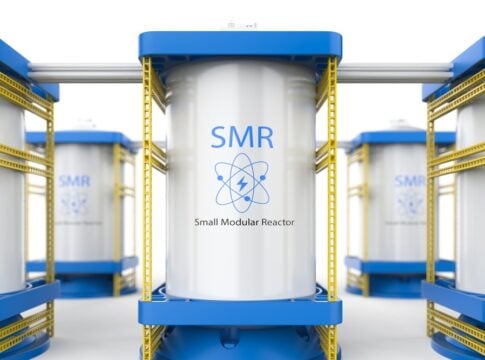

Small modular reactors (SMRs) are moving from concept to commercial reality. A new forecast from GlobalData suggests global SMR capacity could increase nearly sixfold between 2025 and 2030.
The projection reflects rising confidence in advanced nuclear technology as countries search for reliable, low-carbon electricity. This demand is being driven by electrification, artificial intelligence (AI), data center growth, and industrial decarbonization.
For years, SMRs were seen as a long-term idea. That view is now shifting. Governments are updating nuclear policies. Regulators are speeding up licensing reviews. Utilities are forming partnerships with technology developers.
At the same time, electricity demand is rising sharply, strengthening the case for firm power sources capable of operating 24/7. This momentum comes as countries try to meet net-zero targets while also ensuring stable and affordable energy supplies.
Why SMRs Are Gaining Momentum
SMRs are nuclear reactors that typically produce up to 300 megawatts (MW) of electricity per unit. Unlike large nuclear plants, they are designed to be built in factories and assembled on site.
Supporters say this modular approach can reduce construction time, improve cost control, and make deployment more flexible. SMRs can also be added in phases, depending on demand growth.
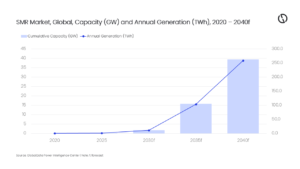
GlobalData’s forecast reflects a wider revival in nuclear energy. The firm expects global nuclear capacity to grow steadily over the next decade, by almost sixfold from 2025 to 2030. That increase could even reach a hundredfold by 2040. Cleaner energy goals, policy backing, and increasing demand for stable baseload electricity will support this growth.

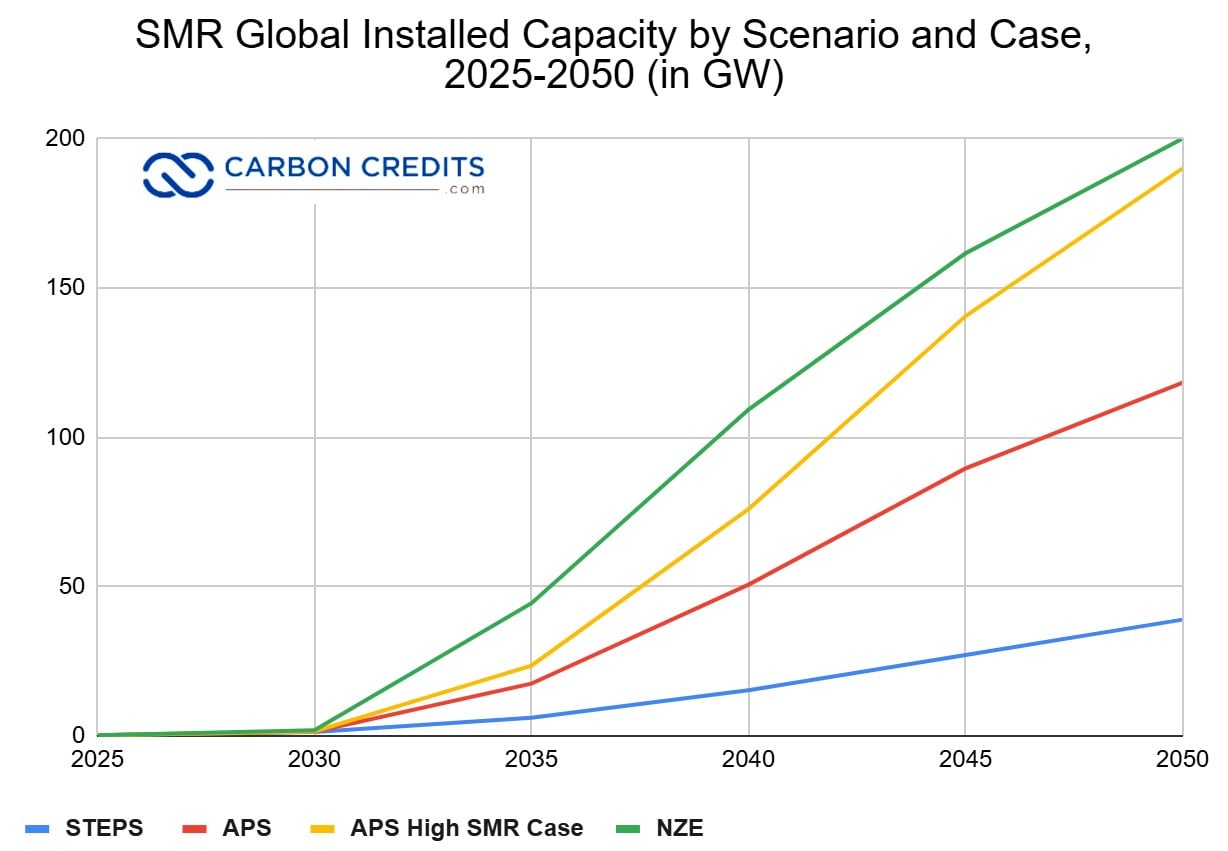
The International Energy Agency (IEA) also expects strong long-term growth. In its Announced Pledges Scenario, the IEA predicts over 1,000 SMRs to be used worldwide by 2050. This would add up to about 120 gigawatts (GW) of capacity. It also estimates SMR investment could rise from about $5 billion today to more than $25 billion by 2030.

Meanwhile, major SMR projects are moving forward. GE Hitachi’s BWRX-300 design will be used at Ontario Power Generation’s Darlington site in Canada. This is one of the most advanced SMR projects currently in planning.
Holtec International is also advancing plans to install SMR-300 reactors at the Palisades site in Michigan. The company has outlined a long-term vision that could scale SMR capacity across North America to as much as 10 GW in the coming decades.
These early projects are important. They will test cost, speed, and performance. Their results will help determine how quickly SMRs can scale globally.
Nuclear Power’s Quiet Climate Comeback
As countries move toward net-zero targets, nuclear energy is receiving renewed attention as a low-emissions power source.
According to the IEA, nuclear is the world’s second-largest source of low-emissions electricity after hydropower. In 2024, more than 410 reactors in over 30 countries supplied about 9% of global electricity. Nuclear also generated more low-carbon electricity than wind and significantly more than solar.
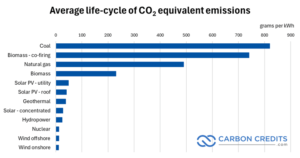

- Since 1971, nuclear power has helped avoid roughly 72 gigatonnes of carbon dioxide emissions by reducing reliance on fossil fuels.
This climate contribution is becoming more important as electricity demand rises and countries retire coal plants. The IEA expects global nuclear generation to reach a record high in 2025, supported by reactor restarts in Japan, maintenance work in France, and new builds in Asia.
More than 60 reactors are currently under construction worldwide, adding over 70 GW of new capacity.
SMRs could strengthen this role further. Their smaller size makes them suitable for regions where large nuclear plants are not practical. They may also replace aging coal plants by using existing grid infrastructure.


In addition, SMRs are being considered for industrial uses such as hydrogen production, mining, and heavy manufacturing, where steady heat and power are required.
Big Tech and Data Centers Drive New Power Demand
One of the strongest drivers for SMR growth is the rapid expansion of artificial intelligence and data centers. AI systems require large amounts of electricity. Training and operating these systems depend on high-performance computing infrastructure that runs continuously. This is pushing electricity demand higher in key technology hubs.
Goldman Sachs has raised its forecast for AI-related capital spending by major hyperscalers. The bank now expects Meta, Microsoft, Amazon, and Alphabet to invest about $5.3 trillion between 2025 and 2030, up from a previous estimate of $4.5 trillion. A large share of this spending will go into AI infrastructure, data centers, and supporting energy systems.
Moreover, Goldman Sachs Research estimates global data center electricity demand could increase by as much as 165% by 2030 compared with 2023 levels.
This surge in demand is changing energy planning. While renewable energy remains central to corporate climate strategies, many technology companies are also looking for stable, round-the-clock power sources.
SMRs are increasingly viewed as a potential solution because they can provide constant power without weather dependence. Unlike wind or solar, nuclear plants can operate day and night continuously. This reliability is becoming more important as AI workloads grow and grids face higher stress.
As a result, several SMR developers are now targeting data center operators as future customers, alongside traditional utilities.
The First Wave of SMR Projects Breaks Ground
The SMR industry is now entering a more practical phase, with several flagship projects moving toward construction and deployment.
In Canada, Ontario Power Generation is advancing the first commercial deployment of GE Hitachi’s BWRX-300 reactor at the Darlington site. This project is widely seen as a key test case for SMR commercialization in North America.
In the United States, TerraPower continues development of its Natrium reactor in Wyoming. The project, backed by Bill Gates, combines nuclear generation with advanced energy storage. This design aims to improve flexibility and help balance electricity grids with growing renewable energy penetration.
These developments mark an important shift. The industry is moving beyond design and licensing discussions and into construction, financing, and real-world deployment.
The Roadblocks on the Nuclear Revival Path
Despite strong momentum, SMRs still face major challenges.
- Cost remains the most important issue. Early projects must prove that factory-based construction can reliably reduce total costs compared with traditional nuclear plants.


- Regulatory approval is another barrier. Even though licensing frameworks are improving, nuclear projects still require long review timelines in most countries.
- Fuel supply is also a concern. Many advanced SMR designs depend on high-assay low-enriched uranium (HALEU), but global supply chains are still limited.
- There are also broader concerns around nuclear waste management and public acceptance, which continue to influence project timelines in several regions.
These challenges explain why some analysts remain cautious about near-term deployment, even while long-term forecasts are becoming more positive.
Outlook: A Defining Decade for SMRs
The next five years could be decisive for SMRs. Global momentum is being driven by several overlapping trends. Electricity demand is rising. AI growth is accelerating. Countries are committing to net-zero targets. Energy security has become a national priority. At the same time, nuclear technology is improving.
GlobalData’s forecast of a nearly sixfold increase in SMR capacity by 2030 reflects growing confidence that the sector is approaching commercial scale.
While SMRs are still in the early stages of deployment, progress in Canada, the United States, China, and other regions suggests the industry is moving closer to wider adoption.
If current projects succeed, SMRs could become an important part of the global low-carbon energy mix. They may help support grid stability, reduce reliance on fossil fuels, and provide the steady power needed for a more electrified and digital economy.
The post SMRs Set for Breakout: Global Nuclear Capacity Forecast to Jump Nearly Sixfold by 2030 appeared first on Carbon Credits.