Climate Change
Q&A: What is in China’s new five-year plan for climate change?
China has released a five-year plan dedicated to addressing climate change.
The 15th five-year plan for a national response to climate change is the latest in a series to outline in-depth climate and energy targets for the 2026-2030 period.
These include five-year plans for “building a Beautiful China”, developing a “new-type energy system” and developing renewable energy.
There are also separate “action plans” for the 2026-2030 period, such as for peaking carbon emissions.
China has pledged to peak its emissions before 2030 and reach carbon neutrality before 2060.
The new plan does not include any major new targets, instead consolidating and reaffirming existing policies.
Nevertheless, it includes significant signals on key policy areas, such as non-carbon dioxide (CO2) greenhouse gases, global climate governance and carbon markets.
Below, Carbon Brief examines some of the notable elements in the latest five-year plan and what it reveals about China’s policy direction through to 2030.
What does the climate plan cover?
The Ministry of Ecology and Environment (MEE) released the plan in late July, in unison with 18 other government departments. These include the National Development and Reform Commission (NDRC), China’s top economic planning agency, and the National Energy Administration.
The document covers a range of topics, including CO2 emissions, other greenhouse gases (non-CO2 GHGs), carbon markets, carbon footprints, climate adaptation and international cooperation on climate change.
For the first time at the five-year plan level, the plan creates a comprehensive target system covering all areas of climate policy, say officials in a MEE Q&A.
They describe it as “the main policy instrument” for advancing China’s climate action during 2026-2030.
China rarely issues high-level multi-year policies dedicated to “responding to climate change”. In 2014, the NDRC published a plan on the topic running through to 2020, but this was not linked to a five-year plan period.
Qin Yan, principal analyst at ClearBlue Markets, tells Carbon Brief that the plan shows that China’s climate governance has reached “an unprecedented strategic level”.
She adds that the plan creates an “all-encompassing target system” to support China’s Paris Agreement climate pledges for 2030 and 2035.
In its 2030 pledge, China aimed to peak emissions “before 2030” and reduce carbon intensity – its emissions per unit of GDP – by more than 65% from 2005 levels.
Last year, president Xi Jinping personally announced China’s 2035 pledge to cut China’s greenhouse gas emissions to 7-10% below peak levels by 2035, while “striving to do better”.
The five-year plan marks a new phase in China’s climate policy, according to researchers at CIB Research, an economic research body affiliated with the Industrial Bank, whose largest shareholder is the Fujian provincial government.
Their analysis adds that the plan represents a broad effort to strengthen China’s climate-governance system, implementation mechanisms and underlying capacity.
Nevertheless, several headline targets and policies in the document simply reiterate already established plans.
These include:
- Cutting carbon intensity by 17% across the five years
- Reducing carbon intensity per product in industries under China’s carbon market by 3%
- Substituting fossil fuels with renewables
- Strengthening climate adaptation
- Supporting the “free flow” of cleantech
What does the plan say about non-CO2 GHGs?
The plan also goes into detail on China’s approach to non-CO2 GHGs. This includes reaffirming a target of an emissions “reduction capacity” from these gases totalling 30m tonnes of CO2 equivalent (MtCO2e) by 2030, although the baseline is unclear.
The target previously appeared in the overarching five-year plan, as well as the plan for building a “Beautiful China”.
The goal refers to emissions reductions, which can be realised through implementing current non-CO2 emissions reduction policies and projects, says Chen Meian, programme director and senior analyst at the Institute for Global Decarbonization Progress (iGDP).
She adds that it is “relatively achievable”, with sources including increasing the number of coal-mine methane utilisation projects.
She points to an MEE explanatory note for a draft methodology under the China Certified Emission Reduction (CCER) scheme, China’s voluntary carbon-credit market. Chen says the note suggests that projects using ventilation air methane and coal-mine methane with concentrations below 8% alone could deliver around 20MtCO2e of reduction by 2030.
The note states that, currently, such projects are estimated to be able to “generate annual emission reductions of approximately 4.5MtCO2e”.
In addition, Chen says, measures targeting industrial nitrous oxide (N2O) and hydrofluorocarbons (HFCs) could help make up the remainder needed to meet the target.
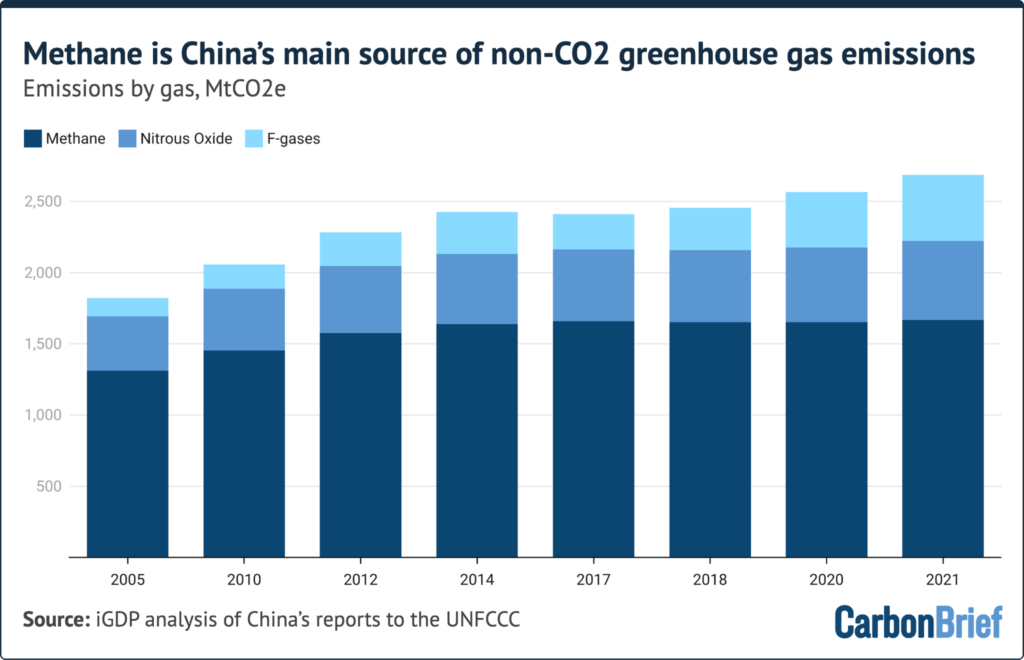
According to iGDP analysis of biennial reports submitted by China to the UNFCCC, China emitted around 14,000MtCO2e of GHGs in 2021, excluding land use, land-use change and forestry (LULUCF).
Non-CO2 GHGs accounted for around 2,700MtCO2e, or 19%, of the total, the majority of which was methane, as shown in the figure below.

China’s plans to curb these super-pollutants in the five-year period include coal-mine methane utilisation projects, end-of-pipe destruction technologies for HFCs and guidance on the use of catalysts to reduce N2O emissions.
The plan also calls for the recovery and replacement of sulphur hexafluoride (SF6) in power equipment.
For Chen, the plan’s focus on SF6 control is particularly noteworthy. She says the gas is “finally receiving policy attention” and that proactive action is “timely and will help avoid future emissions growth” as China’s power system expands.
What does the plan say about global climate governance?
One of the plan’s clearest objectives for international cooperation is for China to play a more active role in global climate governance.
By 2030, it says China should markedly increase its “influence, guiding power, shaping power and moral appeal” in this area.
It says China’s climate action could also feed into the Global Governance Initiative, a policy initiative aimed at reforming the global governance system.
China will also aim to “build a new narrative on climate governance”, it adds.
Prof Thomas Hale, a professor in public policy at the University of Oxford’s Blavatnik School of Government, writes on LinkedIn that the plan “marks a major rhetorical shift” towards China being increasingly willing to “lead and shape” global climate action.
Another clear focal point for international cooperation is in carbon markets.
The plan calls for China to expand the global influence of its carbon market, such as through international rule-setting, cooperation on standards and by hosting the China Carbon Market Conference.
Qin says China’s more active role in global carbon pricing is already evident in the launch of the open coalition on compliance carbon markets with the EU and Brazil. This coalition is expected to adopt a work plan at the China Carbon Market Conference in September.
Qin also notes that China “could become the world’s largest [carbon] offset buyer” as its energy transition progresses.
The country would, therefore, “benefit from helping shape global rules under the Article 6 framework [for carbon trading under the Paris Agreement]”, she adds.
Related

Interview: Dr Sun Yixian on his new database tracking Chinese climate ‘leadership’
Q&A: What do China’s provincial five-year plans say about climate and energy?
Analysis: China’s new carbon metric leaves Germany-sized gap in its emissions
Q&A: China’s leadership calls for ‘strict control’ of fossil fuels
The post Q&A: What is in China’s new five-year plan for climate change? appeared first on Carbon Brief.
Q&A: What is in China’s new five-year plan for climate change?