Climate Change
Q&A: How UK’s seventh carbon budget will deliver ‘£865bn’ in economic benefits
The Labour government wants to cut UK greenhouse gas emissions to 87% below 1990 levels by 2040, which it says will deliver £865bn in economic benefits.
The target has been set out in draft legislation for the seventh “carbon budget”, a legally binding limit on emissions during the five-year period from 2038-2042.
The government says this would protect billpayers from “fossil-fuel shocks”, boost energy security, improve quality of life and help tackle climate change, by getting the country on track for net-zero by 2050.
The UK would need to invest around £880bn over 25 years to meet the budget, but doing so would yield benefits worth £1,620bn, according to a government impact assessment.
Pointedly, the government presents these benefits and costs relative to a policy of “no net-zero”, as the opposition Conservatives and hard-right Reform UK have both pledged to abandon the 2050 goal.
The 137-page impact assessment mentions energy security more than 30 times and says the seventh carbon budget would help save £445bn up to 2050 from ever decreasing fossil-fuel imports.
Moreover, the assessment is based on fossil-fuel price projections published in 2024, before the cost of oil and gas surged earlier this year after the effective closure of the strait of Hormuz.
The document says that the UK’s climate goals would be even more beneficial – worth £1,035bn, relative to “no net-zero” – if the country is exposed to “persistently high fossil-fuel prices”.
The seventh carbon budget must be approved by parliament before the end of June and the government must then publish a plan to meet it “as soon as reasonably practicable”.
What is the UK’s seventh ‘carbon budget’?
The UK’s efforts to tackle and respond to global warming are governed by the Climate Change Act, which was passed with near-unanimous cross-party support in 2008, by 463 votes to five.
In 2019, the then-Conservative government amended the Act to set a long-term goal for cutting emissions to 100% below 1990 levels by 2050, known as the net-zero target.
(The Intergovernmental Panel on Climate Change (IPCC) has affirmed that reaching net-zero is the only way to stop global warming from getting worse – and that emissions would need to reach net-zero by 2050 globally to have a chance of limiting the rise in temperatures to 1.5C.)
To stay on track for the 2050 target, the act requires the government to set a series of “carbon budgets”. These are binding limits on the UK’s emissions covering successive five-year periods.
The UK met its first three carbon budgets, covering 2008-2022. It is currently just over half way through the fourth “carbon budget”, covering 2023-2027.
Under the act, the government is required to set the level of the seventh carbon budget, covering 2038-2042, by the end of June this year.
Before setting the budget, the government must take advice from the Climate Change Committee (CCC). In turn, this advice must take into account a range of factors, including the latest scientific evidence, technological trends, the state of the economy and public finances.
No government has ever gone against the advice of the CCC when setting carbon budgets. However, the government could have chosen not to do so, if it had explained why.
What target is the government aiming for?
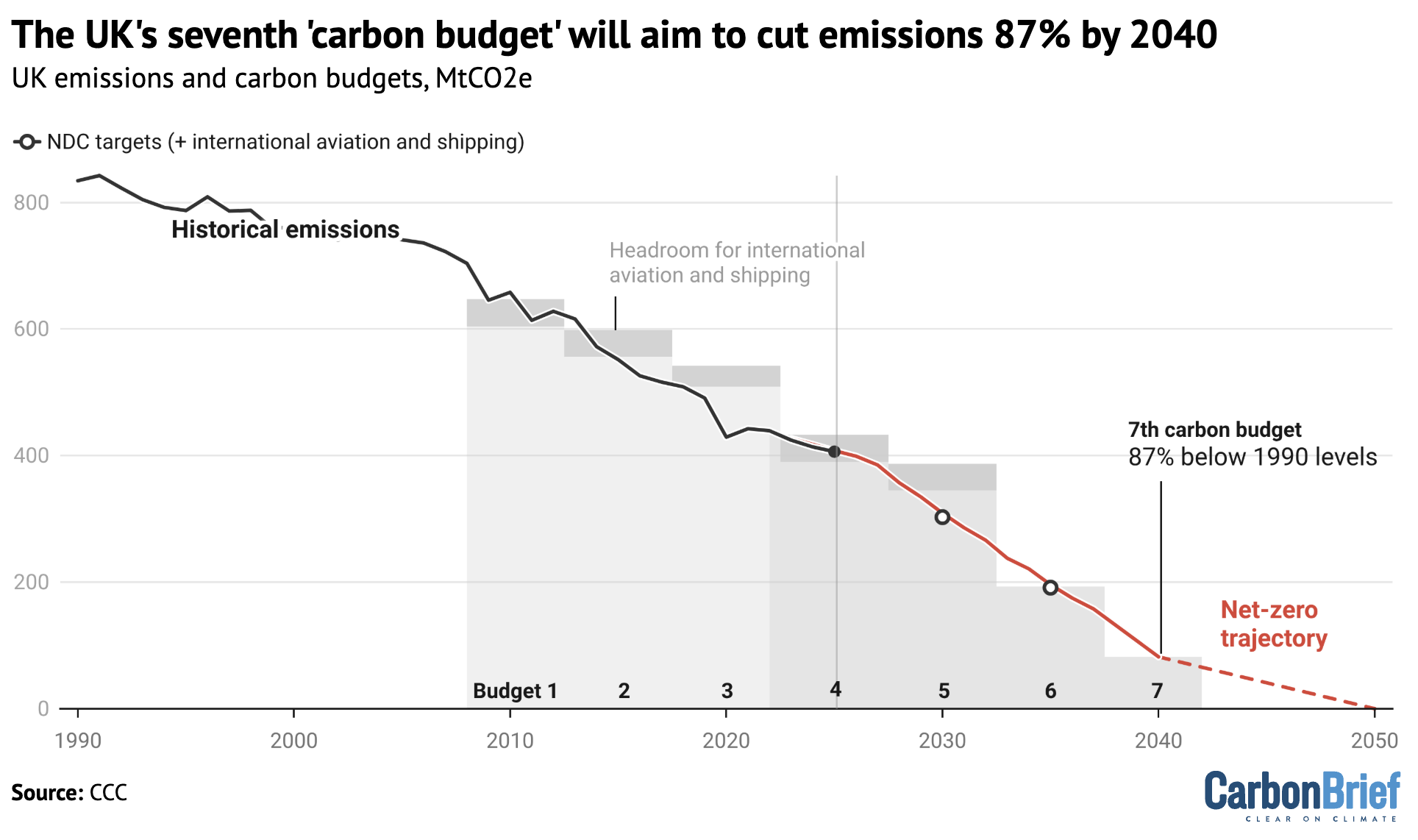
The CCC recommended last year that the UK should aim to cut its emissions to 87% below 1990 levels under the seventh carbon budget for 2038-2042 – equivalent to a three-quarters reduction on current levels.
The government has followed this advice, setting a draft seventh carbon budget of 535m tonnes of carbon dioxide equivalent (MtCO2e), some 107MtCO2e per year.
The proposed 2040 target is shown in the figure below, alongside previously legislated budgets and the UK’s international climate pledges for 2030 and 2035 under the Paris Agreement.

In a written statement to parliament, energy secretary Ed Miliband said the target would reduce the UK’s exposure to “volatile international fossil-fuel markets and protect bill-payers”, as well as delivering benefits for jobs, growth, health and the natural environment. Miliband wrote:
“Against the backdrop of heightened geopolitical instability, including the ongoing crisis in the Middle East and its implications for global energy markets, the case for setting a clear and credible long-term pathway for the UK on clean energy and climate action is stronger than ever.”
Echoing a 2023 review commissioned by the then-Conservative government, Miliband also wrote that “clean energy and climate action is the economic opportunity of the 21st century”.
(On the day of the draft budget, the Guardian reported findings that the UK’s “net-zero economy” was worth “more than £100bn a year”, according to consultancy CBI Economics.)
The impact assessment sets out the climate-change “case for action”. It says the “science is clear” that the UK is becoming wetter and warmer, with increasing floods, droughts, heatwaves and wildfires. This is “unequivocally” due to human-caused greenhouse gas emissions. It continues:
“Without action, climate change will continue to endanger the UK’s food and water security, exacerbate global population displacement and pose national security risks.”
The document adds that the Office for Budget Responsibility (OBR) found the “costs of climate damage are getting higher, while the cost of the net-zero transition is getting lower”.
In its impact assessment, the government also outlines a less ambitious goal to cut emissions to 83% below 1990 levels by 2040 and a tighter target for 89%.
In what may be an attempt to pre-empt future legal challenges (see: What happens next?), the government outlines why it is not choosing to pursue either greater or lesser ambition for 2040.
It says the low end of ambition “increases the risk of underinvestment”, while the highest target could face “deliverability risks [that] may undermine [the UK’s] credibility”.
Note that the sixth and seventh budgets were set in line with the net-zero target, whereas previous budgets were set on a pathway to 80% by 2050 – hence, the step change in the figure above.
The sixth and later carbon budgets include the UK’s share of emissions from international aviation and shipping. These emissions relate to journeys that start or finish at UK ports and airports. Draft legislation to make this change was laid in parliament earlier this year.
The UK’s legally binding climate goals do not include the “imported” emissions associated with the production of goods and services in other countries. Among other reasons, this is because the UK does not have legal jurisdiction over activities taking place outside its borders.
The UK’s imported emissions were growing until around 2008, but have remained relatively flat since then. This means that the UK’s overall “carbon footprint”, including imported emissions, has been falling by a similar amount as the territorial emissions within its own borders.
How could the UK meet the seventh carbon budget?
To date, UK emissions cuts have largely come from the power sector, as the country has stopped burning coal to generate electricity and shifted from gas towards clean power.
In order to meet the seventh carbon budget, the UK will need to cut emissions across the economy. According to the CCC’s advice, the biggest contributions would come from electrifying transport, heat and industry, driven by a massively expanded supply of clean electricity.
It said at the time of its advice:
“In many key areas, the best way forward is now clear. Electrification and low-carbon electricity supply make up the largest share of emissions reductions in our pathway.”
This would mean shifting to electric vehicles (EVs), electric heat pumps and electrified industrial processes on a massive scale, reducing the need for fossil fuels.
Since electrified technologies are far more efficient than those based on fossil-fuel combustion, this shift would also dramatically cut the need for oil and gas imports, the CCC said.
In broad terms, the government backs a similar path to cutting UK emissions through mass electrification. In its release on the seventh carbon budget, it says:
“Half of the UK’s recessions since 1970 have been caused by fossil-fuel shocks. The government is investing in renewable and nuclear energy to get the UK off the rollercoaster of fossil-fuel prices…By 2050, the UK could cut its reliance on fossil fuels from around three quarters of our energy today to around 15%, while avoiding around £445bn in fossil-fuel spending over the next 25 years.”
In its “delivery plan” for the sixth carbon budget, covering 2033-2037, it said roughly a third of UK homes should have heat pumps by 2035 and around half of cars on the road should be EVs.
There is one key difference between the CCC’s suggested approach to meeting the UK’s carbon budgets and that of the government. Specifically, the CCC suggested there would be an important role for behaviour change in relation to diets and efforts to limit the rise in the number of flights.
In contrast, the government has placed much less emphasis on these areas. This means that it relies to a greater extent on expensive technologies that can remove CO2 from the atmosphere.
Despite this context, some right-leaning newspapers have misleadingly focused their coverage on the perceived need to alter diets to meet the seventh carbon budget.
What are the benefits and costs of reaching this target?
The government says that the proposed seventh carbon budget would “deliver the benefits of clean energy and climate action for jobs and growth, health and our natural environment”, as well as aligning with the 1.5C target of the Paris Agreement to “avoid climate disaster”.
Overall, it says that the net-zero target for 2050 “continues to represent value for money, with strong net benefits relative to alternative pathways”.
The detailed impact assessment sets out the benefits and costs of meeting the proposed seventh carbon budget in monetary terms, in line with Treasury guidance under the “green book”.
The results are presented in terms of “net present value” (NPV). This takes into account the human preference for enjoying benefits today, rather than in the future. When measuring NPV, future costs and benefits are “discounted”, to reflect their lower value in the present moment.
Specifically, meeting the proposed seventh carbon budget would have net benefits worth £865bn to the UK, relative to a world where the net-zero target is abandoned and existing technology continues to be used. For example, in this “no net-zero” alternative, gas boilers and petrol cars would be replaced like-for-like when they reach the end of their life.
It says that a lower bill for fossil fuels is a “major component” of the net benefits, with savings reaching £445bn over 25 years if the seventh carbon budget is met, relative to “no net-zero”.
The “vast majority” of these savings result from electrification – in other words, swapping those boilers and petrol cars for heat pumps and EVs.
However, the largest benefit of the proposed budget comes from avoided climate-change damages, which amount to £1,495bn over 25 years, according to the document. This benefit relates to lower UK emissions limiting climate impacts, such as extreme heat and flooding.
The government also acknowledges that significant investments would be required to meet the seventh carbon budget. It puts the cost of these investments at £880bn over 25 years, including financing, relative to the alternative of “no net-zero”.
These benefits and costs of the proposed budget are shown in the figure below. In aggregate, these add up to the headline net benefits of £865bn over 25 years.
In addition to the “no net-zero” baseline, the impact assessment compares the proposed budget with a continuation of current policies. The results are directionally similar to, but slightly lower than, the net benefits relative to “no net-zero”.
The document also considers a range of “sensitivities” to explore the impact of higher or lower technology costs and fossil-fuel prices, as well as to consider alternative pathways that use less carbon capture and storage (CCS), fewer EVs or a reduced number of heat pumps.
Finally, the impact assessment also considers the ongoing benefits and costs of meeting the seventh carbon budget when looking out to 2060.
This roughly doubles the net benefits of meeting the target from £865bn by 2050 to £1,520bn by 2060, because the upfront investments yield ongoing savings, such as lower fossil-fuel bills.
Notably, the impact assessment is based on fossil-fuel price projections published in 2024, when the average cost of wholesale gas was around 80p per therm.
These projections envisaged gas prices of 75p/therm in 2025, falling to 70p by 2030. A “high” case, explored in the impact assessment, had prices of up to around 110p/therm.
In reality, prices climbed to around 85p/therm in 2025 and gas is currently trading at 115p, having reached as high as 150p/therm in the immediate aftermath of the US-Israel attack on Iran in February. This was still well below the 640p peak seen during the global energy crisis in 2022.
In the “high” case for fossil-fuel prices – in which prices are below current levels – the net benefit of the seventh carbon budget climbs to £1,035bn over 25 years.
The impact assessment does not consider the potential for “feedback and system loops, which have potential to decrease costs faster than estimated”.
What happens next?
Under the Climate Change Act, there is a deadline of 30 June 2026 to legislate for the seventh carbon budget, subject to parliamentary approval.
In setting out the draft target, the UK government has already taken into account the views of the devolved administrations for Scotland, Wales and Northern Ireland. The impact assessment notes that none of them had made “representations” on the level of the seventh carbon budget.
The draft carbon budget legislation is subject to the “affirmative procedure”, which means it must be debated and voted through by both houses of parliament.
For the sixth carbon budget, which was legislated under the then-Conservative government in 2021, this vote took place during the “committee stage”.
The government statement says that its delivery plan for the sixth carbon budget, published in October 2025, will “drive substantial abatement into the carbon budget seven period”. It adds:
“These policies will continue to deliver the bulk of emissions savings needed for carbon budget seven. This provides a strong and credible starting point…reducing delivery risk and giving confidence that the transition can be delivered in an affordable and manageable way.”
Specifically, the impact assessment says that the existing CB6 delivery plan “would get the UK to 84% emissions reduction” by 2040, only just shy of the proposed 87% target.
The government commits to publishing a new delivery plan for the seventh carbon budget “as soon as reasonably practical”, in line with the wording with the Climate Change Act. It says:
“This statutory sequencing recognises the time needed to develop and agree an ambitious and robust package of policies to deliver the target.”
The impact assessment notes that the delivery plan will determine how the UK meets the seventh carbon budget, as well as the implications for different regions and sectors of the UK economy.
Two earlier delivery plans, published by previous Conservative governments, were subject to successful legal challenge in the High Court. These cases, brought by groups including Friends of the Earth and ClientEarth, resulted in the latest delivery plan, published last October.
A separate group, calling itself “Carbon Reckoning”, is attempting to crowdfund a fresh legal challenge to the government’s plans for the seventh carbon budget. In late May 2026, it wrote to Miliband arguing that the 87% by 2040 target “fails to comply with international obligations”.
The post Q&A: How UK’s seventh carbon budget will deliver ‘£865bn’ in economic benefits appeared first on Carbon Brief.
Q&A: How UK’s seventh carbon budget will deliver ‘£865bn’ in economic benefits