Climate Change
Power play: Can a defensive Europe stick with decarbonisation in Davos?
Tsvetelina Kuzmanova is EU sustainable finance lead for the University of Cambridge Institute for Sustainability Leadership (CISL), based in Brussels.
Europe is set to arrive in Davos on the defensive after a year of trade uncertainty and tariff threats from the Trump administration, as well as pressure to roll back core elements of the EU’s Green Deal. The war in Ukraine and situation in Greenland also continue to test Europe’s security and strategic cohesion.
While Trump’s administration is “coming in force” to the World Economic Forum in the Swiss ski resort of Davos with the largest-ever US delegation, Europe is not showing up in a strong position or as a shaper of the global agenda. Instead, it has become reactive to other global powers.
Amid the pressure, it is crucial that the EU maintains its ambitions on energy security and decarbonisation, both against headwinds at Davos and by continuing to uphold the energy transition. This is not about climate leadership alone, but a question of power and independence. Maintaining the energy transition is central to reducing geopolitical exposure, limiting external leverage and preserving Europe’s ability to act strategically, including in negotiations on the next EU budget.
-
Roadmaps and Colombia conference aim to shift fossil fuel transition into higher gear
In 2026, global dialogues will chart a path to shift away from fossil fuels without harming workers or financial systems, experts told Climate Home -
Ahead of Davos, climate drops down global elite’s list of pressing concerns
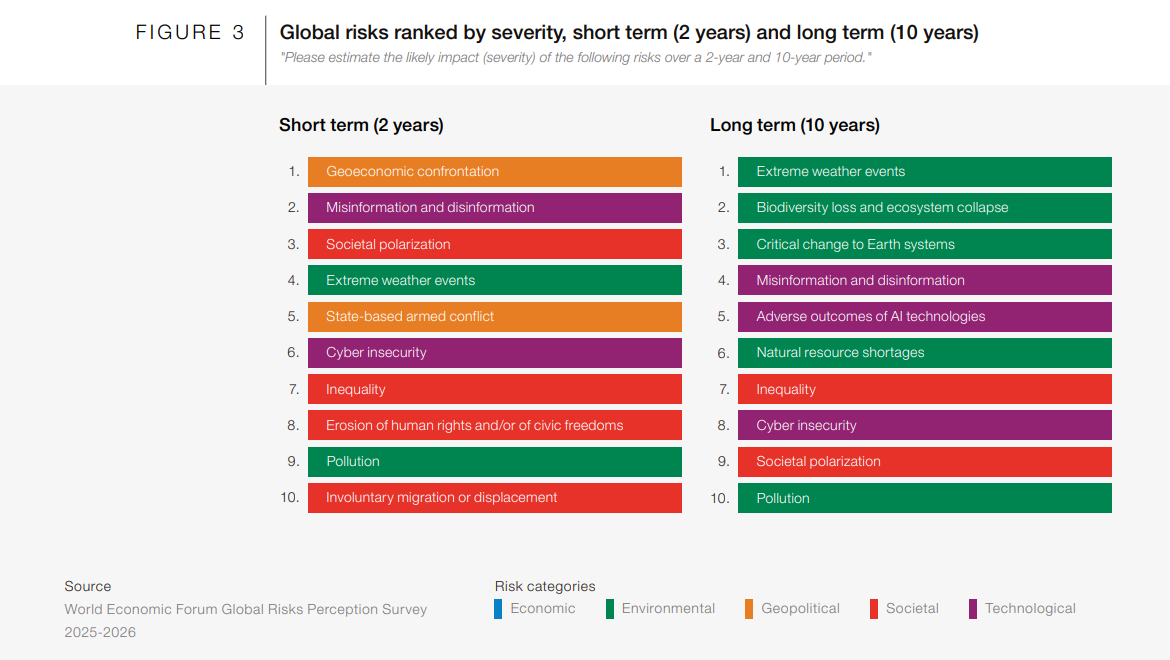
In the short term, leading business people, academics and politicians are more worried about geoeconomic confrontation than extreme weather -
At ‘Davos of mining’, Saudi Arabia shapes new narrative on minerals
Over 100 countries attended the Future Minerals Forum in Riyadh, putting the Kingdom at the heart of discussions on minerals for the energy transition





Over the past year, debates in Europe have increasingly framed climate ambition as a liability to competitiveness. Green policies have been softened, delayed or revised in the name of industrial survival.
Yet global leaders identify climate-driven disruption as the most likely defining risk of the 2030s. Looking a decade into the future, climate collapse and extreme weather dominate the risk landscape, according to the World Economic Forum’s newly published Global Risks Report 2026 . Economic downturn, by contrast, sits far lower on the list at 24.

Near-term risks for Europe
Even setting aside the risk of climate change, Europe’s vulnerabilities are painfully concrete in the short-term: energy remains a pressure point, trade is increasingly weaponised, supply chains are exposed, and geopolitical leverage continues to be exercised through fossil fuel supplies.
If recent history taught Europe anything, it should have been that such dependency directly threatens economic prosperity, as was seen during the 2022 energy crisis.
Oil and gas remain central to geopolitical arm-twisting, including supply threats, price manipulation or diplomatic pressure – for example, the US and Qatar telling the European Union that its corporate sustainability due diligence directive threatens LNG supplies to the bloc.
Strategic spending or strategic drift
In this context, the EU budget is a geopolitical choice as much as a fiscal exercise. It will run until 2034, meaning it overlaps almost exactly with when long-term risks will become tomorrow’s reality and frame Europe’s place on the global stage for almost a decade.
Choices will have to be made as public money is scarce and there is no chance of further joint European debt. The question is whether Europe uses its limited fiscal firepower to preserve the status quo or to address its vulnerabilities and the long-term economic risks.
This is where electrification, grids, incentivising cleantech and greening Europe’s heavy industry come in. These shouldn’t be viewed just as climate projects, but as instruments of strategic autonomy.
Governments defend clean energy transition as US snubs renewables agency
Other economies are already doing this. China will spend 4 trillion yuan ($574 billion) by 2030 in electricity grid infrastructure, treating transmission and system balancing as core national assets.
Even under the Trump administration, the US has continued to scale up grid investment. Last year, it recorded the highest level of grid spending globally, at around $115 billion, accounting for roughly a quarter of total worldwide investment. A significant share of this has been driven by federal funding for grid modernisation and transmission expansion, explicitly linking energy infrastructure to industrial competitiveness and security.
Meanwhile, Europe estimates that it needs close to €600 billion in grid investment by 2030, yet annual spending remains fragmented across national systems and constrained by permitting and financing bottlenecks. This comparison underscores why the next Multiannual Financial Framework (the EU budget) must prioritise strategic public spending on grids, electrification and related infrastructure.
Bolstering competitiveness with electricity
Despite the narrative being pushed by the US in forums like Davos, industrial electrification, system flexibility and cleantech scale-up are prerequisites for a competitive industry in a decarbonising world.
Electrification is critical to reducing vulnerability to fossil fuel imports and grids are essential to do this at scale. This shift would also reduce Europe’s exposure to the very risks flagged by the World Economic Forum, from climate-driven instability to energy and supply-chain shocks, turning vulnerability into strategic resilience.
This is a textbook case for mission-oriented public investment – not picking individual corporate winners but backing system-level capabilities that markets will not support enough despite their strategic importance.
Q&A: “False” climate solutions help keep fossil fuel firms in business
In today’s global economy, power flows from control over infrastructure, energy systems and industrial capacity. Without the underlying investment, even the most sophisticated regulatory frameworks risk becoming aspirational.
And, if Europe does not decisively shift towards investing in electrification, grids and industrial transformation, it will remain exposed to pressure tactics, with oil and gas supplies shaping Europe’s future and making it reactive rather than proactive at meetings like Davos.
Any talk of resilience, competitiveness and strategic autonomy at Davos will be hollow if Europe is unable to match it with spending decisions that address future risks and drive ahead with decarbonisation.
The post Power play: Can a defensive Europe stick with decarbonisation in Davos? appeared first on Climate Home News.
Power play: Can a defensive Europe stick with decarbonisation in Davos?