Carbon Footprint
Nvidia’s $2B Bet in AI: Powering Innovation with Nebius and Palantir While Tackling Energy Impact


Artificial intelligence (AI) is changing many industries. NVIDIA, the company that designs the chips and systems that power large AI models and data centers, leads in AI technology and hardware.
The big tech company made headlines with major news about its AI investments and partnerships with Nebius and Palantir Technologies. These moves have implications for environmental sustainability, energy use, and greenhouse gas emissions.
NVIDIA’s $2B Nebius Investment Fuels AI Cloud Expansion
NVIDIA announced it will invest $2 billion in Nebius, a cloud infrastructure company. This investment aims to support AI cloud expansion and data center capacity.
NVIDIA will take an 8.3% stake in Nebius through this investment. The cloud provider plans to build AI data centers with more than 5 gigawatts of capacity by 2030. This capacity is roughly enough power for over 4 million U.S. homes.
The partnership includes early access to NVIDIA’s compute hardware and software. The companies will work together on large‑scale AI computing clusters. Nebius also received approval to build a 1.2 gigawatt data center campus in Missouri, U.S.
Nvidia (NVDA) stock saw a modest increase, while Nebius Group (NBIS) shares soared over 16% following the announcement of the investment. The deal drove significant investor confidence in Nebius.




What This Means for Energy and Emissions
AI data centers use a lot of electricity. They power powerful chips and run complex models. Building larger infrastructure without considering energy efficiency can raise carbon emissions.
But NVIDIA’s hardware and software often aim to improve performance per watt. Improved efficiency means less energy per unit of computation. Better energy use can reduce running costs and overall emissions at scale.
At CES 2026, NVIDIA unveiled its Rubin architecture for data center GPUs, claiming 40% higher energy efficiency per watt over the prior generation. Unlike single chips, Rubin unites six specialized chips into a rack-level system, slashing power for massive AI workloads while boosting speed. This advances NVIDIA’s “Green AI” for sustainable data centers.


Still, expanding data center capacity will add to total energy demand. For this reason, it is important that such expansions use low‑carbon electricity sources such as wind, solar, and hydropower.
Operational AI with Palantir: Smarter Workflows, Lower Emissions
NVIDIA and Palantir Technologies announced a collaboration to build an integrated operational AI technology stack. This stack combines the chipmaker’s accelerated computing and AI software with Palantir’s data intelligence platform.
Justin Boitano, vice president, Enterprise AI Platforms, NVIDIA, said:
“AI is redefining the infrastructure stack — demanding, latency-sensitive and data-sovereign environments require a full-stack architecture — built from silicon to systems to software. By combining Palantir’s sovereign AI OS reference architecture with NVIDIA AI infrastructure, industries and nations can turn data into intelligence with speed, efficiency, and trust.”
NVIDIA CEO Jensen Huang also noted that ‘Palantir and NVIDIA share a vision: to put AI into action, turning enterprise data into decision intelligence.’ The partnership was highlighted at NVIDIA’s GTC Washington, D.C. event.
This technology helps businesses and governments use AI to manage data and decision intelligence. It allows complex data from supply chains, logistics, and operations to feed into AI systems, which can make real‑time decisions and improve efficiency.
For example, systems built on this stack can automate workflows, optimize routes, and predict supply needs. Logistics and supply processes often involve fuel use and emissions. AI tools that help optimize these processes can help companies reduce waste and energy use.
This partnership also includes integration of NVIDIA’s AI models and tools into the Palantir platform. The combined stack supports automation and digital decision making for complex operations.
AI’s Role in Net‑Zero and Emission Reductions
AI technology has potential benefits for climate and environmental goals. AI can help sectors in many ways, such as:
- Energy systems planning: AI can optimize grid load, match supply and demand, and reduce waste.
- Industrial operations: AI can monitor and adjust machinery to cut fuel use and emissions.
- Transportation and logistics: AI routing tools can lower fuel consumption and emissions.
- Building efficiency: Smart systems can reduce energy use in heating or cooling.
These applications show that AI can support net‑zero goals across industries.
In particular, using operational AI to improve logistics and supply chains can help companies reduce emissions. AI tools can analyze traffic, weather, and delivery patterns in real time. They can recommend routes that use less fuel and avoid delays. AI can also reduce idle time for trucks, ships, and warehouse equipment.
Logistics is a major source of emissions. According to the International Energy Agency, transport accounted for about 23% of global energy-related CO₂ emissions in recent years. Freight transport alone produces roughly 40% of transport emissions.

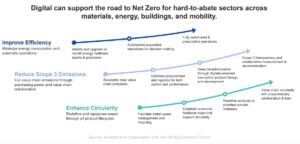
AI optimization can lower these emissions. Research from the World Economic Forum shows that digital technologies such as AI, data platforms, and automation could cut logistics emissions by up to 10–15% by 2030. These tools improve route planning, fleet efficiency, and cargo utilization.
Industry studies show similar results. McKinsey & Company estimates that AI-based route optimization can reduce fuel use in logistics fleets by about 5–10%. Even small gains can matter at scale. For example, a large delivery fleet that burns 100 million liters of fuel per year could save 5–10 million liters annually using smarter routing systems.

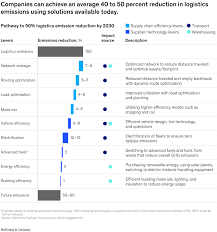
These estimates help explain why companies are investing in operational AI platforms. When applied across supply chains, AI can help businesses lower fuel use, reduce emissions, and improve efficiency at the same time.
NVIDIA’s technology, including high‑performance GPUs, optimized software, and AI models, can be part of these solutions. By improving performance per watt and enabling energy‑aware workflows, the tech giant contributes to both the growth of AI and the efficiency of systems that use it.
AI for Efficiency and Sustainability
Artificial intelligence has a dual climate role:
- AI systems can be energy‑intensive and add to electricity demand.
- AI tools can also help optimize energy use in other sectors.
AI computing infrastructure continues to expand. More powerful chips and larger data centers mean higher energy use. Research shows that data center energy demand could nearly double by 2030 due to AI workloads alone. AI servers and cooling systems are energy‑intensive, and they also use significant water resources.


However, efficiency improvements and smarter energy use can reduce emissions. New hardware designs, better cooling technologies, and renewable power integration can lower the environmental footprint of AI computing.
Major cloud providers and AI infrastructure firms, including NVIDIA partners, are investing in energy‑efficient systems. This includes technologies that cut power demand and reduce heat waste.
NVIDIA’s push for next‑generation hardware, such as chips designed to improve energy efficiency per computation, helps support these goals. GPUs and AI accelerators that do more work with less energy can have a positive impact on total energy use over time.
Conclusion: Balancing Growth and Sustainability
NVIDIA’s recent news shows the company’s strategy at the center of AI growth. Its $2 billion investment in Nebius will help expand AI cloud infrastructure. The collaboration with Palantir aims to bring AI tools into complex enterprise operations.
At the same time, AI infrastructure carries environmental challenges. Data centers and high‑performance computing need vast energy. But the deployment of more efficient hardware, smarter software, and renewable energy integration can reduce this impact.
NVIDIA’s technologies, when used to improve energy use and emissions management, can help companies work toward net‑zero targets. As AI continues to grow, balancing innovation with sustainability will remain essential.
The post Nvidia’s $2B Bet in AI: Powering Innovation with Nebius and Palantir While Tackling Energy Impact appeared first on Carbon Credits.