Carbon Footprint
NVIDIA Controls 92% of the GPU Market in 2025 and Reveals Next Gen AI Supercomputer


NVIDIA (NVDA Stock) closed 2025 with a huge portion of the GPU market. Research data shows that the company held about 92 percent of the discrete graphics processing unit (GPU) market in the first half of 2025. This figure covers add-in boards used in personal computers and workstations. Its closest rivals, including AMD and Intel, held much smaller shares.
The company unveiled its new Rubin data center chips. They claim these chips are 40% more energy efficient per watt. This change aims to make artificial intelligence (AI) computing more sustainable.
NVIDIA’s GPUs dominated the sector used for gaming and AI. Despite challenges with its latest Blackwell GPU launch, the company’s lead remained strong. This article explains how Nvidia maintained this market position. It also explains how the company is tackling environmental and energy issues in its products and operations.
How NVIDIA Came to Control the Majority of the GPU Market
NVIDIA’s market share for discrete GPUs reached about 92% in early 2025, according to analysts tracking GPU shipments. This dominance was especially clear in desktop graphics cards. Competing firms such as AMD held much smaller portions, with AMD’s share closer to 8% and Intel below 1% in the same period.


Discrete GPUs are separate from CPUs and are the main components used for high-end graphics and data-intensive tasks. NVIDIA’s rise in market share reflects strong demand for its GeForce and AI-oriented GPU lines. Many industries, from gaming to data centers, use Nvidia chips because of their computing performance.
Despite this strong market position, the rollout of the Blackwell series of GPUs faced setbacks in 2025. Industry reports noted delays and production issues related to complex design and manufacturing steps. These issues slowed initial deliveries to customers. Company leadership said the problems were fixed, but they still affected how quickly new units reached buyers.
Why Energy Use and Efficiency are Significant for GPUs
Graphics processing units are energy-intensive components. AI and data center workloads consume substantial electricity. Because of this, environmental, social, and governance (ESG) concerns are now central to technology markets.

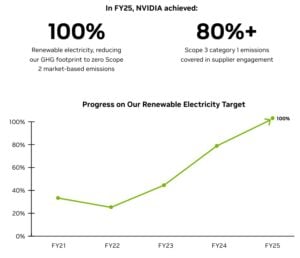
NVIDIA acknowledges the need to improve energy efficiency and reduce emissions. The sustainability report for fiscal year 2025 shows that the company uses 100% renewable electricity for its offices and data centers. This means all the electricity Nvidia buys for those facilities comes from renewable sources, such as wind or solar.
- In product design, NVIDIA promotes energy efficiency as a key measure of sustainability.
At CES 2026, NVIDIA unveiled its new Rubin architecture for data center GPUs. The company claims the chips deliver 40% higher energy efficiency per watt compared to the previous generation.
Unlike a single chip, Rubin combines six specialized chips that work together as one unified system. This rack-level design helps handle large AI workloads more efficiently, reducing power use while boosting speed. The new platform allows large AI data centers to operate more sustainably, making it a notable step in Nvidia’s push toward “Green AI.”
Jensen Huang, founder and CEO of NVIDIA, said:
“Rubin arrives at exactly the right moment, as AI computing demand for both training and inference is going through the roof. With our annual cadence of delivering a new generation of AI supercomputers — and extreme codesign across six new chips — Rubin takes a giant leap toward the next frontier of AI.”


Key components of the Rubin platform include:
- Vera CPU – a multi-core processor that manages data flow to keep GPUs busy.
- Rubin GPU – the main AI processor with next-generation compute engines and high-speed memory.
- NVLink 6 & ConnectX‑9 – fast interconnects for rapid communication between chips.
- BlueField‑4 DPU & Spectrum‑6 switch – manage networking, security, and data traffic efficiently.
This improvement tackles worries about increased power use in AI tasks. It also helps lower emissions from data center operations. Industry leaders, including Microsoft and Google, quickly endorsed the efficiency gains.
NVIDIA has set internal goals to cut emissions and to align reductions with widely accepted climate science targets. It works with many suppliers, especially those linked to its Scope 3 emissions. This helps encourage them to adopt science-based emissions goals.


NVIDIA’s ESG Progress Under Growing Scrutiny
Investors and customers now place greater focus on ESG performance. Environmental criteria include energy consumption, emissions, and resource use. Nvidia sits among tech companies that increasingly report sustainability metrics.
In fiscal 2025, NVIDIA reported progress on its environmental goals. This includes using more renewable energy and improving efficiency. These efforts do not yet translate directly into a formal net-zero emissions commitment for all scopes of greenhouse gases.
- SEE MORE: NVIDIA Posts Over $46B Revenue in Q2 But Stock Slides, Balancing Record Profits with Green Goals
However, they reflect measurable progress. The company’s renewable energy targets and supplier engagement aim to reduce its emissions footprint over time.


At the same time, critics highlight areas where NVIDIA’s broader impact remains unclear. Some assessments say large chipmakers need to improve supply chain emissions. They should also adopt more energy-efficient production methods. These factors are part of an ongoing discussion among investors and sustainability groups.
Using renewable electricity, improving energy efficiency in products, and tackling supplier emissions are key steps. They help NVIDIA reduce direct and indirect climate impacts from its operations. As AI and high-performance computing grow, these sustainability efforts may shape long-term industry standards.
AI Demand, Competition, and the Future of GPUs
NVIDIA’s strong market position affects the tech and semiconductor industries in many ways. The GPU sector supports not only gaming but also AI, cloud computing, scientific research, and automated systems.
NVIDIA is not just a leader in desktop GPUs. Analysts say its influence also covers AI accelerators in data centers. The company holds over 80% of the AI hardware market. This success relies heavily on its architecture and software ecosystem.
The Rubin architecture strengthens NVIDIA’s competitive position in AI hardware. The new 40% better energy efficiency attracts hyperscalers and large enterprises that want high performance without high power use. Analysts believe this may strengthen Nvidia’s lead in AI accelerators. It also helps address ESG concerns about energy use.
Elon Musk, founder and CEO of xAI, remarked:
“NVIDIA Rubin will be a rocket engine for AI. If you want to train and deploy frontier models at scale, this is the infrastructure you use — and Rubin will remind the world that NVIDIA is the gold standard.”
In data centers, NVIDIA reported strong revenue growth driven by demand for AI computing. Blackwell and other GPU families contributed heavily to this trend.
However, the company relies on third-party manufacturing and complex supply chains. This means production challenges can affect future performance. Continued competition from AMD and other firms may also reshape market share over time.
The strong demand for AI processing power has energy and environmental implications beyond NVIDIA alone. Data centers worldwide are expected to grow in electrical demand as AI workloads expand.


Researchers estimate that data centers could account for about 2% of global electricity use in 2025. This highlights how crucial energy-efficient hardware and renewable energy are for the industry.
What NVIDIA’s Dominance Means Going Forward
NVIDIA’s ability to end 2025 with a 92% discrete GPU market share highlights its technological leadership. It also reflects strong demand for AI and graphics hardware in computing markets. The Blackwell launch issues have shown how production challenges can affect schedules, but demand has remained resilient.
At the same time, NVIDIA’s sustainability actions reveal how ESG and environmental issues are increasingly part of how technology companies operate and compete. Renewable energy use, energy efficiency, and emissions-reduction efforts are not only regulatory or investor concerns. They influence product design and operational planning as energy use grows in AI and data center environments.
The post NVIDIA Controls 92% of the GPU Market in 2025 and Reveals Next Gen AI Supercomputer appeared first on Carbon Credits.