Ocean Acidification
New Friends, New Addresses
The JOIDES Resolution (JR) was a renowned, international, scientific research ship. It was home to over 190 expeditions, each sailing for 60 days at a time without docking. Scientists and crew members from all over the world met to discover Earth’s secrets through studying ocean cores. Every two months the JR would get a new crew, sailing to an entirely new place. This once in a lifetime experience forms special and unforgettable social connections.
Since working on the JR I’ve kept those connections strong with snail mail. I have always been an avid penpal, so meeting new friends means new addresses to send my letters and postcards to. Experiences like sailing on the JOIDES Resolution or participating in programs like OCEAN CORE Academy is one of the ways I’ve met people from all over the world.
Now that the JR is retired, there is no more scientific research drilling being done through the International Ocean Discovery Program (IODP). But, there is still plenty to learn from ocean cores, and plenty of people to meet through programs like OCEAN CORE Academy (OCA). OCA is an annual summer opportunity from the U.S. Scientific Support Program (USSSP) that hosts undergraduates interested in geoscience related careers. Students can apply to this program for a chance to research and study data recovered from cores originally brought up by the JR, now located at the Gulf Coast Repository (GCR) in College Station, Texas. Students also practice forms of science communication with the guide of mentors. As a science communicator and fan of snail mail, I ran a craft night teaching students how to make and send science-themed postcards.


Fig. 1) students using watercolor to paint onto 4 by 6 inch board paper, a photo of a thin section slide is in the background. Photo by Dr. Leah Joseph.
For this project, we based the cover image of the postcards off of rock thin section slides. These slides are a slice of a hard rock or mineral that’s been glued to a microscope slide, sanded to 0.03 millimeter thickness, and polished. Thin section slides are used to identify grain size, shape, color, and other physical properties. This helps scientists understand the textural relationships between the rocks and determine the origin or evolution of the parent rock. Thin sections can also be helpful for identifying minerals using cross polarized light (XPL). XPL reduces light reflection and glare, commonly used for sunglasses and professional photography, but in a polarizing microscope, XPL is used to create a dark field causing certain minerals to appear brighter and more visible. Different colors are associated with different minerals, and as the stage of the microscope rotates, light passes through the slide in unique ways aiding scientists with identification. Identifying minerals can help scientists in understanding more about where the rocks came from and how old they are. These thin sections are not only informative, but are incredibly beautiful, making unique and stunning postcard covers.

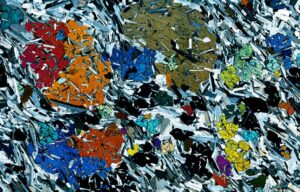


Fig. 2) Examples of thin section slides under a XPL microscope, bronzitite (left) and gabbro (right). Sourced from here.
After the OCA students finished their paintings, my home-made “post card” stamps go on the back, a stamp gets added, and they’re ready to be mailed out. Although most OCA participants this year were U.S. based, they came from all over, ranging from Staten Island to San Francisco to Arizona to Connecticut. In addition to one mentor from New Zealand! For many of these students this was their first time traveling on their own, and their first time forming long-distance connections. With these scientific postcards, OCA students can stay connected by reminding each other of the science they learned together. My experience on the JR taught me great things about geological research, but it also gave me life long connections that I cherish. Although the JR is gone, its legacy lives on in our memories and the ways we stay connected with friends. I’m grateful to know that even without an international ship, I’m still able to add friends to my address book.
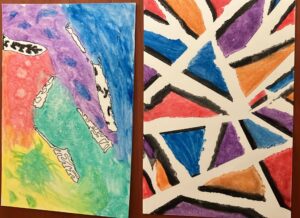
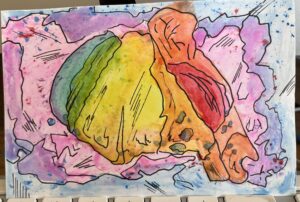


Fig. 3) Examples of participant made postcards
Written by Kellan Moss