Climate Change
Nepal’s disaster has laid bare the world’s adaptation accountability gap
The deadly flash flood that thundered down Nepal’s Bhote Koshi valley a month ago may have been hard to predict given the complexity of monitoring glacial slopes in the high mountains. But it should come as a surprise to no one that such a disaster could happen in a world set to barrel past the 1.5C warming limit governments agreed to in 2015.
I say this with confidence because even before the ink was dry on the Paris Agreement, former colleagues and I were writing extensively about the dangers posed by accelerating glacier melt in the Himalayas. I went back to look at what we covered, often working with local journalists in Pakistan, India and Nepal. It was substantial.
Comment: The response to Nepal’s disaster is a test for global climate institutions
In one story from a conference on climate change and geology, Bill McGuire, a professor who then led the Benfield Hazard Research Centre at University College London, was quoted as saying: “The most likely thing we are going to see soon is an increased level in giant landslides in mountainous terrains, huge collapses, millions of cubic metres of rock.”
That is precisely what unleashed Nepal’s most recent disaster, some 13 years later.
Other articles zoomed in on internationally funded programmes to prevent glacial lake outburst floods; studies warning of the rising risks to downstream communities; and cross-border efforts (or lack of them) to set up monitoring systems. But information has not led to sufficient action.
Falling behind growing impacts
Reporting on climate-related disasters over the past 20 years (it was way back then that UN aid chief John Holmes started referring to extreme weather as the “new normal”) has been a pretty frustrating beat, as things have gotten dramatically worse.
There’s no question that our understanding of the risks has grown hugely – alongside our knowledge of how to protect people and infrastructure in the face of fast-growing threats.
Yet governments and businesses have dragged their feet on adaptation policies and practical measures, even when confronted with the numbers showing it’s far cheaper to prevent and prepare than to clean up and rebuild after a flood or a storm. This intransigence has left a yawning chasm in the world’s ability to deal with climate change-driven impacts.
Let’s call it the adaptation accountability gap.
-
UN Climate Summit: UN chief says world has tools to end fossil fuel age
At the UN Secretary-General’s climate summit in New York, countries shared their energy transition plans while Nepal and island nations advocated for more international support -
Threatened by rising seas, small islands secure right to keep their statehood
Efforts to protect marine ecosystems and coastal communities have risen up the political agenda at the UN General Assembly in New York


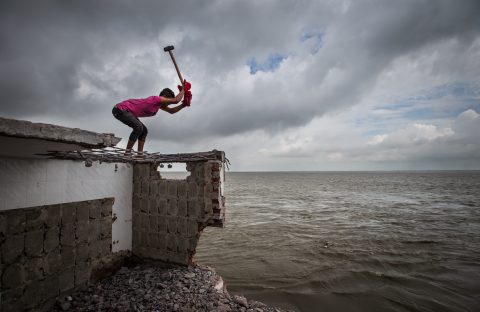
These days we see the effects all around us – in hospital emergency rooms where workers and older people struggle with heat exhaustion; in campsites and hotels abandoned by holidaymakers fleeing forest fires; in flooded streets piled high with mud, broken furniture and twisted cars.
The only bright side to the growing climate chaos we’re experiencing is that it’s become practically impossible for politicians and corporate bosses to ignore the evidence – and the rising cost to their balance sheets. Voters who can no longer afford to shoulder the economic and social burden of this damage need to let their leaders know time’s up.
1.5C overshoot means adapting differently
Last week, during Climate Week NYC, I moderated an event packed with experts who work on adapting to climate change – from Nepal to Brazil, from Sierra Leone to the Marshall Islands, and from communities to the top of governments and UN agencies. They spoke of tree-planting to stabilise slopes, heat insurance for informal workers, a climate risk guide for midwives, drought-resistant seeds and solar panels to irrigate farmland along the Nile.
Amid the diversity of experiences and approaches, there were two common threads: first, as underlined by the UN Environment Programme’s new report on overshooting 1.5C, we may have missed the boat to catch up on adaptation as we know it.
With global warming continuing apace, we’ll need to come up with new “transformational” strategies if the coral reefs, ice sheets, oceans and other natural systems on which we rely cross tipping points and unleash cascading consequences. Nepal’s flash flood is being flagged as an example of the kind of disaster that requires a major change in how we think about adaptation.

Second, the investment required to adapt to intensifying climate shocks and stresses can no longer be seen as something to be squeezed out of shrinking foreign aid budgets. There are a growing number of tried-and-tested funds and mechanisms for channelling finance at the local, national and global levels – these must be filled, replenished and used without delay.
Businesses need to get stuck in too, not least to safeguard their assets, operations and profits – but also because in some sectors like agriculture or water there are opportunities for a return. Despite this, there are many activities governments will have no choice but to pay for, such as moving people out of the path of rising seas.
Finance not flowing where needed
Mikko Ollikainen, who heads up the UN’s pioneering Adaptation Fund for developing countries, told the event the fund has a portfolio of projects worth $1.6 billion but a pipeline waiting to be financed to the tune of $1.8 billion. Yet, in recent years, as needs balloon, donor nations have failed to meet its annual fundraising target of $300 million at COP climate summits.
The chair of the UN climate body for implementation, Julia Gardiner, said she expects to see more pressure on governments at November’s COP31 summit in Türkiye to show how they will meet a goal to triple adaptation finance by 2035 and fill the under-resourced coffers of the fledgling Fund for Responding to Loss and Damage (FRLD).

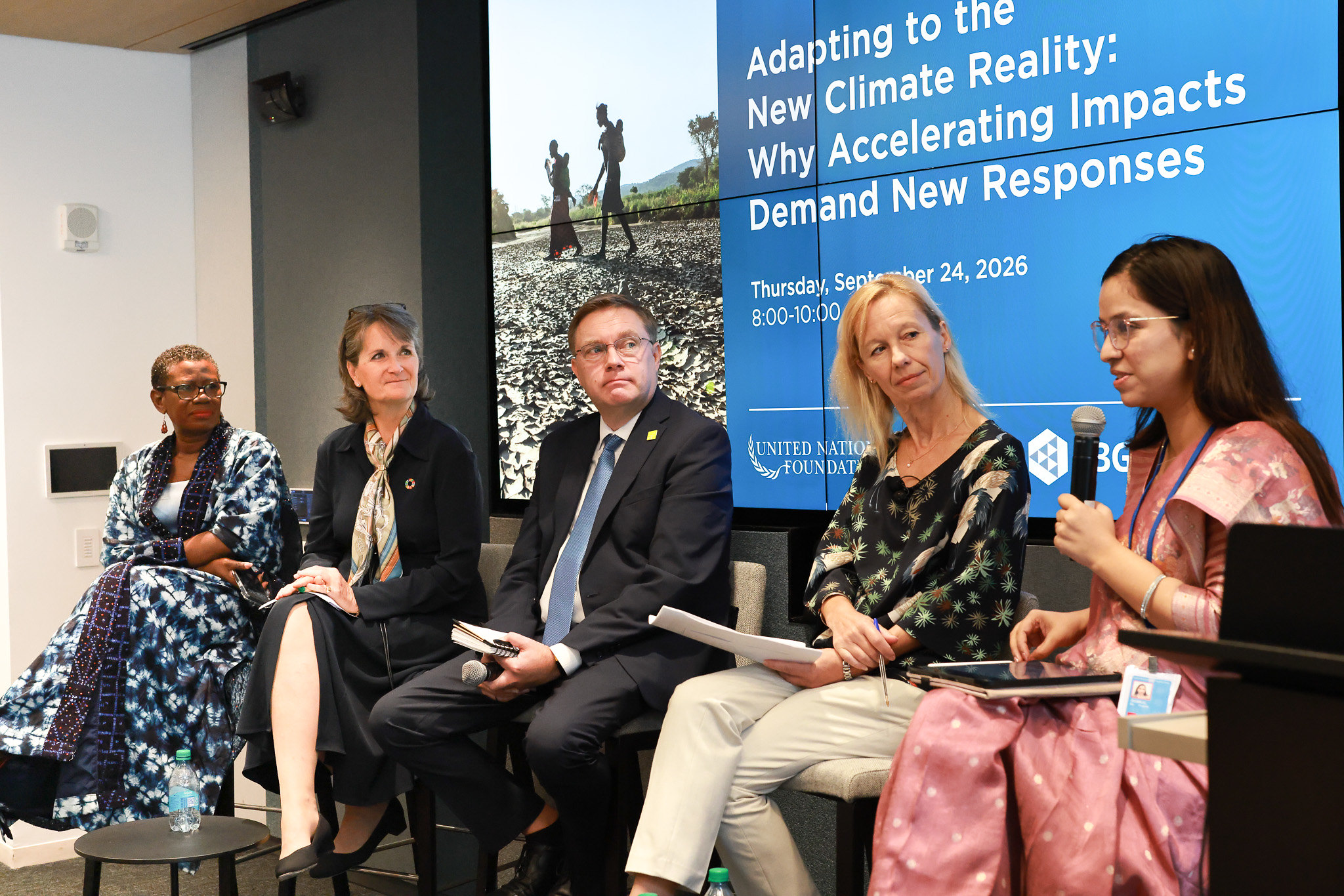
Nepal, meanwhile, is still waiting for a formal response to its request to the FRLD for urgent support to tackle the aftermath of the flood. Manjeet Dhakal, a Nepali scientist who advises least-developed countries in the UN climate process, said the disaster – which killed over 1,450 people and left nearly 6,000 missing – cannot be treated as just the latest climate crisis that grabs the headlines before it’s replaced by another.
That was backed up by Prakriti Dhakal, personal under-secretary to Nepal’s prime minister, who has been working closely on the emergency response. She said she had received many condolences and warm words of support during her meetings in New York.
But, she asked, “when you go home, will you continue having that sympathy for us that translates into something rational, something long-term, to strengthen the communities in Nepal?” A fitting response would be for governments to get behind a new Himalayan Climate Resilience Mechanism, proposed by Nepal’s leader at the UN last week, as one way to start closing the adaptation accountability gap.
The post Nepal’s disaster has laid bare the world’s adaptation accountability gap appeared first on Climate Home News.
Nepal’s disaster has laid bare the world’s adaptation accountability gap