Green Living
Need to Recycle Your Satellite TV Dish? Read This First
Satellite dishes outlast the subscriptions that put them there. Drive through almost any American neighborhood and you will see them still bolted to fascia boards and chimney straps, aimed at satellites their owners stopped paying for years ago.
The subscriber base that installed those dishes is collapsing. Pew Research Center found in July 2025 that 36% of U.S. adults still subscribe to cable or satellite TV, while 83% watch streaming services. DIRECTV and DISH told investors in 2024 that they had collectively lost 63% of their satellite subscribers since 2016.
Every one of those canceled accounts left hardware behind, and removal and recycling still fall to the subscriber, who gets little support from the provider. For lack of clear information, a lot of that hardware ends up in a landfill.
Can You Recycle Your Satellite TV Dish?
Depending on who you ask, the proper method of disposal for a satellite TV dish can be as clear as, well, a fuzzy TV signal. So let’s tune in to what a dish system is made of, because the answer determines where each piece goes.
A residential satellite system is not one product. It is four material streams bolted together:
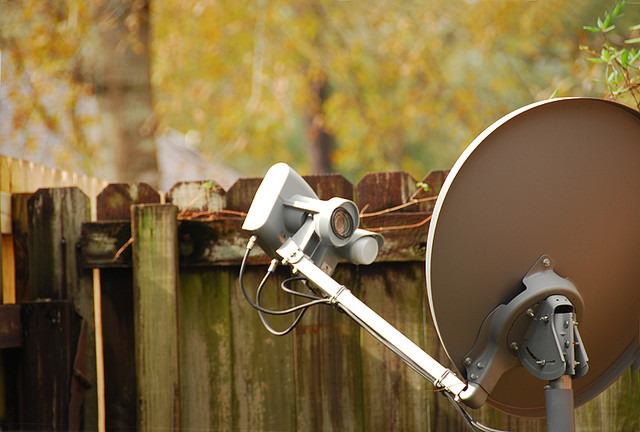
- The reflector. The curved part everyone pictures. On modern 18- to 20-inch DIRECTV and DISH installations it is thin, powder-coated steel. Older and larger dishes are often aluminum. Either way, it is scrap metal and easily recyclable in most communities.
- The LNB. The low-noise block downconverter on the end of the arm. It holds a circuit board and is the piece that makes the system electronic waste.
- The mount and hardware. Usually galvanized steel, and usually the heaviest recyclable component in the assembly.
- Coaxial cable. Copper conductor inside plastic jacketing, which scrap yards buy separately as insulated wire.
The Institute for Environmental Research and Education recommends separating those parts of the dish before you haul anything anywhere: detach the LNB, coil the coax, and sort aluminum from steel. That takes about 20 minutes with a screwdriver and a wrench, and it is the difference between a recycler accepting your load and turning it away.
The receiver, DVR, and remotes are a separate question, and an important one. Those are usually leased. If you cancel service and keep them, you will be billed for them.

Once It’s Installed, It’s Yours
This is the part that surprises people. The dish becomes the property of the homeowner at installation. Neither provider sends a technician to take it down when you cancel, and neither is obligated to. DIRECTV’s own support forums state the position plainly: the receivers go back, the dish stays, and what happens to it next is up to you.
Renters have a related wrinkle. The FCC’s Over-the-Air Reception Devices rule protects your right to install a dish under one meter in areas under your exclusive control, such as a balcony or patio, and it limits what landlords and HOAs can prohibit. It does not cover shared roofs or exterior walls, and it does not remove your responsibility to take the dish down and repair the mounting holes when you move out.
Read your lease before you install anything.
The Rules Changed in Some States, But Not Federally
U.S. federal guidelines still do not regulate circuit boards as hazardous waste, and there is no national electronics recycling law. What exists instead is a patchwork of state and local policy.
Twenty-five states plus the District of Columbia have passed electronics recycling legislation, most of it built on producer responsibility principles, and roughly two dozen states ban electronics from landfills outright. Whether your dish system is legally landfill-bound depends entirely on your ZIP code.
One change is worth flagging because it is new and relevant. Oregon’s modernized E-Cycles program took effect January 1, 2026, and the expanded list of covered devices now includes cable and satellite receivers, routers, modems, and game consoles. Oregon residents can drop those off free. The reflector itself is not a covered device, so it still goes to scrap metal, but the electronic half of the system finally has a no-cost home in one more state.
The stakes behind these rules keep climbing. The UN’s Global E-waste Monitor 2024 found the world generated a record 62 million metric tons of electronic waste in 2022 and formally collected and recycled just 22.3% of it. Generation is on track to hit 82 million metric tons by 2030, growing about five times faster than documented recycling.
Don’t Count on the Scrap Value
Earlier versions of this article suggested that local scrap vendors might be willing to pull the system down for the value of the materials. That is worth a reality check in 2026.
Scrap yards pay by weight and by grade. A modern 18-inch dish is a few pounds of thin, coated steel, which grades low and weighs almost nothing. The coax and the mount are worth more than the reflector, and the whole assembly is still unlikely to buy you lunch. Older six- to 12-foot aluminum C-band dishes are a genuinely different story and can be worth hauling. For the small dishes on most roofs, treat scrap as a disposal route rather than a payday, and do not expect a yard to send a crew for it.
Tips To Get You Started
Here at Earth911, we want your satellite TV dish handled properly at the end of its life. That is not the case. Here is the sequence that actually works:
- Check your provider’s recycling page first and know what it covers. DIRECTV’s recycling page issues a prepaid shipping label and routes equipment to R2-certified recyclers. DISH points customers to Best Buy and a UPS mail-in program that offers free recycling if you pay the shipping costs. Both programs are built around receivers, remotes, and small equipment. Neither is designed to take the dish off your roof.
- Return leased equipment on time. Providers typically give you about three weeks from the disconnect date before non-return fees land on your final bill. Get a receipt at the drop-off point and keep it.
- Search for a satellite dish removal service, a handyman, or a local roofing company. Roofers are the right call if the mount is through the shingles, because someone has to seal the penetrations afterward. Removal is a roof job, not a recycling job, and the two rarely come bundled.
- Find a certified recycler for the electronics. Look for R2 or e-Stewards certification, which tells you the downstream processing is audited. Use the Earth911 recycling search to find electronics and scrap metal locations near you.
- Take the reflector and mount to a scrap metal yard. Separate steel from aluminum before you go.
- Consider reuse before recycling. A working dish and LNB have a second life in free-to-air reception, RV and off-grid setups, and amateur satellite work. Offer it to others locally before you scrap it. There are also plenty of repurposing projects if you would rather keep it out of the waste stream entirely.
- Watch out for lead-generation sites. Several “satellite dish removal” domains are referral networks that sell your contact information to whichever contractor is paying, not recyclers. Ask any service directly where the material goes and whether they are certified.
Earth911 Does Not Remove or Recycle Dishes
We regularly receive inquiries about whether Earth911 offers removal services. We do not. Earth911 does not offer satellite TV dish removal or recycling. If a satellite TV provider or one of its representatives tells you otherwise, that is not accurate information.
What Comes Next for Satellite TV
The retirement wave is not finished. DIRECTV shed roughly 288,000 subscribers in the third quarter of 2025 alone, according to reporting by TheStreet. EchoStar reported 6.63 million pay-TV subscribers at the end of the first quarter of 2026 after a net loss of 366,000 in three months, and its Dish DBS unit filed a prepackaged Chapter 11 restructuring on June 30, 2026. The company says Dish Network and Sling TV service continues without interruption.
For subscribers, the practical takeaway is unchanged: corporate restructuring does not come with a dish removal crew. If you are canceling, plan for the disposing of the hardware. Return what is leased, get the dish down safely, split the metal from the electronics, and route each stream to somewhere that will process it. That is a Saturday afternoon’s work that can keep your dish out of a landfill.
Related Reading
Editor’s note: This article was originally published on June 10, 2015. It was most recently updated in July 2026. Feature image courtesy of Alexis Lê-Quôc.
The post Need to Recycle Your Satellite TV Dish? Read This First appeared first on Earth911.
https://earth911.com/eco-tech/looking-to-recycle-your-satellite-tv-dish-read-this-first/