Carbon Footprint
Moeve, Masdar, and Enalter Partner on Southern Europe’s Largest Green Hydrogen Project

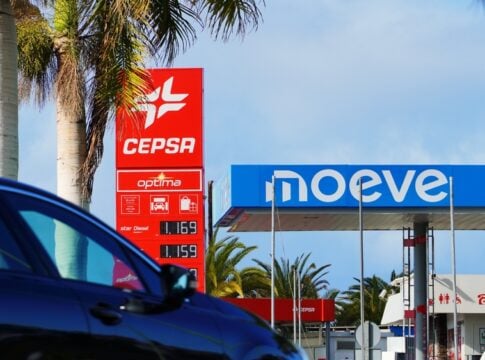

Spanish energy company Moeve approved more than €1 billion ($1.2 billion) for the first phase of its Andalusian Green Hydrogen Valley. The final investment decision cleared the way for construction to begin in the coming weeks. Significantly, Moeve will hold a 51% majority stake. The remaining share will be owned by Masdar and Enalter.
Enalter is majority controlled by Enagás Renovable, a pioneer in renewable gas development. Meanwhile, Masdar brings global clean energy expertise from Abu Dhabi.
This first phase, called Onuba, will install 300 megawatts (MW) of electrolyser capacity in southern Spain. Moreover, the company kept the option to expand the project by another 100 MW, subject to grid access and board approval.
Onuba: A Strategic Project With European Backing
The Onuba project will be the largest green hydrogen facility in southern Europe once operational. It carries a total investment of over €1 billion. That includes related infrastructure and a dedicated solar power plant for self-consumption.
Importantly, the project secured strong public support. The European Commission classified it as a Project of Common European Interest (PCI). In addition, the Spanish government awarded €304 million in funding under its Recovery, Transformation and Resilience Plan. This support came through the EU’s NextGenerationEU program under the Hydrogen Valleys scheme.
Such backing places the project at the center of Europe’s industrial decarbonization strategy. Brussels aims to reduce dependence on imported fossil fuels while scaling domestic clean energy production.
Ownership Mix Boosts Financing
This ownership mix reflects a wider shift in global capital. Gulf and European investors are increasingly channeling funds into hydrogen infrastructure. Notably, Moeve itself is owned by Mubadala, Abu Dhabi’s sovereign fund, and U.S. private equity firm Carlyle. As a result, the project benefits from deep financial backing and international reach.
Production Capacity and Climate Impact
- At 300 MW, Onuba will produce about 45,000 tonnes of green hydrogen per year. This output will help avoid around 250,000 tonnes of CO₂ annually.
Simply put, the emissions reduction equals more than the total emissions generated by passenger vehicles with internal combustion engines in the Spanish cities of Huelva, Cádiz, and Jaén.
The hydrogen produced will serve multiple sectors. It will support aviation fuels, road transport, and marine fuels. In addition, it will help decarbonize chemical and fertilizer industries. Therefore, the project directly targets hard-to-abate sectors.
Solving the Grid Bottleneck
Grid access has slowed many hydrogen projects across Europe. However, Moeve recently secured a connection to the Spanish electricity grid. This approval came at a crucial time.
Besides grid power, the project will use a dedicated solar plant. This hybrid model will stabilize the electricity supply and improve the plant’s carbon intensity profile.
Access to renewable electricity remains essential. Green hydrogen only delivers climate benefits when powered by clean energy. Therefore, Andalusia’s strong solar resources give the region a clear advantage.
Furthermore, the region’s port infrastructure could support exports of hydrogen derivatives such as ammonia to northern European markets. This strengthens Spain’s ambition to become a renewable energy exporter.
Moeve’s Broader €8 Billion Transition Plan
The hydrogen valley forms part of Moeve’s broader €8 billion transition strategy. Formerly known as Cepsa, the company rebranded in 2024 to signal its shift toward low-carbon businesses.
Since 2022, Moeve sold most of its oil production assets, including operations in Abu Dhabi and South America. It redirected that capital into renewables, biofuels, and hydrogen.
This capital reallocation marks a clear pivot. Instead of expanding oil production, the company invested in long-term clean infrastructure.
Financially, the company strengthened its position before making this move. Net profit rose to €341 million last year, compared to €92 million in 2024. This improved profitability provided internal funding capacity for large-scale energy transition projects.
At the same time, Moeve entered non-binding talks with Portuguese energy firm Galp. The companies are exploring a combination of refining, chemicals, and fuel retail businesses. They aim to complete due diligence and possibly reach an agreement by mid-2026.
If successful, consolidation could free up more capital. It could also stabilize legacy businesses during the transition period.
Solving Europe’s Hydrogen Challenge
Low-carbon hydrogen plays a critical role in cutting emissions from industry and transport. The European Union set ambitious goals under its hydrogen strategy and REPowerEU plan. The bloc aims to produce 10 million tonnes of renewable hydrogen and import another 10 million tonnes by 2030.
However, the path remains complex.
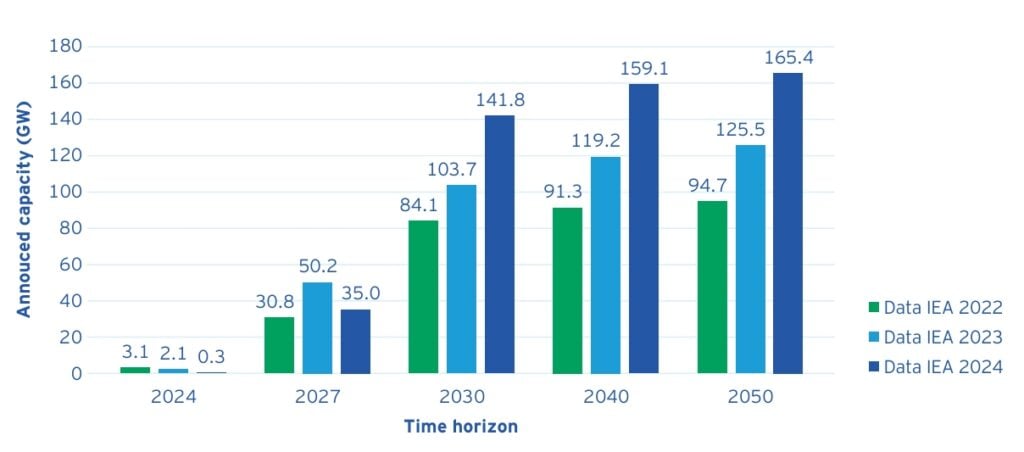
Analysts say that by 2030, Europe would need at least 100 gigawatts (GW) of installed electrolyser capacity to meet REPowerEU targets. That implies annual capacity growth of roughly 150% between 2025 and 2030. By comparison, growth between 2020 and 2024 averaged around 45%.
European renewable hydrogen production capacity announced

In addition, regulatory rules for renewable hydrogen, such as strict temporal and geographical correlation requirements, increase development costs. Projects often require extra storage and grid adjustments.
Funding remains another bottleneck. Although the EU structured many subsidies and incentives, approval processes can take 12 to 24 months. These delays risk slowing deployment.
As of December 2024, about 60% of Europe’s renewable hydrogen production ambition was covered by national targets. Member states must better align policies and accelerate ramp-up if the EU hopes to meet 2030 goals.
A Fast-Growing Market
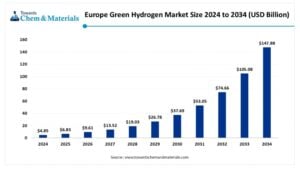
Despite challenges, market growth remains strong. The European green hydrogen market was valued at around $4.85 billion in 2024. Analysts expect it to reach nearly $147.88 billion by 2034. This implies a compound annual growth rate (CAGR) of about 40.7% between 2025 and 2034.
Several factors drive this expansion:
- Rising demand for net-zero solutions
- Decarbonization pressure on heavy industry
- Expanding renewable energy capacity
- Policy incentives and carbon pricing
By technology, alkaline electrolysers dominated the market in 2024, holding about 45% share. These systems remain cost-competitive and proven at scale.

Why This Project Matters
Moeve’s Andalusian Green Hydrogen Valley signals more than a single investment. It highlights three broader trends. First, capital is shifting from oil to clean infrastructure. Second, Europe is backing hydrogen with serious public funding. Third, Spain is emerging as a strategic clean energy exporter.
If executed successfully, Onuba could become a cornerstone of Europe’s hydrogen economy. More importantly, it shows that large-scale projects are moving from ambition to action. Thus, in a decade defined by energy transition, this €1 billion decision may mark a turning point for southern Europe’s clean industrial future.
The post Moeve, Masdar, and Enalter Partner on Southern Europe’s Largest Green Hydrogen Project appeared first on Carbon Credits.