Carbon Footprint
Microsoft Inks Biggest-Ever U.S. Biochar Deal with Liferaft



A new agreement between Microsoft and Liferaft highlights the rapid growth of carbon removal markets. The deal covers 1 million carbon removal units or credits over 10 years, making it one of the latest long-term offtake agreements in the sector.
These agreements are important. They give developers guaranteed future demand while helping them raise capital, build projects, and scale operations. For buyers like Microsoft, they secure access to high-quality carbon removal credits in a tight market.
Phillip Goodman, Director, Carbon Removal at Microsoft, commented:
“At Microsoft, we’re pleased about the Liferaft project’s potential to pair high-quality, durable carbon removal with meaningful local benefits. Liferaft has strong plans for putting locally available biomass waste to productive use, generating local jobs, and supporting farmers and land managers. This demonstrates how carbon removal can strengthen agricultural communities, improve land outcomes, and deliver durable climate impact.”
The deal also reflects a broader shift. Companies are moving from short-term carbon offsets to long-term carbon removal contracts. These focus on physically removing carbon dioxide from the atmosphere and storing it for long periods.
Microsoft Expands Its Carbon Removal Playbook
Microsoft is the largest corporate buyer of carbon removal credits today. The company has rapidly scaled its purchases in recent years.

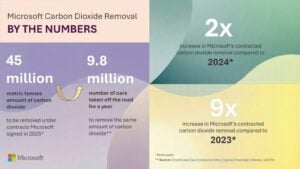
In 2025 alone, Microsoft signed agreements covering about 45 million tonnes of carbon removal. This was more than double its 2024 volume and a major jump from about 5 million tonnes in 2023.
- The company also dominates the broader market. In 2024, Microsoft accounted for about 63% of all durable carbon removal purchases, securing over 5.1 million tonnes.
Recent deals show how fast this is growing:
- 2.85 million tonnes of soil carbon removal credits with Indigo Ag over 12 years
- 2 million tonnes from afforestation projects in Africa
- 1.24 million biochar credits in one of the largest deals of its kind
- 3.6 million tonnes from a bioenergy carbon capture project in the U.S.
These numbers show a clear trend. Microsoft is using long-term contracts to build supply across multiple carbon removal pathways.
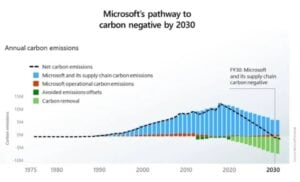
The company’s goal is ambitious. It aims to become carbon-negative by 2030 and to remove all its historical emissions by 2050. Carbon removal plays a key role in achieving this target.

- SEE MORE:
Why Biochar Is Dominating Early Carbon Markets
Biochar is produced by heating organic materials like agricultural waste in low-oxygen conditions. This process locks carbon into a stable solid form that can be stored in soil for hundreds to thousands of years.
It is considered one of the most practical carbon removal methods available today. Moreover, it is relatively low-cost compared to technologies like direct air capture. It can also scale faster because it uses existing biomass waste.
Biochar already plays a major role in the market. In 2024–2025, it accounted for about 86% of global carbon removal purchases and deliveries.


Demand is strong, but supply is limited. In 2024, biochar made up a large share of purchases, but actual issued credits remained below demand levels.
The long-term potential is also huge. Estimates suggest biochar could remove between 0.3 and 4.9 billion tonnes of CO₂ per year globally, with some studies pointing to around 3 billion tonnes annually using available biomass waste.
This makes biochar one of the most scalable carbon removal options available today.
How Offtake Deals Help Scale Carbon Removal
The Liferaft–Microsoft agreement follows a model that is becoming standard in carbon removal markets: long-term offtake contracts.
These deals serve several purposes:
- They provide price certainty for developers.
- They reduce investment risk for new projects.
- They help scale technologies that are still early-stage.
Microsoft has emphasized that early demand is critical. By committing to future purchases, companies help suppliers secure financing and expand capacity. This model is similar to how renewable energy markets grew. Long-term power purchase agreements helped scale solar and wind by guaranteeing revenue.
Now, the same model is being applied to carbon removal.
From Offsets to Permanent Carbon Removal
The carbon removal market is still small but growing fast. Demand is driven by corporate climate targets and stricter net-zero standards. Global purchases of carbon removal credits reached about 8 million tonnes in 2024, up nearly 78% from 2023.
By 2025, demand had already surged further, with tens of millions of tonnes under contract. Looking ahead, forecasts show strong growth:
- The market could reach $40 billion to $80 billion per year by 2030.
- By 2050, it could expand from $300 billion to $1.2 trillion annually.
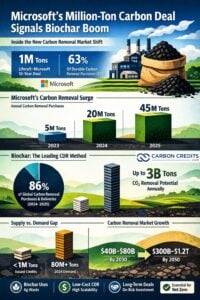

However, supply remains a key constraint. Less than 1 million tonnes of durable carbon removal credits have been issued globally, far below demand.
This gap is pushing companies to secure long-term contracts early. It also supports higher prices for high-quality credits, especially those with long-term storage like biochar.
Carbon Removal Becomes Essential for Net Zero
Carbon removal is now seen as essential for climate goals. Reducing emissions alone is not enough. Some emissions are hard to eliminate, especially in sectors like agriculture, aviation, and heavy industry.
Carbon removal helps address these residual emissions. It removes CO₂ directly from the atmosphere and stores it in a durable way.
Experts note that carbon removal is what makes “net-zero” possible. Without it, many climate targets would be difficult to achieve at scale. This is why companies like Microsoft are investing heavily in the sector. They are building portfolios that include:
- Nature-based solutions like forests and soil,
- Engineered solutions like DAC and BECCS, and
- Hybrid approaches like biochar.
This diversified strategy reduces risk and supports multiple technologies at once.
A New Phase for Carbon Markets Emerges
The Liferaft agreement may seem small compared to Microsoft’s larger deals. But it reflects an important shift in the market.
First, it shows that demand is spreading across more suppliers. This helps build a broader and more competitive market.
Second, it highlights the growing role of biochar. As one of the most mature carbon removal methods, it is likely to remain a key part of early market growth.
Third, it reinforces the importance of long-term contracts. These agreements are becoming the main way to scale carbon removal globally.
With all these, the broader trend is clear. Carbon removal is moving from pilot projects to large-scale deployment. Companies are no longer testing the market. They are actively building it.
For now, Microsoft remains the dominant buyer. But its strategy is also creating space for others to follow. By securing supply early, the tech giant is helping to unlock a new phase of growth in climate technology.
The post Microsoft Inks Biggest-Ever U.S. Biochar Deal with Liferaft appeared first on Carbon Credits.