The LEGO Group is giving its new Virginia factory a major clean energy upgrade. The company plans to build a large on-site solar park at LEGO Manufacturing Virginia in Chesterfield County. At the same time, it will add thousands of rooftop solar panels across the site.
Together, these projects mark a big step toward LEGO’s goal of covering 100% of the facility’s yearly electricity needs with renewable energy. The move also shows how the toy giant is tying factory expansion to its wider climate strategy.
A Big Solar Build for a Big Factory
The company announced that its Virginia site is one of its biggest investments in the U.S, having more than 28 MWp of on-site solar capacity in total. Now it is also becoming one of its most important clean energy projects.
Construction on the solar park should begin in summer 2026. The ground-mounted system will include more than 30,700 solar panels and deliver 22 megawatt-peak (MWp) of capacity.
The solar park will spread across nearly 80 acres at the Chesterfield factory site. On top of that, LEGO plans to install 10,080 rooftop solar panels, adding another 6.11 MWp.
Thus, it is a core part of how the company wants this factory to operate from the start.
Lego also said the solar build is a major milestone in its effort to source renewable energy for the plant’s annual needs. That matters because the factory is being designed as a long-term manufacturing hub, not just a packaging or distribution site.
Jesus Ibañez, General Manager of LEGO Manufacturing Virginia, said:
“We’re proud of the progress we continue to make. These initiatives are key to increasing our use of renewable energy and support our ongoing commitment towards more sustainable operations.”
Using Mass Timber for Low- Carbon Factory
The solar park is only one part of the Virginia story. LEGO is also trying to reduce the site’s footprint through the building design itself.
Construction is moving ahead on schedule after the main factory reached its steel topping-out milestone in October 2025. The site’s office space, built with mass timber, is expected to top out later in spring 2026. Mass timber matters because it is a renewable material and can store carbon, unlike many traditional building materials that come with heavier emissions.
Focuses on Energy, Waste, and Better Materials
LEGO also wants the facility to earn LEED Platinum certification once completed. That target covers energy, water, and waste performance. The company further said the Virginia site shares the same goal as all LEGO operations: zero waste to landfill.
In simple terms, it wants almost all factory waste to be reused, recycled, composted, or sent to non-landfill treatment.
These details matter because clean power alone does not make a factory sustainable. Companies also need smarter materials, better energy use, and stronger waste systems. LEGO seems to be taking that broader route here.
Long-Term Impact: Jobs and Local Growth
The Virginia factory is not just about energy. It is also a major job project.
More than 500 people already work across the factory under construction and LEGO’s temporary packing facility. That number is expected to rise to about 900 by the end of 2026 as the company gets ready to run highly automated molding and packing equipment.
The overall investment in the site and regional distribution center is more than $1.5 billion. The full campus covers 340 acres and includes 13 buildings with roughly 1.7 million square feet of space. LEGO has said the site is expected to create more than 1,700 jobs over 10 years.
The company is also trying to build stronger local ties while construction continues. In February 2026, LEGO announced more than $1.3 million in grants for eight nonprofit groups in the Greater Richmond area. Since 2022, it has provided more than $3.5 million in local grants through the LEGO Foundation.
So, the Virginia site is becoming more than a factory. It is shaping up as a long-term regional base for manufacturing, jobs, and community funding.
The company has committed to reaching net-zero greenhouse gas emissions by 2050 across its full value chain. The Virginia solar project also fits into LEGO’s bigger climate plan.
It also has near-term targets validated by the Science Based Targets initiative, aiming to cut absolute Scope 1 and 2 emissions by 37% by 2032 from a 2019 baseline, and reduce Scope 3 emissions by the same amount. Those targets align with the 1.5°C pathway.
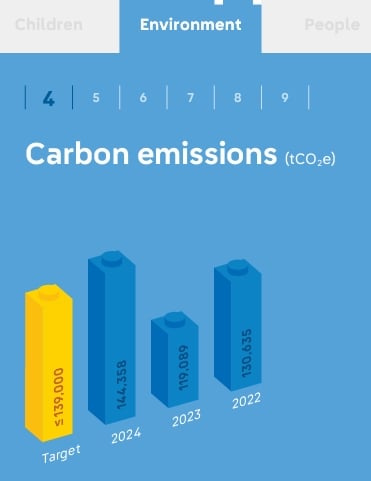
However, the toy maker’s emissions rose in 2024 as consumer sales grew faster than expected. Its greenhouse gas emissions are approximately 144,400 metric tons of CO₂‑equivalent (around 144.4 million kg CO₂e) globally.
The company noted that higher product demand pushed carbon emissions 3.9% above target, even as it increased spending on more sustainable manufacturing. This means that when a business grows fast, cutting emissions gets harder, not easier.
Even so, LEGO says it remains committed to its climate goals and is investing in local solutions at each factory rather than using a one-size-fits-all model. That approach makes sense because every site has different energy systems, weather, and infrastructure options.
Renewable Growth Spreads Across Global Sites
The company also expanded renewable energy projects at other locations in 2024. It added 6.64 MWp of solar capacity across operations globally, a 43% increase from the previous year.
In Kladno, Czech Republic, it expanded rooftop solar by 1.5 MWp, bringing total capacity there to 2.5 MWp.
In Billund, Denmark, it added 4.4 MWp, bringing the site’s total solar capacity to 5.5 MWp.
It also cut Scope 1 emissions in Billund by moving 11 buildings from natural gas to district heating, saving about 1,064 tonnes of CO2e each year. Meanwhile, LEGO launched a geothermal project in Hungary and upgraded heat-recovery systems in Jiaxing, China, to reduce gas use.
Progress in Waste Reduction
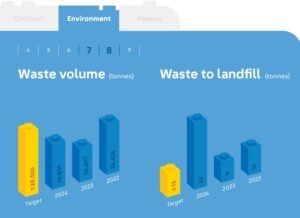
In 2024, its manufacturing sites generated a total of 25,859 tonnes of waste, which was 7.6% below the target of 28,000 tonnes.
As a remedy for this situation, factories in Denmark, China, and Mexico improved moulding processes to recover more raw materials and cut waste. These efforts reduced scrap by more than 160 tons, helped by digital tools that identified materials for reuse and improved efficiency.
Additionally, in the Czech Republic, it also introduced more circular packing methods. The factory reused 39% of cardboard tube cores from suppliers and tested returnable inbound packaging, cutting waste by more than 39 tons a year.
Source: Lego
Of course, none of this solves LEGO’s full emissions challenge overnight. Scope 3 emissions across the supply chain will still be the harder part.
However, taken together, these efforts show a company trying to clean up its manufacturing footprint piece by piece. The Virginia project stands out because of its scale, but it is part of a wider pattern. Even though it is still under construction, it already shows what modern industrial planning can look like: on-site renewables, lower-carbon materials, waste reduction, and job creation in one package.
But this project gives LEGO something important: a real, visible step forward. And in climate action, visible progress matters.