Climate Change
Keeping to 1.5C of warming is no longer possible – but we must still limit the overshoot
Laurence Tubiana is CEO of the European Climate Foundation and was formerly France’s Climate Change Ambassador and Special Representative for COP21 in Paris.
The UN has released a report this week confirming what many people have feared: the world is going to pass 1.5C of warming.
At current emissions, the remaining carbon budget will be exhausted within roughly three years. We are heading into “exceedance” of the 1.5C threshold: a sustained breach of the Paris Agreement’s primary temperature goal before any possible return below it.
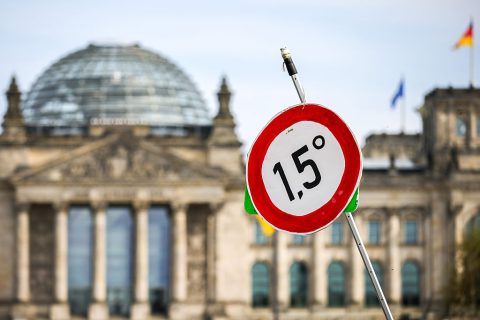
1.5C is the line we should not have crossed – and, once we cross it, the line we must quickly get back below, on what the UN Environment Programme calls an “overshoot, peak and decline pathway”.
-
UN sets out narrow path back to 1.5C warming after inevitable overshoot
Leading scientists say warming must peak at 1.8C to be able to reverse course this century, but current government climate policies are way off track -
Battle over cleaning up shipping set to resume at London talks
The US and Saudi Arabia want to scrap shipping’s Net-Zero Framework and have swung behind a far less ambitious alternative


Of course, climate risk is a spectrum: 1.4C is not safe, and 1.5C is not a sudden cliff edge. But the further the world moves beyond that level, the harder it becomes for communities and economies to adapt, and the greater the risk of more abrupt or systemic changes.
The importance of 1.5C
Some will argue that exceeding 1.5C means the Paris Agreement has failed, and that it is no longer a useful threshold. I disagree.
Before Paris, the world was heading for roughly 3.5C to 4C of warming. The UN now estimates that warming will reach a lower level of around 2.6C by 2100, due to policies implemented since Paris. That is still far too dangerous, but it is not the same world we were facing in 2015.
When we negotiated the Paris Agreement, 1.5C was not an arbitrary number. It was fought for by small island states and other climate-vulnerable countries because it represented a red line for their survival. Since then, we have witnessed the stark impacts of global temperature rises even in countries that did not consider themselves vulnerable, as seen with the devastating heatwaves in Europe this summer.
WHO issues new guidance on heat-health action plans, as El Niño sets in
The International Court of Justice underlined this in an advisory opinion, endorsed overwhelmingly by the UN General Assembly earlier this year, recognising 1.5C as the primary temperature threshold under the Paris Agreement and affirming that states must align their commitments with it. Overshoot does not move the goalposts. 1.5C remains the benchmark we must work to return to.
Lasting consequences of overshoot
But even as we fight to get back below 1.5C as quickly as possible, we now have to reckon honestly with what overshoot means. We are entering a period for which our societies, economies and institutions are not prepared. Even if overshoot itself is temporary, many of its consequences will not be. The longer it lasts, and the higher temperatures rise, the greater the lasting damage. We therefore need to limit its duration and magnitude.
The longer warming remains above 1.5C, the greater the risk of crossing tipping points in major Earth systems such as ice sheets, the Atlantic Meridional Overturning Circulation, permafrost and tropical forests. Crossing them can trigger self-reinforcing changes that may prove irreversible even if temperatures later fall. We need to understand and monitor these systems more than ever. That requires sustained investment in climate science – just as funding is being cut in many places.
An overshoot pathway will also strain human systems. When a flood destroys a home, the damage is not undone because global temperatures later fall. Crop failures, missed schooling, debt and displacement can have lasting effects. Farms, cities, healthcare systems and insurance markets will all have to cope with risks they were not designed for, and risk facing “tipping points” of their own, such as financial panic when markets suddenly reprice risks they had underestimated. Infrastructure built today will stand for decades, so we need to design and plan for the climate risks it will actually face.
From firefighting to future-proofing: Preventing wildfires must be the priority
Our priority must be to transition away from fossil fuels and rapidly cut emissions, including short-lived climate pollutants like methane. It traps around 80 times more heat than carbon dioxide over a 20-year period, and cutting it sharply can act as an emergency brake on near-term warming. Much of the methane from fossil fuel operations can be cut with existing technologies.
We will also need sustainable carbon dioxide removal, although its role will be limited: trying to use it as a substitute for emissions cuts would be prohibitively expensive at scale.
The radical options
The major risks of overshoot have led to proposals to explore active intervention in the climate system itself. Solar radiation modification (SRM) is the best-known example: reflecting a small share of sunlight back into space to reduce warming. Other proposals would target different parts of the climate and Earth systems, such as trying to stabilise glaciers.
These responses would bring us into further uncharted territory across Earth systems and nature, diplomacy and governance, technology and societies.
Such ideas are born of genuine concern about the major risks facing vulnerable countries and communities as temperatures rise. But even under the most favourable assumptions, these are tactics for managing some of the symptoms of overshoot, not a strategy for addressing its causes. Greenhouse gases would keep accumulating, oceans would keep acidifying, and many of the social and economic impacts of overshoot would remain.
EU warns on solar geoengineering but research debate grinds on
The more we learn about the complexity of the climate and Earth systems we are disrupting and how much uncertainty there already is, the clearer it becomes that full control is likely an illusion, and new interventions bring new complex risks. SRM, for example, could change regional climates, such as rainfall patterns or agricultural production, in ways that benefit some regions and harm others, with knock-on geopolitical risks.
Governance and research needed
None of this is an argument against research into these technologies. On the contrary, the risks they’re responding to are so extreme that we must explore all the options we might have. But we need to understand the potential effects and capabilities much better and from many more angles, including the political and social implications. Serious global governance is particularly urgent, alongside transparent research that is open to scrutiny.
But the fundamental elements of a strategy to navigate overshoot are already understood. The priority is still to rapidly cut greenhouse gas emissions to limit peak warming, protect people against the warming already locked in, and ensure technological innovation aligns with the public interest.
Overshoot is not just an engineering challenge. We need a full-scale response across societies, economies and political systems to prepare to navigate a more uncertain climate.
The post Keeping to 1.5C of warming is no longer possible – but we must still limit the overshoot appeared first on Climate Home News.
Keeping to 1.5C of warming is no longer possible – but we must still limit the overshoot