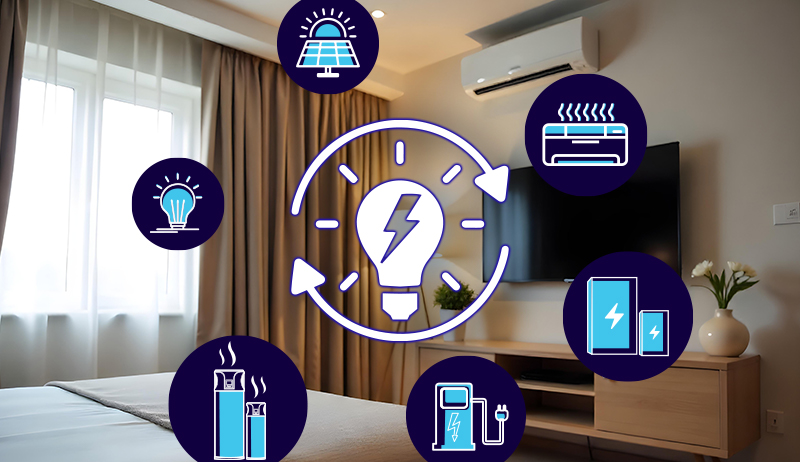
Suppose you are someone who has a lot of power-hungry appliances and uses them fairly regularly; you will need a lot of electricity. Air conditioners, hot water systems, washing machines, and ovens, to name a few, are considered power-hungry appliances.
The question is, how often and for how long do you use them? Also, different capacities and sizes of devices require varying amounts of energy. A mini-fridge certainly won’t use as much electricity as a double-door one, so that’s something to keep in mind.
Now, rather than going into bits and pieces like calculating how much energy each thing in your house requires, you should look at your electricity bill.
If you look carefully, you will see there is a tab for ‘average daily energy use’ in your monthly bill where your consumption is stated in kilowatt-hours (kWh).
Note down this number and make a yearly average to determine how many kWh of energy you consume, which will help you decide on your solar system size.
The whole process is not as simple as it sounds; that’s why you seek professional help from a solar expert like Cyanergy to determine the exact costs.
The more electricity you use, the bigger the solar system you need. The financial benefits of solar also depend on when you use electricity.
On average, Australian homes use 11–23 kWh per day.
The average daily usage for your home or business is probably different in summer and winter. You can check your average daily usage for each season by looking at your quarterly or monthly electricity bills.
If you have plans to expand your household, you must plan accordingly. Solar panels are such technology that lasts about 25 to 30 years.
You have to look past your current situation and think about where you see yourself in 5 to 10 years.
If you have the opportunity to extend your family, your energy needs will likely increase, too. So, future proofing is indeed necessary to make the most out of your investment.
Does that mean there is no way to add more solar panels in the future if required? That is certainly not the case; however, the newly added solar panels may come with a new set of issues that were not accounted for during the initial installation.
Solar panels generate energy, specifically one form of energy that later needs to be converted into another for practical use.
Solar panels generate DC (direct current), whereas our appliances run on AC (alternating current). This conversion is done by a solar inverter that has a conversion capacity.
A solar inverter can only convert a certain kW amount of energy, beyond which you cannot get AC, no matter how large a solar panel system you have.
Of course, a larger solar PV system will require an inverter of equal power, but adding more solar panels later on will mean you’ll need to get another inverter to cater to a smaller array of systems.
Ultimately, you lose money. So, that means if you anticipate needing extra energy in the future, upsize your solar at the time of installation.
Regarding system sizing, battery sizes are measured in kilowatt-hours, or kWh.
As mentioned before, an average home consumes 16 kWh of energy. And 30% of the energy is consumed in the daytime and 70% at night. That mounts up to approximately 5 kWh consumed during the day and 11 kWh consumed at night.
Based on simple maths, the average Australian would require approximately 11 kWh of solar battery storage to offset all their night usage.
As of 2025, the Tesla Powerwall has a capacity of 13.5 kWh, costing around $16,600 fully installed.
Remember that you do not need batteries to offset your nighttime electricity consumption. If you run the numbers, the first kWh of energy storage has the best payback because it works the hardest. As of the next kWh, the payback becomes longer.
However, the most important consideration when sizing and comparing solar batteries is that it is only possible when you thoroughly understand your energy usage profile. First, you’ll need a good energy monitor in your home with accurate data.
Then, a good installer will use their software to show you the optimal number of batteries and solar panels for your situation and the payback period. After that, instead of leaping into the unknown, you’ll go into your solar battery investment with your eyes wide open.
Including these aspects, there are many other things to figure out and factor in. Figuring all these out on your own is a challenging task. If you have any further questions or require some help, please don’t hesitate to contact us.
Cyanergy is a CEC (Clean Energy Council) approved solar installer with more than 10 years of experience in the field. Get in touch with us today to take advantage of a FREE consultation session with one of our experienced solar experts.
The post How Many Solar Panels Do I Need? appeared first on Cyanergy.
https://cyanergy.com.au/blog/how-many-solar-panels-do-i-need/