Ocean Acidification
First Spotted, or Simply First Recorded? Velella and Our Ecological Blind Spots

A remarkable strandline discovery deserves attention, but not exaggeration. The arrival of Velella velella on Sylt is probably Germany’s first documented record. It is not the first occurrence in the North Sea, nor is one stranding sufficient proof of a climate-driven invasion.
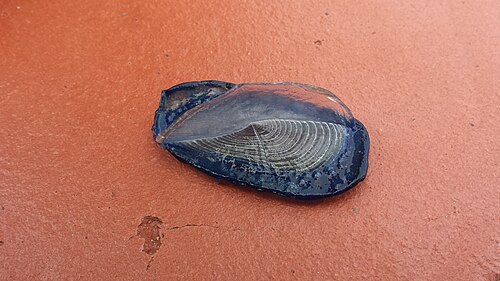
The discovery of Velella velella on Sylt on 23–24 August 2026 has been announced as the first German record of this oceanic hydrozoan (Listen to the News here). It is an exciting observation, but the word “first” needs careful interpretation. A first documented record is not necessarily the species’ first arrival. It may instead be the first time somebody recognized, photographed and reported it through the right channels. Fragile marine organisms such as Velella decompose rapidly, and their transparent floats are easily overlooked among material on the strandline.
A photographed Velella found on the west coast of Jutland in 2018 was considered the country’s first documented record. However, earlier reports exist (see here). Velella velella, known as the by-the-wind sailor or Segelqualle, is often described in the German media as a “Mediterranean jellyfish.” This is misleading. The species is a widely distributed oceanic hydrozoan found in tropical and warm-temperate waters, including the Mediterranean and the Northeast Atlantic. The familiar blue object is not a single conventional jellyfish but a floating colony of specialized polyps. Its diagonal sail allows wind to push the colony across the sea surface. Velella cannot swim effectively against this transport, so large strandings are principally the outcome of population size, surface currents and persistent onshore winds. The Sylt animals should therefore be understood as oceanic visitors transported into German waters, not automatically as an invasive species or an established North Sea population.
The North Sea has seen Velella before
In February 1988, thousands of colourless Velella floats washed ashore along the Belgian coast after strong westerly storms. The event was described as the first published North Sea record (See the article) Denmark also has a documented history. A photographed colony was found at Grønhøj on the west coast of Jutland on 26 July 2018. It was considered Denmark’s first documented record, although unverified reports exist from 1947, 1976 and 1997. Naturbasen
In Scotland, strandings have been recorded since at least the 1950s, with another mass event in the Clyde in 2002. Scottish Marine Atlas
The Sylt discovery is therefore regionally unusual, but it is part of a longer history of intermittent Velella transport into northern European waters.
Is this climate change?
Ocean warming may increase the probability that warm-water organisms survive and occur farther north, while winds and currents determine whether they reach Sylt in a particular year. Calling this one observation definitive proof of climate-driven range expansion would be premature. Equally, dismissing it as an irrelevant accident would ignore the wider pattern of warming seas and increasing biological movement into the North Sea.
This is exactly why systematic observations matter.
Historical absence from a database is not proof of ecological absence. It may reflect limited monitoring, failed identification or observations that were never preserved. The public can help close this gap. Photograph unusual strandline organisms, record the date and exact location, include a size reference, estimate their number and submit the observation to us (GoJelly/JellySpotter APP) or another biodiversity platform like the iNaturalist. Today’s carefully documented beach find may become tomorrow’s essential evidence of how marine distributions are changing.
Recommened for reading:
- Pires RFT, Cordeiro N, Dubert J, Marraccini A, Relvas P, dos Santos A (2018) Untangling Velella velella (Cnidaria: Anthoathecatae) transport: a citizen science and oceanographic approach. Mar Ecol Prog Ser 591:241-251 https://doi.org/10.3354/meps12266
- Betti, F., Bo, M., … Enrichetti, F. (2019). Massive strandings of Velella velella (Hydrozoa: Anthoathecata: Porpitidae) in the Ligurian Sea (North-western Mediterranean Sea). The European Zoological Journal, 86(1), 343–353. https://doi.org/10.1080/24750263.2019.1671506
Picture courtesy to https://commons.wikimedia.org/wiki/File:20160518_170717_Velella_velella_1.jpg

First Spotted, or Simply First Recorded? Velella and Our Ecological Blind Spots