- The plan would increase UK emissions
- The plan would slow electrification
- Gas prices are unlikely to remain low and stable
- The plan assumes gas plants are cheap to build
- Nuclear faces high costs and delivery challenges
- The report’s high network cost estimates do not ‘add up’
- The system integration costs are ‘far out of line with mainstream thinking’
- The proposed changes could undermine investor confidence
- Carbon market ‘savings’ are ‘just rearranging things on a spreadsheet’
- The report ‘grossly simplifies’ long-duration energy storage
Climate Change
Factcheck: 10 flaws in the Conservative report on ‘cheap power’
In a new report, the opposition Conservatives argue that UK electricity prices are too high and that it would be better for the climate to have cheap electricity, even if that means using more gas.
The idea is that cheap power would encourage people to use more electric vehicles (EVs) and heat pumps, leading to higher electrification of the economy and lower emissions.
This is at the heart of a Conservative push to abandon the UK’s net-zero by 2050 target and various climate policies, which the party says are “bankrupting” the country.
Now, the party is using a report by centre-right thinktank Onward to advance this argument, claiming that the UK could save “over £320bn” by scrapping net-zero policies.
In the report foreword, shadow energy secretary Claire Coutinho says this approach would make electrification “more attractive”, ensuring both “prosperity and a better environment”.
However, the report fails on these terms, as its alternative scenario ends up with less electrification of heat and transport and an extra 524m tonnes of carbon dioxide (MtCO2) emissions by 2050.
Moreover, the report relies on a series of questionable assumptions to claim that gas and nuclear will be cheaper than renewables – including the idea that gas prices will be low and stable.
Experts tell Carbon Brief that with credible assumptions, the report’s conclusions would be flipped on their head, such that renewables – not gas and nuclear – would bring the “lowest total costs”.
Iain Staffell, an associate professor of sustainable energy at Imperial College London, tells Carbon Brief that while the report “tells a good story”, the modelling underpinning it “has more holes than a Swiss cheese”.
In this factcheck, Carbon Brief speaks to experts and identifies flaws in the report, explaining why they undermine the anti-net-zero rhetoric of the Conservatives and their supporters.
- The plan would increase UK emissions
- The plan would slow electrification
- Gas prices are unlikely to remain low and stable
- The plan assumes gas plants are cheap to build
- Nuclear faces high costs and delivery challenges
- The report’s high network cost estimates do not ‘add up’
- The system integration costs are ‘far out of line with mainstream thinking’
- The proposed changes could undermine investor confidence
- Carbon market ‘savings’ are ‘just rearranging things on a spreadsheet’
- The report ‘grossly simplifies’ long-duration energy storage
The plan would increase UK emissions
The report by Onward is based on modelling by advisory firm Transira Energy, which compares two pathways out to 2050.
One is a “business-as-usual” scenario based on current “net-zero” policies. (Nevertheless, this only achieves a clean power system by 2045 – far short of the 2030 Labour target.)
The other is an “alternative policy pathway” (APP), developed by Onward, which assumes the UK’s 2050 economy-wide net-zero target is abandoned after the next election in 2029.
The latter says it places “greater emphasis on reducing the cost of electricity”, which includes fewer renewables, no electrification goals and more gas and nuclear power capacity.
This mirrors the policy platform set out by the Conservatives, who argue that “net-zero” drives up energy costs and that climate change can be tackled without such targets.
In fact, the Conservatives say their “common sense” approach would make it easier to cut emissions, as shadow energy secretary Claire Coutinho states in the report foreword:
“If we want those emissions to fall, then we need people to want to use electric cars and electric heating – then our priority should be to make electricity cheap.”
Yet, this argument is firmly contradicted by the report itself.
The APP results in an extra 524MtCO2 being emitted between 2030 and 2050 – equivalent to the annual emissions of South Africa.
The Transira Energy analysts say this is “explained by an increased share of unabated gas-fired capacity”.
Finally, it is worth noting that the UK’s net-zero target is based on the fact that the planet will continue warming until global emissions reach net-zero. Without such targets, climate change – and its impacts – will get worse.
The plan would slow electrification
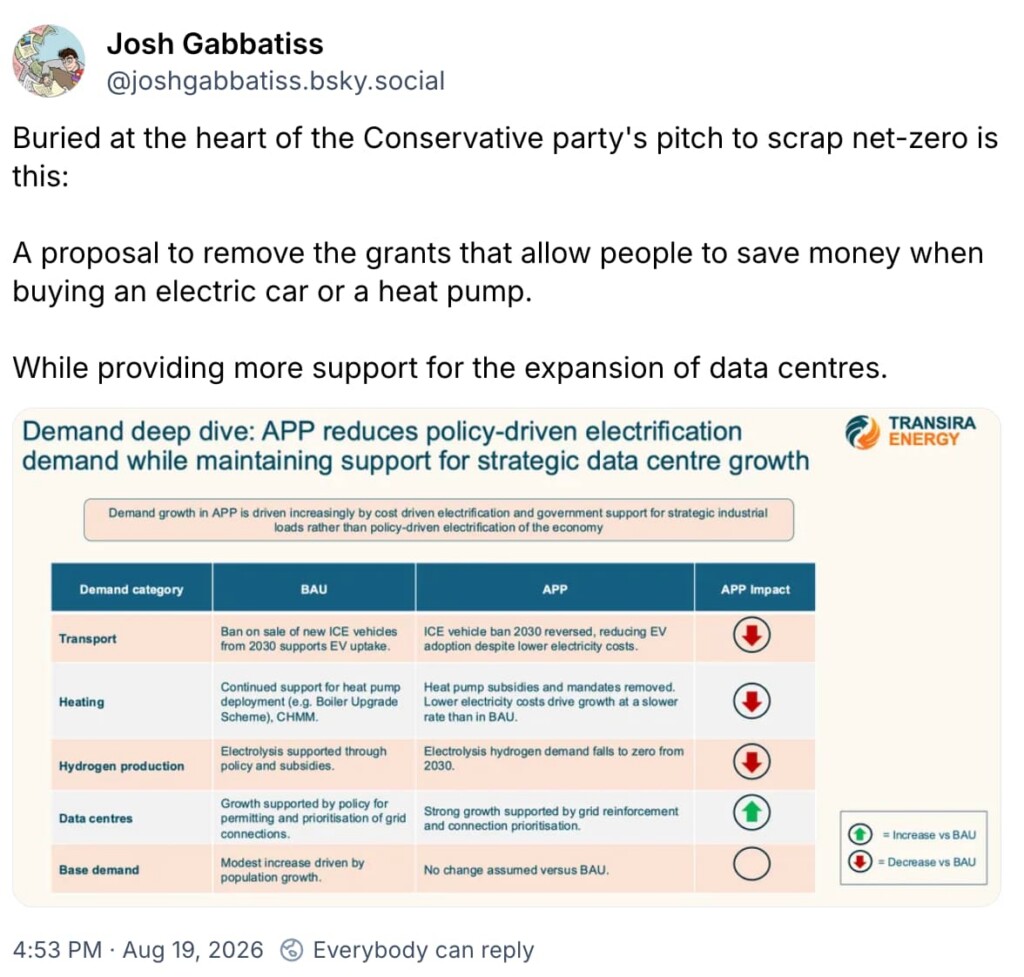
Contrary to Conservative claims, uptake of heat pumps and electric vehicles is actually expected to be slower in the alternative scenario, “despite lower electricity costs”.
This is due to the removal of supportive government subsidies and mandates, such as the boiler upgrade scheme and the 2030 ban on the sale of new petrol and diesel cars.
Overall electricity consumption is 7% lower in the APP, compared to the current pathway.
Daniela Quiroga, a senior associate at Copenhagen Infrastructure Partners, questions this reliance on lower electricity demand in the APP, telling Carbon Brief:
“While this is an interesting scenario to explore, it overlooks potentially important feedback effects – mainly, as electricity prices and the capital costs of electrification technologies fall, uptake would be expected to increase.”
A related point was made in a LinkedIn post by Tara Singh, chief executive of trade body RenewableUK, who noted:
“APP makes the electricity system cheaper partly by electrifying Britain less – while leaving the fuel costs that replace electricity outside the model.”
For example, Singh estimates that the extra petrol and diesel fuel expenditure to replace the missing electric vehicles (EVs) on the road could be around £65-95bn over two decades. These costs are not included in the APP scenario.
The only sector that sees increased power demand is data centres, due to policy support to “prioritise” new grid connections for these facilities.
Quiroga notes that the costs of accelerating data centre connections “are not mentioned at all” in the report.
In short, the proposed pathway involves removing grants that help households buy EVs and heat pumps, while providing more policy support for the AI industry.

Finally, Onward stresses the UK’s “high spark gap” – referring to the electricity-to-gas price ratio. This makes switching from gas boilers to heat pumps less appealing for consumers, given the relatively high price of electricity, compared to gas.
However, Matt Elliott, lead economic analyst at the Energy and Climate Intelligence Unit (ECIU), says the analysis does not indicate this gap would substantially change in the proposed APP. He tells Carbon Brief:
“The report claims that electrification would happen even without specific policies, simply due to lower retail electricity prices driving consumer choice. However, its own modelling indicates that the gas-electricity price ratio would actually rise in the early years and end up only marginally lower than today by 2050.”
In other words, in the APP the price of electricity compared to gas would not fall sufficiently to drive consumers towards heat pumps without subsidies or other incentives.
Rather than scrapping net-zero policies, analysts have suggested shifting tax and policy levies from electricity to gas, or breaking the link between wholesale gas prices and electricity, as more effective ways to reduce the spark gap.
Gas prices are unlikely to remain low and stable
The “alternative” scenario pushed by the Conservatives continues to rely heavily on gas for both electricity generation and heating.
This includes constructing new gas power plants in a bid to lower electricity prices, despite the fact that gas is the main driver of high electricity prices in the UK.
In recent years, the largest spikes in energy prices have been triggered by wars in Ukraine and the Middle East, which have disrupted fossil-fuel supplies and sent gas prices spiralling.
(Indeed, the report was published on the same day the Office for National Statistics announced that inflation had jumped to its highest rate in four months, due to energy costs surging because of the impact of the Iran war on global oil and gas supply chains.)
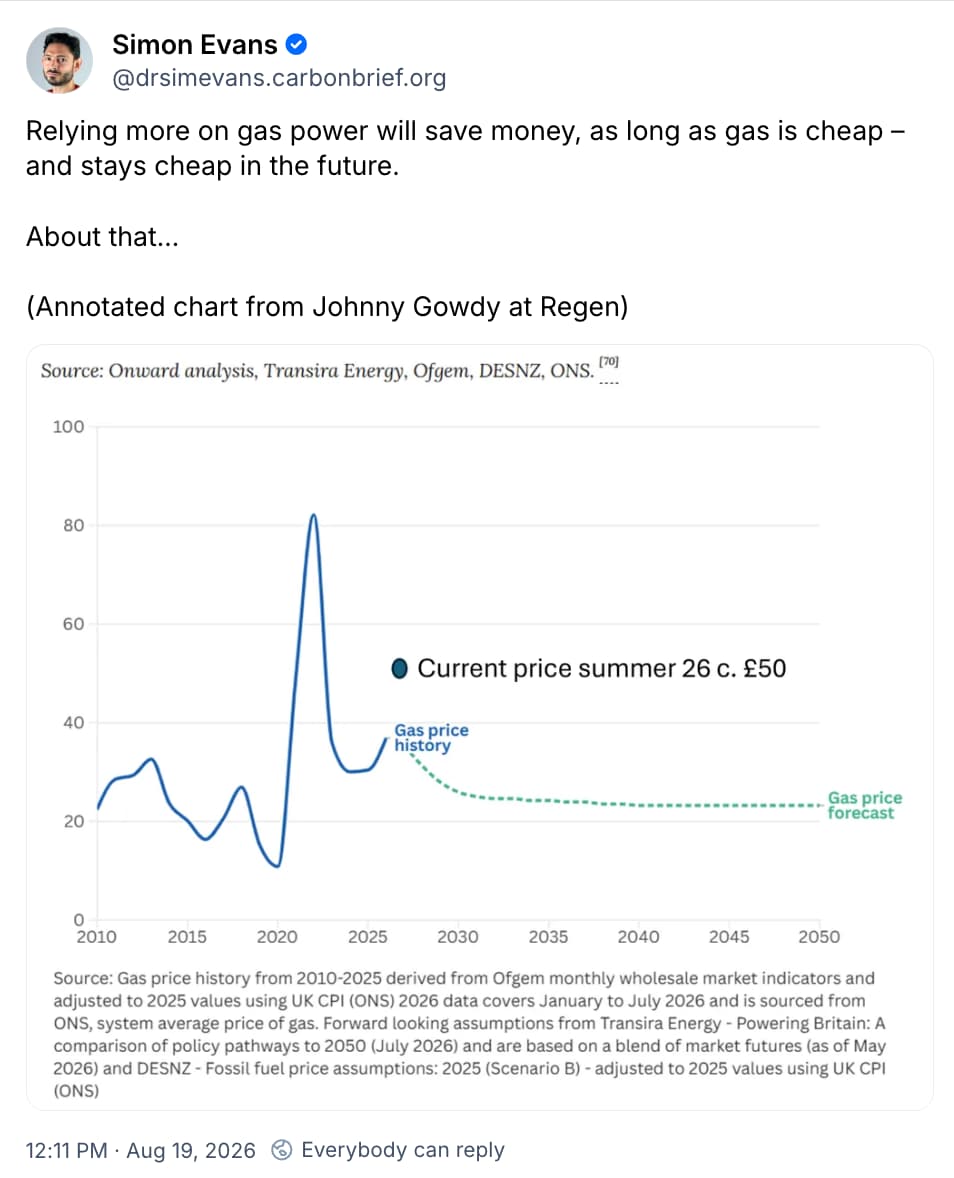
Despite this, the scenario set out by Onward assumes that gas prices drop to pre-conflict levels and remain that way for the next two decades.
Ashutosh Padelkar, research lead at Aurora Energy Research, tells Carbon Brief that the gas price assumptions are “hard to fathom” and significantly at odds with future expectations, from both Aurora and other market analysts.

Analysis by E3G and ECIU in 2025 concluded that four years of energy spikes caused by the post-pandemic demand surge and Russia-Ukraine war had cost the UK £183bn.
The Onward report acknowledges that the new scenario is “more exposed to a future gas price shock” than the current net-zero scenario. It suggests that a new spike could increase fuel costs in the gas-reliant scenario by another £6bn in 2040.
However, Onward argues that the impact of gas price spikes on consumers would be “significantly smaller” than the shock following Russia’s invasion of Ukraine. This is owing to existing renewable energy contracts and future nuclear power construction in the APP.
In the press release accompanying the new report, Conservative leader Kemi Badenoch is clear that “our plan means using our own oil and gas in the North Sea”.
This mirrors rhetoric that has been widespread on the right of UK politics, stressing the importance of expanding North Sea drilling as a way to cut energy bills.
However, given the relatively small volumes remaining in the North Sea, the UK will likely remain reliant on gas imported from the US and the Middle East.
Gas prices will still be set globally and remain subject to geopolitical turmoil, no matter where the UK sources its supplies.
Given this, Johnny Gowdy, director of the thinktank Regen, tells Carbon Brief that the scenario presented by the Conservatives is “a call to rely on imported gas, with global gas prices”.
The plan assumes gas plants are cheap to build
The Conservative plan involves building new gas power plants, in order to meet part of the nation’s growing electricity demand without relying on renewables.
Onward states that the UK “has lost firm generation capacity” – such as gas and nuclear plants – and replaced it with “intermittent”, or variable, power in the form of wind and solar.
To remedy this, its alternative pathway involves building an extra 21 gigawatts (GW) of gas power plants by 2050 – equivalent to around 20 new facilities. This is roughly a 70% increase from the UK’s current capacity.
However, the small print in the accompanying Transira Energy report explains that it assumes capital expenditure – the cost of building the power plants – is £650 per kilowatt (kW).
This is considerably lower than other recent analyses, which tend to cite capital expenditure figures that are more than double this estimate.
For example, a 2025 GridLab report notes that new US gas power plants set for completion in 2026 and 2027 had a cost range of $1,116/kW (£819/kW) to $1,427/kW (£1046kW).
However, it adds that more recent projects are “routinely reporting” costs of $2,000/kW (£1467/kW) or more. Other sources have reported up to $2,800/kW (£2054/kW).
Gas power plant costs have increased significantly in recent years – a trend that has been attributed to a tight supply of gas turbines worldwide.
This, in turn, is the result of increased demand for gas turbines to power data centres and countries transitioning from coal to gas.
The International Energy Agency (IEA) says data-centre demand in the US is “limiting the availability of turbines for near-term deployment elsewhere in the world”.
Nuclear faces high costs and delivery challenges
The Onward report champions a substantial increase in nuclear power capacity.
However, it fails to explain how this could be facilitated or why its cost assumptions are lower than the most recent nuclear projects in the UK.
Within the report’s net-zero scenario, there is 13.3GW of nuclear power by 2050, roughly double the current capacity. It notes that this will be financed under the regulated asset base (RAB) model – a government-backed funding approach announced in 2022.
Under the APP scenario, nuclear power capacity more than triples from current levels to 20GW by the middle of the century, all backed by the RAB model.
The report adds:
“Reducing nuclear construction costs and timelines becomes the core energy priority of the UK government, with measures to improve the availability of sites and grid connections.”
The report acknowledges that the APP scenario “faces significant cost headwinds from expensive nuclear capacity”.
However, it suggests that large-scale nuclear power stations built in the 2040s could cost £122-£138 per megawatt hour (MWh) in 2025 terms.
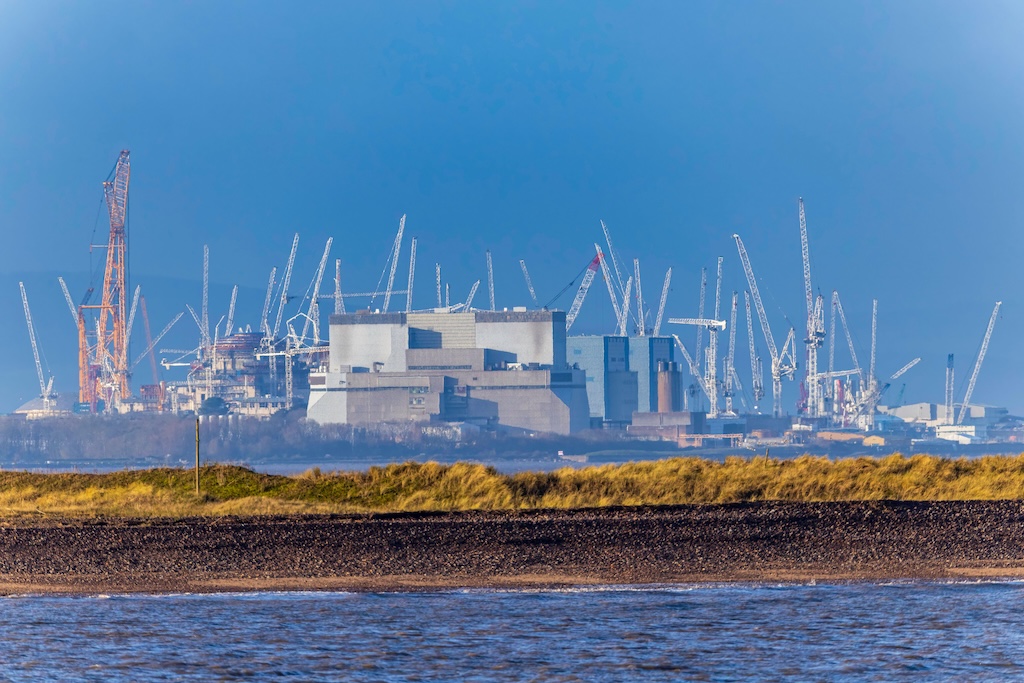
Hinkley Point C – which in 2018 became the first new nuclear power plant to begin construction in the UK since the 1980s – has a “strike price” of £138/MWh for 2030. (This is the fixed price for the electricity it will generate, guaranteed by the power plant’s contracts for difference agreement.)
This price is at the top end of Onward’s forecast range for “levelised cost of electricity” (LCOE) – the average total cost of building and operating an asset over its lifetime.

As such, the report suggests, on average, costs will fall over the course of the decade from 2030, but provides little detail as to how this would happen.
As Richard Howard, global research director at Aurora, wrote on LinkedIn, the cost assumptions for nuclear are “optimistic”. He adds:
“It assumes that the LCOE of nuclear will fall 10-20% below the *original* cost of Hinkley Point C, when we know that nuclear costs escalated massively since the HPC deal was struck. The UK does not have a great track record of managing down the costs of nuclear.”
In fact, Sizewell C – a replica of Hinkley Point C in the early stages of construction in Suffolk, which received a final investment decision in 2025 – has a considerably higher strike price of £150/MWh in 2039.
Hinkley Point C is the first new nuclear power plant to be built in 30 years in the UK. It has been beset by delays and nearly doubled in cost since it was originally approved.
A footnote in the Transira Energy report adds that its calculations for the cost of nuclear include expected capital expenditure for new large-scale plants ranging from £10,000/kW to £12,500/kW.
While the 3.26GW Hinkley Point C was originally supposed to have a price tag of £18bn, which would equate to £5,521/kWh, costs have repeatedly increased. More recent estimates from developer EDF suggest a figure of £10,736/kW, closer to Onward’s figure.
However, if this is adjusted for inflation for 2026, this jumps closer to £14,724/kW.
As such, the upfront cost of new nuclear is already around £2,500 more per kilowatt than the assumptions in the report for 10 years from now.
The report provides limited information about how these costs would fall so substantially.
It suggests that the recommendations from the 2025 Fingleton review should be implemented in full to cut the cost of the technology.
The Fingleton report – a full review of the UK’s nuclear sector by the Nuclear Regulatory Taskforce, led by John Fingleton – found an “overly complex” and “bureaucratic” system was holding back the nuclear industry. It advocated for “smarter regulation”, as an overhaul of the planning regime.
In March 2026, the Labour government committed to full implementation of the Fingleton review by the end of 2027. Despite this, the Onward report includes the implementation of the Fingleton review in the APP scenario, but not the net-zero scenario.
The report’s high network cost estimates do not ‘add up’
The biggest drop in costs outlined in the Onward APP scenario comes from a reduction in network costs, but experts have said that this “just doesn’t add up”.
Network costs are broadly made up of the price of building, maintaining and operating the transmission and distribution systems.
A reduction in network spending accounts for £137bn of the £320bn in “savings”, compared to the net-zero scenario that sees significant network expansion to help facilitate more renewables on the grid.
This drop is “thanks to a higher utilisation of firm power system with supply located closer to demand”, the report says.
In particular, the report points to discrepancy between the “best wind resources” being located in the north of Scotland, while the major centres of demand are in the southeast of England. As such, currently grid expansion is needed to avoid constraints or the requirement to curtail generation in windy periods with low demand.
By avoiding the connection of geographically dispersed generation assets, such as 78GW of generation, storage and interconnectors, the APP scenario can reduce total network costs by 43%, according to the report.
Staffell tells Carbon Brief that the £137bn saving has “a convincing story to it – if we build more fossil and nuclear capacity we can utilise the system better”.
However, he adds that Onward gives “so little detail about how this works that it’s hard to comment”.
The Transira Energy report notes that the APP still includes £19bn in investment for the electricity network, covering the cost to maintain the existing system and connect new gas and nuclear generation.
However, this 86% drop in new transmission investment compared to the BAU scenario leans on “flawed logic”, according to Tara Singh from RenewableUK.
On LinkedIn, she explained that it “rests on an extraordinarily aggressive assumption about how little grid Britain will need”, adding:
“Onward assumes £137bn of new transmission assets under BAU between 2030 and 2050, but only £19bn under their plan, even though by 2050 it still has 32m EVs/hybrids, more than 6m additional heat pumps, 45GW gas, 20GW nuclear and – particularly strikingly – 62 terawatt hour (TWh) a year of datacentre demand. Is this grid figure credible…?”
Beyond this, the report also attributes a significant portion of the proposed savings to cuts in “balancing costs”. These are the costs to the system operator of balancing electricity supply and demand.
It claims that having more firm generation located closer to demand and existing transmission infrastructure will “save billions of expenditure on network expansion and balancing costs”.
Onward suggests that under the APP scenario, the cost of keeping generation and demand balanced would fall by £67bn.
However, claiming savings by both cutting network expansion and balancing costs amounts to “double counting” and “just doesn’t add up”, according to Aurora’s Padelkar.
He tells Carbon Brief that including both high capital expenditure for the electricity network and high balancing costs in the BAU scenario is “difficult to reconcile”.
Expanding the electricity network would reduce constraints, reducing the need for constraint management. Such a move would lower balancing costs.
As noted by the National Energy System Operator (Neso), retaining the current transmission network into 2030, with no expansion, would mean constraint costs could reach around £12.7bn a year. But building new network capacity could cut costs by as much as 75%.
Padelkar says:
“They’re saying ‘we continue to invest in the network’…But somehow the network [balancing] costs just don’t come down…This is basically saying ‘we’re paying both to fix the problem and to have the problem’. You can have one of the two, but you can’t have both.”
Despite the claim that the APP approach will lead to the cheapest electricity, Padelkar says that the report does not present a “consistent picture” as to how the system would operate, pointing to the approach to network and balancing costs. He adds:
“Overall, we would expect that once these figures are correctly accounted for, that renewable energy would remain the cheapest form of a form of decarbonisation. I would even further flip the argument around, to say that decarbonisation is not a prerogative [on] its own, but because it also achieves lowest total costs.”
The system integration costs are ‘far out of line with mainstream thinking’
A central argument in the Onward report is that the costs of renewables are higher than often claimed by proponents, due to the wider system costs of having a large amount of “intermittent” generation.
As such, it proposes pulling back support for wind and solar, and instead putting focus on “firm generation” sources, particularly gas and nuclear power.
This relies heavily on the claim that “system integration costs” for wind and solar are much higher than is being “properly revealed” in either contracts for difference (CfD) auctions or levelised costs estimates.
(CfD’s are power contracts between generators and the government, which work as the UK’s main method for supporting the development of renewables by providing long-term price certainty to developers.)
Therefore, when assessing the overall cost of renewable energy, the cumulative network investment, balancing and ancillary services system costs necessary to manage such variable generation must be considered, it suggests.
The existence of integration costs is not widely understood, but the scale of their impact is disputed.
The report continues that if these costs are taken into account, the “marginal system integration costs” of renewables are “much higher than their individual levelised costs”.
Onward suggests that the cost to integrate additional offshore wind, onshore wind and solar onto the electricity system is £125/MWh. This is far higher than the cost of generating electricity from these sources in the first place.
The figure has been challenged by a number of commentators, with Staffell telling Carbon Brief that this is “very far out of line with mainstream thinking”.
Analysis published in Nature suggests that if 80% of the electricity mix comes from renewables, the system integration cost is around €30/MWh (£26/MWh).
Elsewhere, engineering firm Afry put the total cost of electricity at around £55-75/MWh in a high-renewable system. This is “less than [Onward’s] integration cost alone”, Staffell adds.
The high price tag of the £128/MWh marginal integration “is derived by apportioning additional balancing and transmission costs solely to 60GW of new wind and solar deployed from 2030 onwards”, explains Callum MacIver, research fellow at the University of Strathclyde and the UK Energy Research Centre.
He adds:
“[This figure] only looks at the cost side and there is not enough published detail on where the renewables are deployed and the transmission upgrades it triggers to critique the scale of the numbers presented.
“It also excludes potential wider system benefits of further renewables deployment, including reduced wholesale prices, avoided fuel and carbon costs and reduced exposure to future external gas price shocks, which are properly examined by looking at overall system costs and testing various sensitivities including different gas price futures.”
Writing on LinkedIn, Adam Bell – a partner at consultancy Stonehaven – suggests that the £125/MWh system costs are “really egregious”. He explains:
“The ‘system costs’ of renewables…rests on assuming that all additional network upgrades and balancing costs for a net-zero system after 2029 are attributable to additional renewables deployed in that net-zero system.
“Many of those costs relate to existing renewables as well as nuclear, so this likely overstates system costs by an order of magnitude [roughly 10-fold].”
Furthermore, the system costs for the APP scenario are not fully accounted for in the report. Regardless of the technology mix, old network and generation assets will need replacing, adding additional costs to the system.
The proposed changes could undermine investor confidence
The APP scenario involves stripping back all support for renewables going forward.
It calls for the CfD scheme to end in 2030. Pre-existing CfD contracts would continue under APP, but after this decade, all further support would “exclusively” be for nuclear power.
Additionally, the renewable obligation (RO) payments for existing wind and solar would end from 2033. These are legacy contracts signed ahead of the scheme closing to new applicants in 2017. Payments are expected to continue until 2037.
(Onward makes an exception for the large-scale biomass power plant owned by Drax, which already has a contract with the UK government to switch from an RO to a low-carbon “dispatchable CfD”. This switch is included under both the net-zero and APP scenarios, in recognition of the “importance of its contribution to generation and to system stability”.)
Both the CfD and RO schemes have contributed significantly to the expansion of the renewable energy sector in the UK. For example, despite coming to an end in 2017, nearly 30% of current electricity supplies are still covered by RO contracts.
It is unclear from the report what the 10GW of capacity currently expected to receive the RO would do beyond 2033.
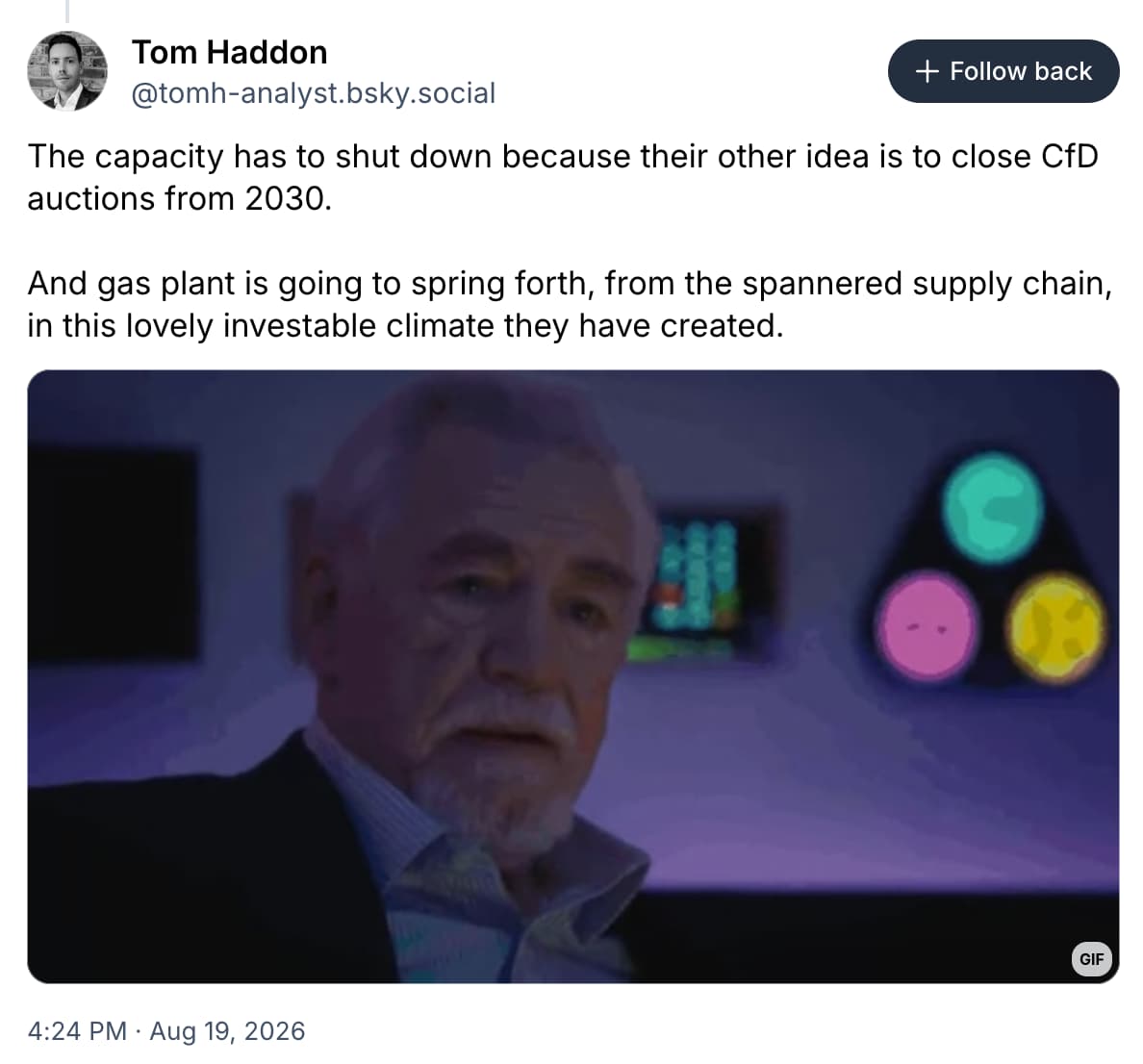
Writing on Bluesky, Tom Haddon, senior economist at Arup, says that if, as the APP scenario proposes, the UK “bin[s the] RO”, this could force 10GW of renewable capacity still on the system to simply shut down after 2033.
Such a dramatic change to a longstanding support system could have an impact on investor confidence.

Padelkar tells Carbon Brief that energy investors are often involved in numerous technologies. He adds:
“You wouldn’t be able to say ‘yeah, not going to continue honouring this contract [for renewables], but I expect you to sign this new one for me [to build new nuclear]’. That just wouldn’t work.”
As such, there is no guarantee that investors would agree to enter into government-backed RAB contracts to develop nuclear power plants, having just seen government-backed RO contracts being reneged on four years early.
Carbon market ‘savings’ are ‘just rearranging things on a spreadsheet’
One of the large chunks of “savings” identified to bring down electricity prices in the Onward report is £94bn from “lower wholesale prices, thanks to the removal of carbon taxes”.
This refers to removing power plants from the UK emissions trading scheme (UK ETS) from 2031.
Onward argues that this reduces the cost of gas power plants, which frequently set wholesale power prices under the marginal pricing system.
Staffell tells Carbon Brief that this is a “concern” when considering the report’s findings:
“That is £94bn no longer going into the government coffers, so it’s not saving the country any money; it’s just rearranging things on a spreadsheet. This lowers electricity bills, but does that get compensated for by higher taxes elsewhere, or do we have to take on a larger national deficit, or does it go hand-in-hand with cutting public services?”
Tom Edwards, a consultant at Cornwall Insight, wrote on Bluesky that it would be “madness” to simply remove the UK ETS and “expect things to remain stable”.
The UK currently sources around a tenth of its electricity via interconnectors that link its grid up with Ireland and parts of mainland Europe. It also exports electricity to other European countries when it has surplus supply.
These relationships would be complicated if the UK abandoned its carbon price on electricity altogether.
The UK and EU have been negotiating over linking their carbon pricing systems, which would involve the UK navigating the EU’s carbon border adjustment mechanism (CBAM).
Alongside ending support for renewables, the new Onward scenario also removes subsidies for new interconnectors, although it says “existing interconnectors will continue”.
The Transira Energy analysis says there would be “new cross-border trading arrangements” from 2031. Such “arrangements” would, presumably, need to be negotiated from scratch with the EU.
Specifically, the report proposes a “carbon reference price” for electricity sold to the EU to “prevent carbon leakage and the distortion of cross-border electricity flows”.
Adam Berman, policy director at Energy UK, pointed out that the post-Brexit trade and cooperation agreement between the UK and the EU includes a legal commitment by the UK to maintain a carbon price on electricity. He wrote that the Onward proposal “would run contrary to that agreement”.
The report ‘grossly simplifies’ long-duration energy storage
The Onward report states that it would cancel support for long-duration energy storage (LDES), such as large batteries and pumped hydropower.
This follows the government recently launching a “cap-and-floor scheme” to support the technology. In June 2026, the nation’s energy regulator Ofgem identified 16 LDES that it is “minded to” support under the new scheme.
LDES can store power across days, weeks or even seasons, helping to boost electricity system security. Analysis by analytics company LCP Delta suggests that rolling out LDES technologies could cut energy system costs in the UK by more than £24bn between 2030 and 2050.
Onward lists support for storage systems – including LDES, as well as smaller batteries, which are only briefly mentioned in the report – as one of the “costs of an intermittent-first, low-carbon electricity system”.
As such, alongside cuts to support for renewable energy technology, the APP scenario includes ending the cap-and-floor scheme for LDES. (See: The proposed changes could undermine investor confidence)
The report suggests that even if all 16 of the projects shortlisted by Ofgem were built, the total would only provide around five and a half hours of generation.
It adds: “This is not enough to make it through a winter spell of low wind and sun”.
This assertion is based on the total storage capacity of all the projects being 136GWh.
However, the report “grossly simplifies the operation of LDES”, explains Padelkar. He adds:
“This assumes a rate of discharge that the fleet doesn’t have. Further, this LDES capacity would play a key role in reducing the balancing and ancillary costs, even in the early 2030s, by helping absorb cheap wind generation in Scotland in constrained periods and then discharging it when the transmission from Scotland to the south of Great Britain is not constrained.”
The role of LDES is more complex than simply all projects providing the entire electricity demand for the nation in one go. The projects are designed to act together with other assets to absorb excess supply, smooth out peaks in demand and step in to provide cheaper power when prices spike.
Related

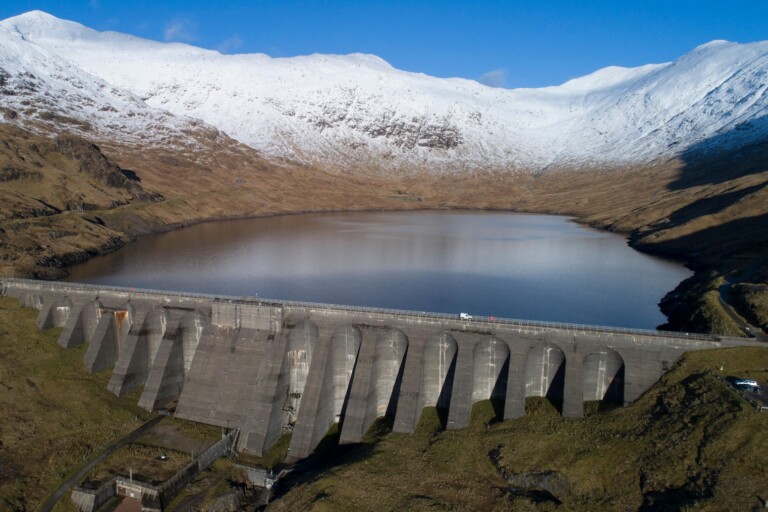
Q&A: What is ‘long-duration energy storage’ – and why does the UK need it?
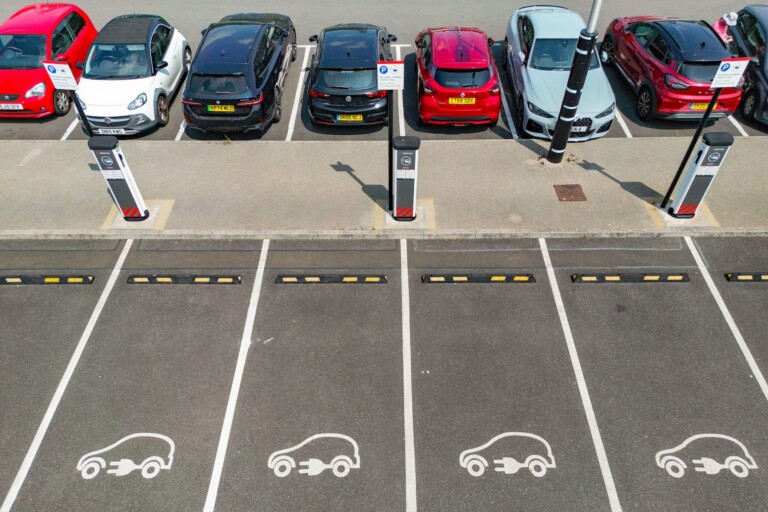
Analysis: Weaker EV targets could cost UK consumers £3bn a year by 2030
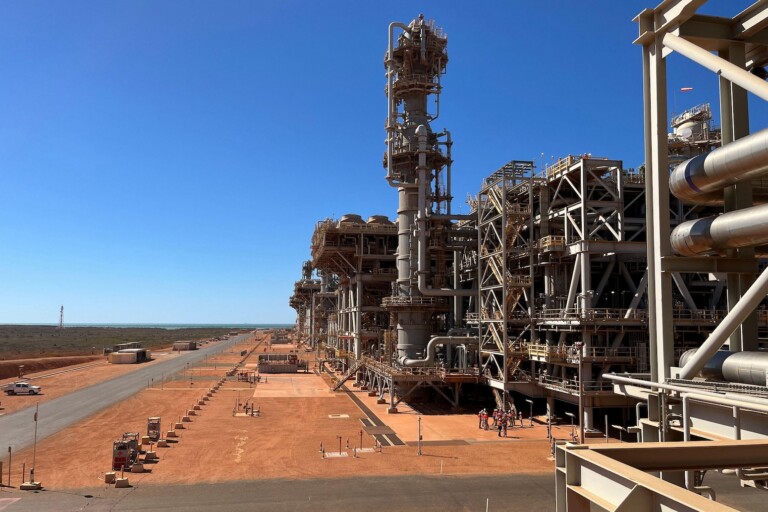
Q&A: Does the world need ‘carbon capture and storage’ to reach net-zero?

UK withdraws millions in funding from world’s second-largest rainforest in Congo
The post Factcheck: 10 flaws in the Conservative report on ‘cheap power’ appeared first on Carbon Brief.
Factcheck: 10 flaws in the Conservative report on ‘cheap power’