Carbon Footprint
EU Sets Global Benchmark for Permanent Carbon Removals and Carbon Farming


The European Union (EU) has taken a major step toward climate neutrality. The European Commission adopted the first certification methodologies under the Carbon Removals and Carbon Farming (CRCF) Regulation. These rules define how projects that permanently remove carbon dioxide from the atmosphere can be verified and certified across Europe.
Wopke Hoekstra, European Commissioner for Climate, Net-Zero and Clean Growth, stated,
“The European Union is taking decisive action to lead the global effort in carbon removals. By establishing clear, robust voluntary standards, we are not only fostering responsible and climate action within Europe but also setting a global benchmark for others to follow. This is a vital step toward achieving our climate neutrality targets and ensuring a sustainable future.”
Why Certification Is Critical for Carbon Markets
Carbon removals are key to meeting climate goals. Even with big emission cuts, some sectors will still release greenhouse gases, and removals can offset them.
Trust is crucial. Without clear rules, companies could overstate their climate claims, investors may hesitate, and policymakers risk losing confidence. The CRCF methodologies solve this by defining how to measure removals, ensure permanence, and manage risks. This builds credibility and reduces greenwashing.
The CRCF Regulation creates the EU’s first voluntary system to certify carbon removals, carbon farming, and carbon storage in bio-based products. It sets clear rules for what counts as a verified tonne, how to keep it permanent, and how to handle risks.
By turning carbon removals into a structured market, the framework supports innovation, attracts investment, and strengthens the EU’s path to net zero by 2050.
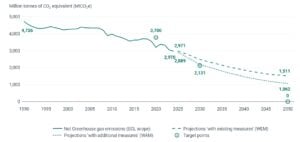
Progress towards achieving climate targets in the EU-27

Three Carbon Removal Technologies Covered
The news release revealed that the Commission selected three carbon removal pathways for the first certification methodologies. These technologies are mature and can scale in the near term.
-
Direct Air Capture with Carbon Storage (DACCS)
DACCS removes CO₂ directly from ambient air. Machines capture CO₂ and store it underground in geological formations. This approach is highly permanent because the CO₂ stays locked away for thousands of years.
DACCS is expensive today, but it has strong long-term potential. Clear certification rules could accelerate private investment and government support.
-
Biogenic Carbon Capture and Storage (BioCCS)
BioCCS captures CO₂ from biomass-based processes, such as bioenergy plants. Since plants absorb CO₂ as they grow, capturing and storing emissions can result in net negative emissions.
This pathway could help industries decarbonize while producing energy or materials.
-
Biochar Carbon Removal (BCR)
Biochar is a stable form of carbon produced by heating biomass in low-oxygen conditions. When applied to soil, biochar can store carbon for centuries and improve soil health.
This method links climate mitigation with agriculture and soil restoration.
From Policy Design to Real Project Deployment
With the certification framework in place, carbon removal projects can now apply for EU certification. This marks a shift from rule-setting to real-world implementation.
Certification schemes must apply for recognition by the European Commission. The Commission will assess them using a standardized protocol that checks compliance with EU climate rules and audit standards.
Once certified, projects can issue verified carbon removal credits. These credits could attract corporate buyers, governments, and financial institutions that want high-quality climate offsets.
Upcoming Rules for Carbon Farming and Bio-Based Construction
The Commission plans two additional delegated regulations by 2026. These will expand the CRCF framework beyond industrial carbon removals.
One regulation will cover carbon farming practices such as improved agricultural methods, agroforestry, peatland rewetting, and afforestation. These rules could allow farmers and foresters to earn payments for storing carbon, helping them diversify income and adopt resilient practices.
Another regulation will cover carbon storage in bio-based construction materials. This will help building owners prove the carbon storage performance of buildings and encourage the use of circular bioeconomy materials in construction.
EU Buyers’ Club and Funding Support
To jumpstart the voluntary carbon removal market, the Commission announced an EU Buyers’ Club. This initiative will connect buyers with certified carbon removal projects and help create early demand.
The EU is also exploring ways to mobilize public and private finance. Existing funding tools such as the European Innovation Council and the Innovation Fund already support innovative carbon removal technologies.
Together, policy support and financing could accelerate the deployment of carbon removal solutions across Europe.
Governance, Audits, and Transparency
The CRCF framework builds on earlier EU rules that define certification bodies, audit procedures, and governance structures. Certification schemes must meet strict requirements for quantification, permanence, and sustainability.
The methodologies were developed with input from the Carbon Removal Expert Group. All preparation documents and meeting recordings are publicly available, which improves transparency and trust.
This governance structure aims to ensure environmental integrity while keeping administrative complexity manageable.
Carbon Removals and the EU’s Net Zero Strategy
The EU’s goal of climate neutrality by 2050 is legally binding under the European Climate Law. Carbon removals play a critical role in reaching this target because some emissions are hard to eliminate.
The CRCF framework aligns with the European Green Deal and the EU’s commitments under the Paris Agreement. It also supports the EU’s long-term climate strategy submitted to the United Nations.
Emissions Trends Highlight the Challenge Ahead
Recent data shows the difficulty of balancing economic growth and emissions reduction. EU greenhouse gas emissions reached about 900 million tonnes of CO₂-equivalent in the first quarter of 2025, up 3.4 percent from the previous year. During the same period, GDP grew by 1.2 percent.

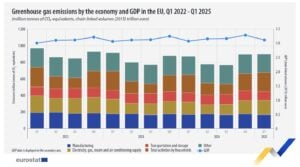
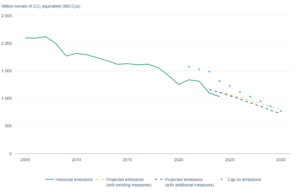
This shows that economic activity can still drive emissions upward, even with climate policies in place. The EU Emissions Trading System has helped reduce emissions from power and industry by 51 percent since 2005. However, aviation emissions have rebounded close to pre-pandemic levels.
The EU aims to cut ETS-covered emissions by 62 percent by 2030 compared to 2005. Carbon removals will complement these policies and help close the remaining gap to net zero.
Fig: Historical and projected emissions from stationary installations covered by the EU Emissions Trading System in the European Economic Area

What This Means for Industry and Investors
The CRCF methodologies create a structured market for carbon removals. This could attract startups, large companies, and institutional investors. To summarize:
- Certified carbon removals provide high-quality offsets for net-zero strategies and reduce reputational risk for companies.
- Clear rules reduce uncertainty and improve project evaluation for investors.
- The framework provides a scalable tool for responsibly managing negative emissions for policymakers.
Despite progress, challenges remain. Carbon removal technologies are still expensive and require large infrastructure investments. Long-term liability for stored CO₂ remains complex and requires legal clarity. Demand for carbon removals is still uncertain, especially outside voluntary markets.
However, the CRCF framework provides a strong foundation for addressing these issues and building a credible market.
Final Take: A Global Benchmark for Carbon Removals
The EU’s move positions it as a global leader in carbon removal governance. Only a few regions have such detailed certification rules. Other countries may adopt similar frameworks, and global standards could emerge.
The post EU Sets Global Benchmark for Permanent Carbon Removals and Carbon Farming appeared first on Carbon Credits.