Climate Change
DR Congo’s power-hungry mining sector drives record solar surge

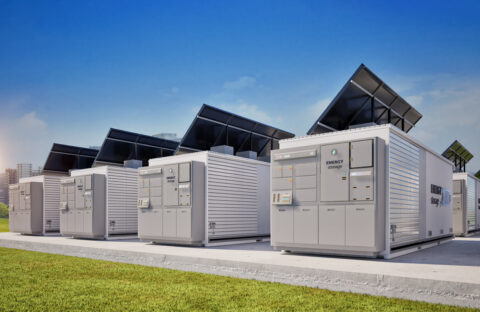
More than 300,000 solar panels and 120 battery containers are helping to power Africa’s largest copper mine with continuous clean energy in the Democratic Republic of the Congo, as miners turn to solar as an alternative to expensive diesel and energy imports.
The project at the Kamoa Copper mine in the south of the DRC, which became operational last month, is one of the largest solar and battery facilities generating baseload power on the continent.
The clean electricity is displacing millions of litres of polluting diesel and costs less than a fifth of the price of generator power per kilowatt hour, the mining company said.
The project is part of a massive solar deployment across the continent. Recent data from global energy think-tank Ember found record solar capacity of 17 GW will be installed in Africa this year – a 45% rise from 2025.
Installed by CrossBoundary Energy, a developer of distributed renewable energy systems, the solar-battery facility at the DRC mine is “proof of concept” that solar and battery systems can provide the reliable power at scale needed by remote industrial operations, Annebel Oosthuizen, managing director at Kamoa Copper, told Climate Home News in an interview.
“There’s always been this perception in the DRC that solar isn’t ideal because it is raining half of the year. But it’s perfectly ideal. We are seeing a lot of interest from other mines that are still depending on generators and power imports,” she said.
Mining drives solar and battery surge
Like Kamoa Copper, a growing number of miners in the DRC are looking to solar power to compensate for the country’s chronic energy deficit at a lower cost as global diesel prices hit record highs amid ongoing attacks on oil infrastructure in the Middle East.
As a result, the mining sector has become a key driver of the country’s growing clean energy demand and one of the biggest importers of large-scale solar equipment.
Ember found the DRC is set to install a record 1.7 gigawatts (GW) of solar panels this year – a 544% increase compared to 2025 and the equivalent of adding more than 60% of the country’s entire 2023 grid capacity.
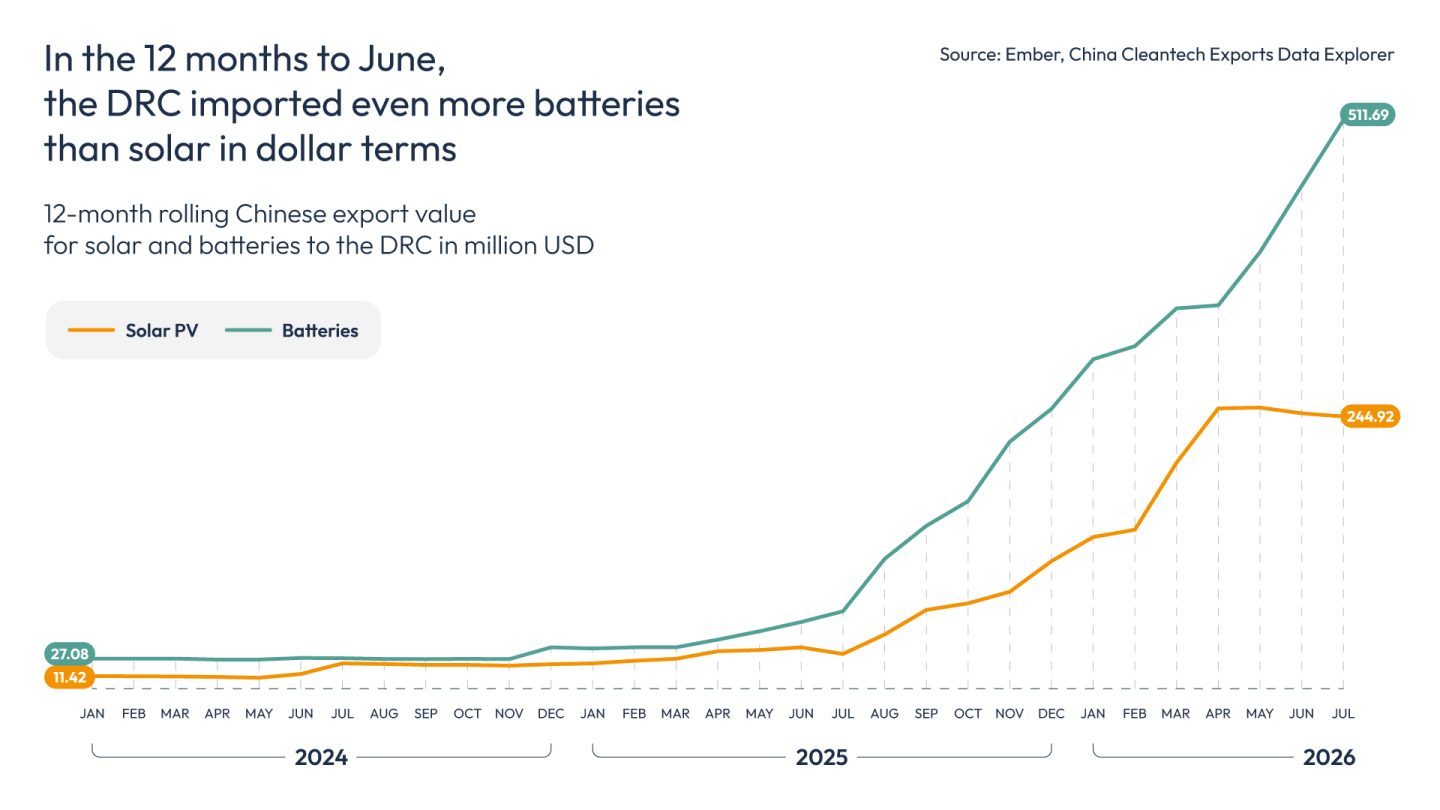
The deployment of combined solar and battery storage solutions to deliver stable energy supplies to mines has also caused battery imports to surge. In dollar terms, the DRC’s imports of batteries from China far exceeded that of solar in the year to June 2026, according to Ember.
A crippling power deficit
The DRC holds significant energy resources and some of the world’s largest reserves of the minerals required to manufacture clean energy technologies. It is the world’s largest producer of cobalt, which is needed to make batteries, and Africa’s top producer of copper – a metal sought after for its electrical conductivity which is pivotal to the world’s electrification efforts.
Yet just 22.5% of the DRC’s population had access to electricity in 2024 – one of the lowest rates in the world, according to the World Bank. And as mining expands and more of the minerals extracted are being processed in the country, unreliable power supply has become a major constraint for the sector, which contributed to more than a quarter of the country’s GDP in 2024, excluding oil and gas.
The country has enormous hydropower potential, with the hydroelectric potential of the Congo River estimated at around 100 GW. But only a fraction is being harnessed.
-
Made in Nigeria: The race to build an African solar industry from scratch
A solar power revolution is gathering pace in Africa and Nigeria wants a slice of the fast-growing industry, but competing with Chinese imports won’t be easy -
Can giant batteries unlock Africa’s green industrial future?
Battery energy storage systems (BESS) could drive clean tech manufacturing in Africa but shortfalls in finance and data are still limiting deployment at scale -
Egypt seeks to unlock renewable potential to power regional clean energy hub
Europe is investing in Egypt’s bid to position itself as a clean electricity exporter to reduce its emissions and generate a new source of income



Still, virtually all of the DRC’s grid-connected electricity is generated by hydropower by the state-owned utility, Société Nationale d’Électricité (SNEL).
The electricity then has to be transported more than 1,500 kilometres to reach the mining belt in the south – a challenge made more difficult by ageing grid infrastructure and limited transmission capability. SNEL did not respond to a request for comment.
“It is estimated that there’s around a 1 GW energy deficit for the DRC mining sector,” said Matt Tilleard, CEO of CrossBoundary Energy, which owns the solar and battery equipment at the Kamoa Copper mine and provides the power as a service.
“The interest in solar from the mining industry is not theoretical – it is already translating into large-scale solar and battery procurement for mining operations in the region,” he added.
Solar displaces gas, saves energy costs
The facility installed by CrossBoundary is part of a plan by Kamoa Copper to supply more of the electricity it needs with solar energy and batteries as its operations expand, a faster solution than relying on harder-to-build hydropower projects.
“Our processing capacity has increased drastically over the last couple of years. We’ve constructed the largest copper smelter in Africa and that is so power-intensive,” said managing director Oosthuizen.
A joint venture between Canadian firm Ivanhoe Mines, Chinese company Zijin Mining Group and the DRC government, the mine needs 235 megawatts (MW) of power, which is expected to nearly double to 450 MW in the next five years.
Kamoa Copper currently receives 100 MW from state utility SNEL – “and the rest we have to find a solution for”, said Oosthuizen.

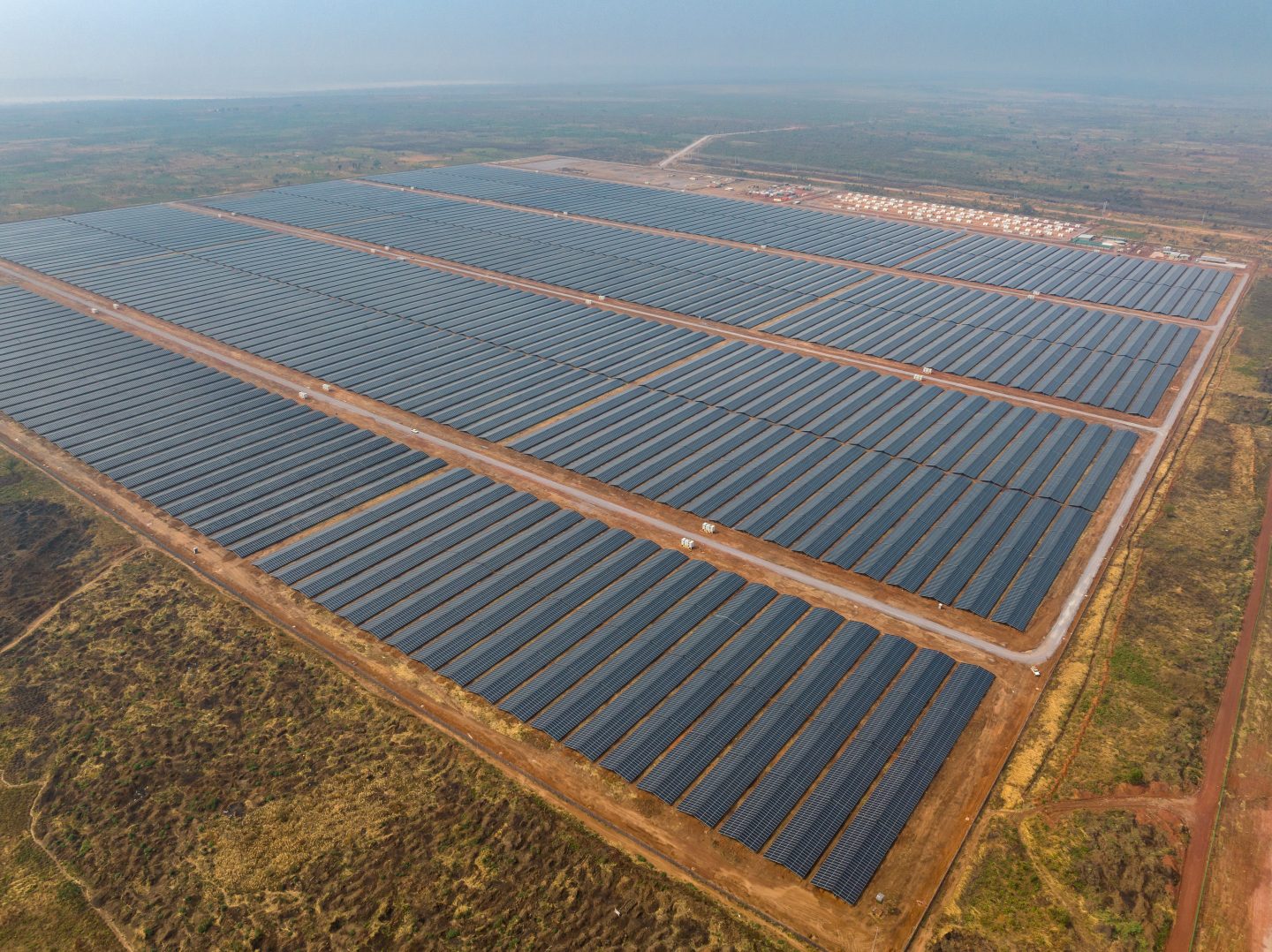
Another 30 MW solar and battery baseload facility is expected to come into operation this month, enabling around 25% of the mine’s power needs to be generated by solar energy. An additional 60 MW of continuous solar power will be added by the end of 2027, and the company is exploring options for more solar capacity and two hydropower projects.
The operational 30 MW of clean electricity provided by CrossBoundary Energy will power pumps that prevent 400 million litres of water from flooding the underground mine every day.
In August alone, the facility has reduced the mine’s diesel consumption by around four million litres, generating an estimated $11 million dollars in savings at current diesel prices, Oosthuizen said.
The mine still relies on generators to meet a 20-40 MW deficit and to power the trucks used in the mine, which Oosthuizen said would be difficult to electrify in the next five years because the technology isn’t yet ready to operate in the mine’s tough and wet conditions.

Avoiding a two-speed transition
To prevent a major imbalance between industrial players’ access to clean, reliable energy and the millions of Congolese who remain without power, the government requires private electricity producers to reserve at least 10% of their generated power for local communities living near rural production sites.
Delivering this, combined with rural electrification, mini-grid development and national grid expansion, is critical to prevent a two-speed energy transition that leaves people behind, said Catherine Mukobo, head of ACERD, the Congolese Association for Renewable and Decentralised Energies.
“Without implementing these policies, the DRC could get in a situation where mines have access to abundant modern energy while a large part of the population remains without electricity,” she said.
The post DR Congo’s power-hungry mining sector drives record solar surge appeared first on Climate Home News.
DR Congo’s power-hungry mining sector drives record solar surge