Carbon Footprint
DOE and Amazon Partner to Secure Critical Minerals Through AI-Driven Recycling


The U.S. Department of Energy is intensifying efforts to secure critical minerals as global supply risks rise. In a new collaboration, the DOE’s Ames National Laboratory and the Critical Materials Innovation Hub have joined hands with Amazon to recover high-value materials from waste.
The partnership focuses on extracting battery-grade graphite and key minerals from discarded textiles and electronic waste. This move reflects a broader U.S. strategy—reduce import dependence, build domestic capacity, and create a circular supply chain for critical materials.
Assistant Secretary of Energy (EERE) Audrey Robertson, leading DOE’s Office of Critical Materials and Energy Innovation, said:
“At scale, the recovery of critical minerals from end-of-life technologies and textile waste has the potential to transform our domestic critical materials supply chains. This pioneering work, made possible by an exciting new partnership with Amazon, supports the Trump Administration’s efforts to reduce our reliance on foreign imports and strengthen our national security.”
U.S. Aims for Domestic Graphite Supply
The collaboration combines materials science with artificial intelligence. Ames Lab and CMI bring decades of expertise in metals refining and advanced materials. Amazon contributes AI, logistics, and large-scale supply chain capabilities.
Ames Laboratory Director Karl Mueller also noted,
“This is an excellent match for Ames National Laboratory’s deep expertise in materials science. For decades, Ames Lab has led the nation in metals refining, purification, and critical materials research—and applying that strength to real-world challenges.”
Turning Textiles into Battery-Grade Graphite
A major project aims to convert discarded textiles into battery-grade graphite. This is significant because graphite is essential for lithium-ion batteries used in electric vehicles (EVs) and energy storage systems.
Today, the U.S. remains heavily dependent on imports for graphite. In fact, more than 90% of global battery-grade graphite processing is concentrated in China, creating a major supply risk.
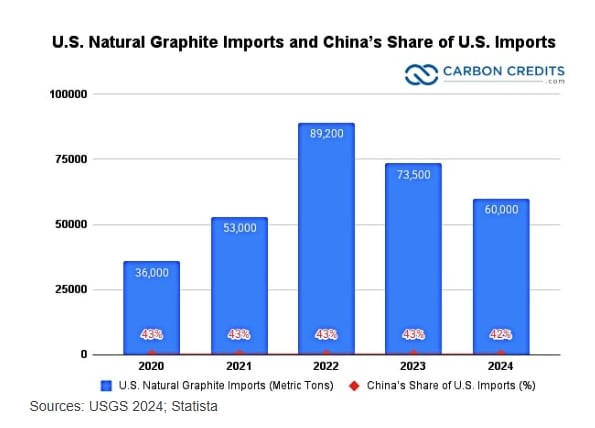
- As of 2024, the U.S. imported about 60,000 metric tons of natural graphite, down from roughly 84,000 tons in 2023.
- China remained the largest supplier, accounting for around 67.6% of all natural graphite imports by value.
This is worth roughly $375 million. It represents a slight decrease in volume but still a dominant share of the market.

By extracting graphite from waste, the U.S. can reduce both landfill pressure and foreign dependence. This approach aligns with the DOE’s push to secure materials from “secondary sources” such as waste streams.
AWS Powers AI-Driven Mineral Recovery
A second initiative focuses on recovering minerals like gallium from end-of-life IT hardware. Gallium is a critical input for semiconductors, power electronics, and defense technologies.
The importance of this effort is clear. In recent years, China has restricted exports of gallium and germanium, disrupting global supply. These restrictions effectively removed up to 90% of global gallium supply from international markets, exposing major vulnerabilities.
Here, Amazon Web Services will deploy AI tools to map supply chains, identify recovery opportunities, and assess economic feasibility. At the same time, CMI researchers will develop efficient extraction and refining methods.
This fusion of AI and materials science could transform recycling. Instead of being discarded, old electronics could become a reliable domestic source of critical minerals.
A Fragile Supply Chain: Why the U.S. Is Acting Now
Critical minerals are the core of modern industries—from EVs and renewable energy to semiconductors and defense systems. However, U.S. supply chains remain highly vulnerable.
According to recent industry analysis:
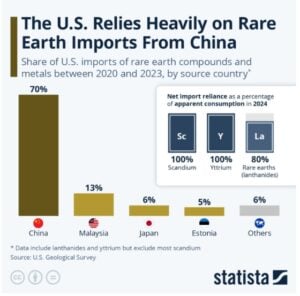
- The U.S. is 100% import-reliant for at least 13 critical minerals
- Over 20 additional minerals have an import dependence above 50%
- The country exports much of its raw materials for processing overseas due to limited domestic capacity
China dominates refining and processing, backed by decades of industrial policy. This concentration creates risks of supply disruptions, price spikes, and geopolitical leverage.

To address this, the U.S. government is mobilizing large-scale investments. In 2025, the DOE announced nearly $1 billion in funding to strengthen domestic critical mineral supply chains, with a strong focus on battery materials processing and recycling.
Additionally, new initiatives such as strategic stockpiles and international partnerships are being developed to secure long-term supply.
CMI Hub Leads the Shift to Circular Supply Chains
The Amazon–DOE partnership reflects a major shift in strategy. Traditionally, supply security depended on mining new resources. Now, recycling and “urban mining” are becoming equally important.
The CMI Hub is leading this transition through research in:
- Expanding material supply sources
- Developing substitutes for scarce minerals
- Recovering materials from waste
- Accelerating the commercialization of new technologies
Recycling offers several advantages. It is faster to deploy than mining, less environmentally damaging, and often more cost-effective in the long run. For example, the U.S. has already committed funding to advanced graphite recycling projects to build domestic battery supply chains.
CMI Hub Director Tom Lograsso
“This collaboration is a natural extension of the expertise that CMI Hub was created to deliver. CMI’s mission is to move breakthrough materials technologies from the laboratory into real-world applications on timelines that meet industry’s needs. Working with Amazon gives us the opportunity to apply our capabilities at scale—combining CMI’s materials science expertise with Amazon’s AI to turn innovations into practical solutions that strengthen the nation’s critical materials supply chains.”
Public–Private Partnerships Drive Scale
This collaboration also highlights a broader trend—closer ties between government research institutions and private companies.
Amazon brings AI, data analytics, and global logistics. Ames Lab and CMI contribute scientific expertise and research infrastructure. Together, they aim to move solutions from the lab to real-world deployment at scale.
Such partnerships are critical because the challenge is not just technical. It also involves economics, infrastructure, and supply chain coordination. By combining strengths, these collaborations can accelerate innovation and reduce risks.
Conclusion: A Strategic Shift With Global Impact
The U.S. is clearly redefining its critical minerals strategy. Instead of relying only on mining, it is tapping into waste as a new resource base.
This approach offers strong advantages:
- Waste streams are abundant and underutilized
- Recycling reduces environmental impact
- Domestic recovery improves supply security
However, challenges remain. Domestic processing capacity is still limited, and scaling recycling technologies will require sustained investment and policy support.
At the same time, AI is emerging as a key enabler. It can optimize recovery processes, improve efficiency, and reduce costs. As adoption grows, it could become a critical tool in securing mineral supply chains.
And the partnership between the DOE, Ames Lab, CMI, and Amazon marks a turning point in how the U.S. approaches critical minerals.
- READ MORE: DOE Launches $500M Funding Drive to Strengthen U.S. Battery Supply Chains and Critical Minerals Processing
- LATEST: AI Solutions from Microsoft and NVIDIA Power DOE’s Nuclear Energy Genesis Mission • Carbon Credits
The post DOE and Amazon Partner to Secure Critical Minerals Through AI-Driven Recycling appeared first on Carbon Credits.