Climate Change
Deep divisions persist as plastics treaty talks restart at informal meeting

Officials from about 20 countries met informally in Japan this week in a bid to bridge major differences in talks on a global treaty to curb plastic pollution, eight months after the last round of negotiations collapsed without agreement.
A participant told Climate Home News the closed-door meeting, hosted by Japan’s Environment Ministry, had been helpful to test ideas and restart conversations before formal talks resume, but said progress remained “challenging”, with national stances largely unchanged.
The meeting brought together countries pushing for efforts to rein in soaring plastic production, including European and Latin American nations, with major fossil fuel producers such as the United States, Saudi Arabia, Russia and Kuwait, which say the treaty should focus only on managing waste.
US hits out at EU and Pacific islands
In a sign of the persistent divisions, a spokesperson for the US State Department told Climate Home News after the meeting that Washington opposes “global plastic bans driven by the EU and Pacific Islands that would harm our economy and raise consumer prices”.
The EU and other members of the so-called High Ambition Coalition have called for the phase-out of certain plastic products that pose significant risks to human health and the environment, but have not advocated for any wide-ranging plastic ban.
“The EU is committed to securing a treaty with global measures across the full lifecycle of plastics, from production and consumption to waste management and end-of-life treatment,” a European Commission spokesperson told Climate Home News. “A global treaty can unlock economic opportunities, next to its environmental and health benefits,” the spokesperson added.
-
US set to exit UN climate convention in February 2027
With Trump’s announcement made official, the US will become the first country to leave the 1992 treaty

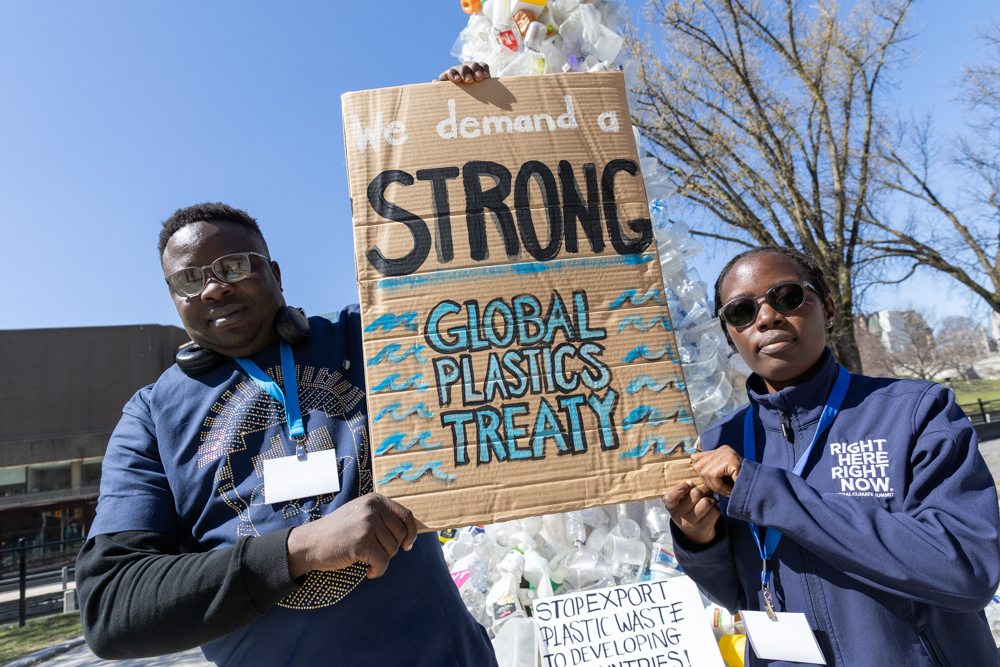
Dennis Clare, a negotiator for the Pacific island nation of Micronesia, told Climate Home News that the world produces too much plastic, driving the plastic and climate pollution that all countries are struggling so hard to reduce.
He said he hoped countries could agree on enough actions in the treaty to make some meaningful progress towards ending plastic pollution, but he added that there should be flexibility to adjust course along the way.
Rescuing talks from turmoil
Plastic production is set to triple by 2060 without intervention, according to the UN. As nearly all plastic is made from planet-heating oil, gas and coal, the sector’s trajectory will have a significant impact on global efforts to reduce greenhouse gas emissions.
The informal talks this week were seen as an attempt to facilitate discussions between some of the key nations before formal negotiations guided by the UN Environment Programme (UNEP) resume.

The process, which began in February 2022, was thrown into turmoil in the second half of last year. In August, nations left what was meant to be the last round of talks in Geneva with no agreement or a clear way forward after a chaotic night of negotiations. Two months later, the chair of the talks, Ecuadorean diplomat Luis Vayas Valdivieso, stepped down, citing personal and professional reasons.
Believing that countries can still deliver “a treaty for the ages”, the UNEP has been working to steer the process back on track. Veteran Chilean ambassador Julio Cordano was elected as the new chair during a one-day session in early February. In a letter to diplomats, Cordano acknowledged the task was “hard and complex”, but said establishing a global treaty was “not only achievable, but also urgently needed”.
Call for inclusivity
Andrés Del Castillo, a senior attorney at the Center for International Environmental Law (CIEL), said it was important to keep the process transparent and inclusive.
While Japan’s efforts to use its diplomatic leverage to address thorny issues are commendable, only a handful of countries – including “some of the biggest blockers” – attended the informal meeting, he said, while others championing stronger action were left out.
Explainer: Will AI data centres make or break the energy transition?
Following this week’s restricted gathering in Tokyo, all countries are set to exchange views on the way forward during an online meeting hosted by Cordano on March 12. It remains unclear when governments will reconvene for a formal negotiating session, but diplomats told Climate Home it is unlikely to take place in the first half of 2026.
A participant at the Tokyo meeting said countries must produce a significant shift in positions in the coming months to make reconvening formal negotiations worthwhile.
The post Deep divisions persist as plastics treaty talks restart at informal meeting appeared first on Climate Home News.
Deep divisions persist as plastics treaty talks restart at informal meeting