Climate Change
DeBriefed 10 April 2026: Worst energy crisis ‘ever’ | India withdraws COP33 bid | Drag artists and climate change
Welcome to Carbon Brief’s DeBriefed.
An essential guide to the week’s key developments relating to climate change.
This week
Ceasefire causes oil price drop
CEASEFIRE SLUMP: Following the announcement on Tuesday of a two-week ceasefire agreement between Iran and the US and Israel, oil prices dropped below $96 per barrel, according to the Associated Press. However, price volatility resumed when a Saudi Arabian oil pipeline was hit just hours later, according to Reuters.
CRISIS COMBINED: Reuters and other outlets covered comments made by the International Energy Agency’s Fatih Birol to Le Figaro, where he said that the current energy crisis is worse than those of “1973, 1979 and 2022 combined”. It added that Birol said the “world has never experienced a disruption to energy supply of such magnitude”.
POLLUTERS PROFIT: The Guardian covered how the “worst polluters hold [the] world’s future in their hands as they benefit from higher fossil fuel prices”, but it added “global trends favour renewables”. The South China Morning Post reported that, according to experts, the diversification of energy sources is set to accelerate as the war continues to disrupt the world’s energy supplies.
Around the world
- CLIMATE GOALS PERIL: The UK opening new oil and gas fields in the North Sea “would imperil” international climate goals, experts told the Guardian. The warning came as the government pushed back against the speculation that it is set to approve new drilling projects, according to Sky News.
- COP33 CHANGES: The Indian government has withdrawn its offer to host the COP33 climate summit, “following a review of its commitments for the year 2028”, reported Climate Home News.
- ‘LONG-LASTING’ SHOCK: The Financial Times covered comments by EU energy commissioner Dan Jørgensen that the bloc was bracing for a “long-lasting” energy shock from the Iran war. Reuters reported that five EU countries have called for a windfall tax on energy companies’ profits in response to rising fuel prices.
- US BUDGET CUTS: US president Donald Trump’s 2027 budget proposal included targeting the “green new scam” with substantial cuts to energy and environment programmes, according to the Los Angeles Times.
- AFGHAN FLOODS: Since 26 March, at least 148 people have died and 216 have been injured due to heavy rains, floods, earthquakes and landslides in Afghanistan, reported Reuters.
- PENGUINS ENDANGERED: The “mass drowning” of emperor penguin chicks as sea ice melts due to climate change has led the International Union for Conservation of Nature to declare the species officially in danger of extinction, according to the Guardian.
86,120
The record number of battery electric vehicle sales registered in the UK in March, making up 22.6% of the total car market, according to the Society of Motor Manufacturers and Traders.
Latest climate research
- More than a quarter of the world’s population will face more frequent and severe hot-and-dry extreme events by 2100 under current climate policies | Geophysical Research Letters
- Climate change will increase wildfire exposure for nearly 10,000 species by the end of the century | Nature Climate Change
- A variety of climate hazards critically expose up to 30% of southern Africa to “environmental degradation” | PLOS One
(For more, see Carbon Brief’s in-depth daily summaries of the top climate news stories on Tuesday, Wednesday, Thursday and Friday.)
Captured

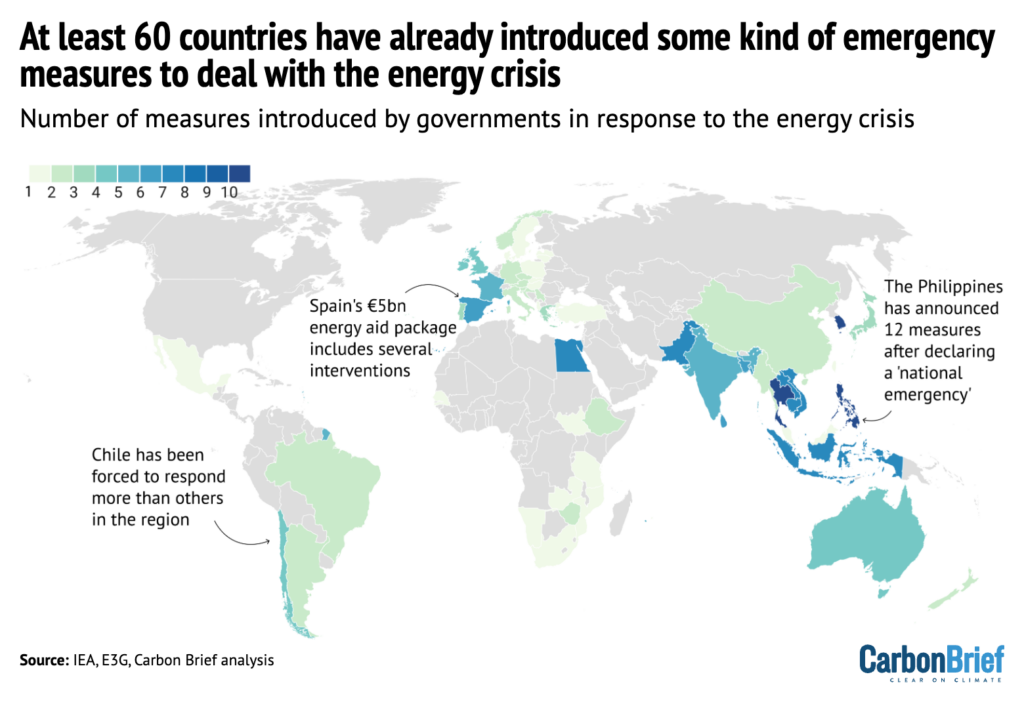
Carbon Brief analysis found that, since the beginning of the Iran war in late February, at least 60 countries have announced nearly 200 emergency energy-saving measures. Around 30 nations, from Norway to Zambia, have cut fuel taxes to help people struggling with rising costs, making this by far the most common domestic policy response to the crisis, said the analysis. Some countries have stressed the need to boost domestic renewable-energy construction, while others – including Japan, Italy and South Korea – have opted to lean more on coal, at least in the short term.
Spotlight
How drag is tackling climate change
This week, Carbon Brief looks at how some drag artists are using their performances to draw attention to climate change
Back in 2005, veteran climate journalist Bill McKibben wrote that “what the warming world needs now is art, sweet art” to help “build a general consciousness about climate change”.
Since then, the topic of climate change has spread to a host of art forms, from literature and music through to comedy and film.
One of the most recent art forms to take up the climate communication baton is drag, with performers using it as a “Trojan horse” to engage with audiences, according to Cheddar Gorgeous, a British drag performer.
‘Joy inspires momentum’
Drag artists around the world have begun to draw attention to the climate movement, using creativity, entertainment and their platforms to engage with their audiences.
In the UK, Cheddar Gorgeous declined a nomination for the British LGBT Awards due to its sponsorship by Shell and has made repeated calls for climate action.
Speaking on the “climate quickie” TEDx podcast, she argued:
“Drag can disrupt the master narratives that dictate our society. I love drag that makes you look at yourself and look at the world in a different way. And that can be deployed in all sorts of exciting ways.”
Drag has a proud history of disruption. As part of a TED talk titled, “Why joy is a serious way to take action”, US drag queen Pattie Gonia provided the audience with some “herstory” about the role of drag within protests. She said:
“Since the birth of the queer rights movement, drag performers and trans people have always been on the forefront of organising and protesting and community building.
“When we had the statistics and the facts on the millions of queer people dying of AIDS, yet no one was joining our fight, drag performers turned pain into joy and, in doing so, welcomed millions more people to fight with us.”


Pattie Gonia is arguably the best-known drag artist to engage with climate change. She is currently touring her environmental drag show “SAVE HER!” and has, according to her website, fundraised more than “$4.7m for LGBTQIA+, BIPOC and environmental non-profits”.
A key part of her message is the need for diversity and inclusion within the climate movement, adding that “our creativity is critical in this climate dilemma”. In her TED talk, she added:
“The problem in the climate movement isn’t just the abundance of carbon; it is the lack of joy. The scientific facts, the doom and gloom, they scare people, they wake them up. But joy is what will get people out of bed every day to take more action.”
Alongside Pattie Gonia, climate conversations are filtering into the wider drag movement, including being a topic repeatedly touched on in the highly successful TV drag contest, RuPaul’s Drag Race.
This ranges from drag artist Asia O’Hara explaining what global warming is in season 10 – telling her fellow contestants: “Bitch, the ice is melting!” – to queens dancing to “97% of scientists and four out of four Drag Race judges agree” that climate change “is real” during a challenge in season 11. (Drag Race host RuPaul Andre Charles has faced criticism for reportedly allowing fracking on his Wyoming ranch.)
Drag is opening up the climate movement to a wider audience, promoting diversity, inclusion and creativity in the space, according to its advocates. For Pattie Gonia, a key part of climate action has to be joy, she added:
“Joy provides an unbelievable opportunity to make the climate movement irresistible. Do not underestimate the power of joy. We deserve more than doom and gloom, because this is the only planet with a Beyoncé on it.”
Watch, read, listen
COOPERATION OVER CHAOS: In the Indian Express, Simon Stiell, the executive secretary of UN Climate Change, argued that “climate cooperation offers a way out of energy price chaos”.
ELECTRIC WORLD ORDER: On the Polycrisis podcast, Mark Blyth, a professor of international economics at Brown University, and Dr Naa Adjekai Adjei, a non-resident fellow, Africa, at the China Global South Project, discussed “what the US dollar has to do” with energy access in Africa.
‘THE RECKONING’: In the Equator, Mona Ali, associate professor of economics at the State University of New York, explored the closure of the Strait of Hormuz and the “end of American hegemony”.
Coming up
- 12 April: Hungarian elections
- 12 April: Peruvian elections
- 13-18 April: World Bank and International Monetary Fund Spring Meetings, Washington, DC, US
- 14 April: IEA Oil Market Report launch
Pick of the jobs
- Global Witness, several climate change jobs | Salary: Varied. Location: London
- London School of Economics, policy fellow – climate, gender and inclusivity | Salary: £53,949-£62,160. Location: London
- Climate Group, senior manager, international policy and advocacy | Salary: £47,160-£49,930. Location: London
- WWF, Nedbank green trust manager | Salary: Unknown. Location: Cape Town or Johannesburg, South Africa
- Greenpeace Australia Pacific, creative producer | Salary: AU$101,272. Location: Australia
- The Fairness Project, climate policy researcher | Salary: $96,000. Location: Remote (US)
DeBriefed is edited by Daisy Dunne. Please send any tips or feedback to debriefed@carbonbrief.org.
This is an online version of Carbon Brief’s weekly DeBriefed email newsletter. Subscribe for free here.
The post DeBriefed 10 April 2026: Worst energy crisis ‘ever’ | India withdraws COP33 bid | Drag artists and climate change appeared first on Carbon Brief.