Climate Change
COP31 must deliver finance for Africa or there will be no implementation
Nana Antwi-Boasiako Amoah is chair of the African Group of Negotiators on Climate Change. Charles Wanguhu is director of the Enzi Ijayo Africa Initiative and Africa Futures Policy Hub.
A COP held in Africa does not automatically deliver for Africa. That matters now, with COP31 in Antalya ahead and COP32 in Addis Ababa on the horizon. What counts is not where the world gathers, or what it pledges, but whether climate finance reaches African countries on terms they can use.
Without real progress on finance and implementation at Antalya, an African-hosted COP will simply inherit the same unmet promises.
Africa accounts for about 4% of global emissions, yet carries a wildly disproportionate share of the cost, losing an estimated 2%-5% of GDP each year to climate extremes, money pulled from classrooms and clinics into disaster response.
The finance meant to help it adapt arrives in a trickle. Developing countries will need an estimated $305 billion a year for adaptation alone by 2035, according to the latest UN Adaptation Gap Report. In 2024, international public adaptation finance stood at $28 billion-$32 billion, just a $1 billion increase over the previous year. That gap is the difference between plans on paper and protection on the ground.
Predictable, grant-based funding
The problem is not only how much, but on what terms. Too much arrives as loans rather than grants, deepening a debt burden that already crowds out spending on essentials in health, education and multipliers of development like affordable and accessible energy. The cost of capital has become the real tax on African ambition. A fairer financial system is not charity. It is the precondition for delivery.
-
Africa wants adaptation finance on COP31 agenda, raising risk of a fight
The African Group wants dedicated space on tripling adaptation finance, the Green Climate Fund and trade, setting up a possible clash -
Why COP31 needs to start talking about just transition finance
Funding that helps workers and communities navigate the clean energy switch remains overlooked, splintered and poorly tracked – a blindspot that could undermine climate goals -
Turkish giant sponsoring COP31 cut climate goals then cashed in on oil boom
COP31 sponsors should be screened for “climate integrity”. Yet Koç Holding has become a top partner while its oil refiner runs flat out and its climate targets slip



So, Africa comes to Antalya with a collective strong proposition. This is no longer a slogan: across the continent, states are building shared positions and common pavilions, learning to bargain as a bloc. We will press for finance that is predictable and grant-based, and for adaptation finance to be at least tripled, to around $120 billion a year by 2035. Even that would fall short of what the continent actually needs.
The goal this forms part of, which was agreed at the Baku COP – $300 billion a year – is a floor, not a ceiling; the real benchmark is the $1.3 trillion from all sources sketched out in the Baku-to-Belém Roadmap. And we will ask for direct access, so resources reach the institutions and communities that must use them, and for mechanisms that track whether commitments are met.
Powering green industrialisation
Finance is not an end in itself. Pledges become results when finance builds economies, creates jobs and strengthens productive capacity – the grids, the processing and the skills that let African economies add value to what they produce rather than exporting it raw.
Here we should be honest with ourselves. Value addition is an energy story before it is a minerals story. There is little point in curbing raw exports if there is no reliable power to run the smelter. Credibility means pairing the call to process at home with a plan to power it.
Other enablers of a just transition become crucial. Trade, for instance, can be an enabler of a low-carbon transition by facilitating the exchange of low-carbon goods. However, it has increasingly become a hindrance, particularly for African countries.
-
Tensions set to flare over trade at COP31 as China makes it a priority
After difficult talks in Belém last year, trade is likely to remain a sticking point at COP31 despite Brazil’s efforts to contain the issue to a series of dialogues -
African governments strengthen waste rules as solar and battery use surges
With solar panels, batteries and inverters spreading, officials want to bolster weak recycling systems to protect the environment and reuse key materials


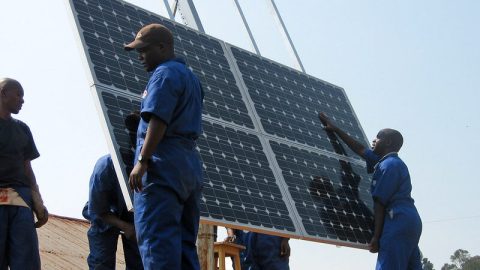
The use of unilateral trade measures has disproportionate impacts on market access and industrial capabilities, consigning African countries to the export of raw materials. The poor sequencing of these measures and lack of flexibilities, exemptions and targeted support are likely to cause harm.
At COP31, we will push for an agenda item on trade to create a specific space as an enabler of systematic discussion on the impact of trade‑related climate measures.
Communities at the table
This is where the design of co-operation matters as much as its scale. The proposed Just Transition Mechanism should be country-led and grant-based, so it adds capacity rather than debt. It should fund the things that make diversification real – reliable power (smarter grids and delivery networks), local processing, and the skills to run them – and it should put workers and affected communities at the table, not merely in the communiqué. Get that design right, and diversification builds new industries and jobs rather than leaving communities behind.
Antalya opens into a vacuum in global climate leadership. Africa can help fill it, not with grievance but with a credible voice on delivery and finance. An implementation COP must be judged by implementation.
The question is plain. Does the finance follow the ambition, and does it reach the economies and the people who need it? Africa will be watching the answer.
The post COP31 must deliver finance for Africa or there will be no implementation appeared first on Climate Home News.
COP31 must deliver finance for Africa or there will be no implementation