Climate Change
COP31: Key outcomes for food, forests, oceans and nature at the UN climate talks in Antalya
The COP31 climate talks in Antalya, Turkey, failed to agree on a “pact” that – despite making no clear reference to fossil fuels or adaptation finance – had contained strong signals for oceans.
The “Antalya pact” took up much of the two weeks of negotiating time in Turkey, only to be rejected during the closing plenary by the EU, the UK and several climate-vulnerable countries.
Several countries expressed their regret during the plenary that significant work on advancing ocean-climate action would be lost.
The COP ran nearly 50 hours over time, but did not end with substantive outcomes on several key topics.
For the second year in a row, negotiations on agriculture and food security broke down and will now have to resume next year.
Food-systems advocates were, however, heartened by the explicit inclusion of “agroecology” in a decision within the “just transition work programme”.
Ocean-conservation groups noted an increased focus on ocean-climate links at this year’s COP, but said COP31 did not live up to its promise of being a “blue COP”.
There was also scant new funding for food systems and nature, with just a handful of small pledges to ocean initiatives and two newly announced contributions to the Tropical Forest Forever Facility.
Here, Carbon Brief analyses all of the key outcomes for food, forests, oceans and nature at COP31 – both inside and out of the negotiating rooms.
(See Carbon Brief’s coverage of food, forests, oceans and nature at COP30, COP29, COP28, COP27 and COP26.)
Formal negotiations
Cover decision
The final draft of a COP31 “cover decision” was rejected by at least 32 countries during a chaotic – and, at times, acrimonious – closing plenary in Antalya.
Other recent COPs have issued cover decisions, setting a firm precedent.
However, many parties remained unhappy about the existence of the cover decision, the process by which it was put together and the impact it had on time for other negotiations.
Ultimately, parties did not find consensus on the text, particularly around the removal of any reference to fossil fuels and the lack of concrete climate-finance targets.
The cover text was one of the places in the negotiations where ocean advocates were hoping to see ocean-climate linkages highlighted.
Marine Lecerf, head of international policy at Ocean & Climate Platform, told a press huddle:
“What we’re really asking for right now is to make sure we can recognise ocean-based interlinkages…We’re not asking for a new mandate. We are asking for acceleration of the work that is already undertaken.”
The first draft of the cover decision, published on 16 November, was a compilation of all the issues that parties had put forward for inclusion. It was accompanied by a short “presidency note” explaining that all elements were still in play, including whether or not they should appear in a final text.
This lengthy first draft had 21 references to the ocean, including recognising the impacts of climate change, support for ocean-observing systems, encouraging parties to strengthen ocean-climate action and a multi-year plan for the “ocean and climate change dialogue”, which occurs annually at the Bonn intersessional meetings in June.
Regarding that draft, Steven Guilbeault, former environment minister of Canada, told Carbon Brief:
“I don’t see why the elements that are in the cover decision right now on oceans should be controversial or problematic to any nations. If you’re serious about fighting climate change, there’s nothing in this text regarding oceans that should be problematic for you.”
(Earth Negotiations Bulletin reported that Russia opposed mentions of the ocean in the cover text during the ocean ministerial consultation.)
The next iteration of the text, on 19 November, retained many of the ocean elements, albeit with less detail than the first draft. The second text also removed references to post-2028 ocean work and a proposed high-level ministerial ocean dialogue.
In the end, oceans had 19 mentions in the rejected Antalya pact.

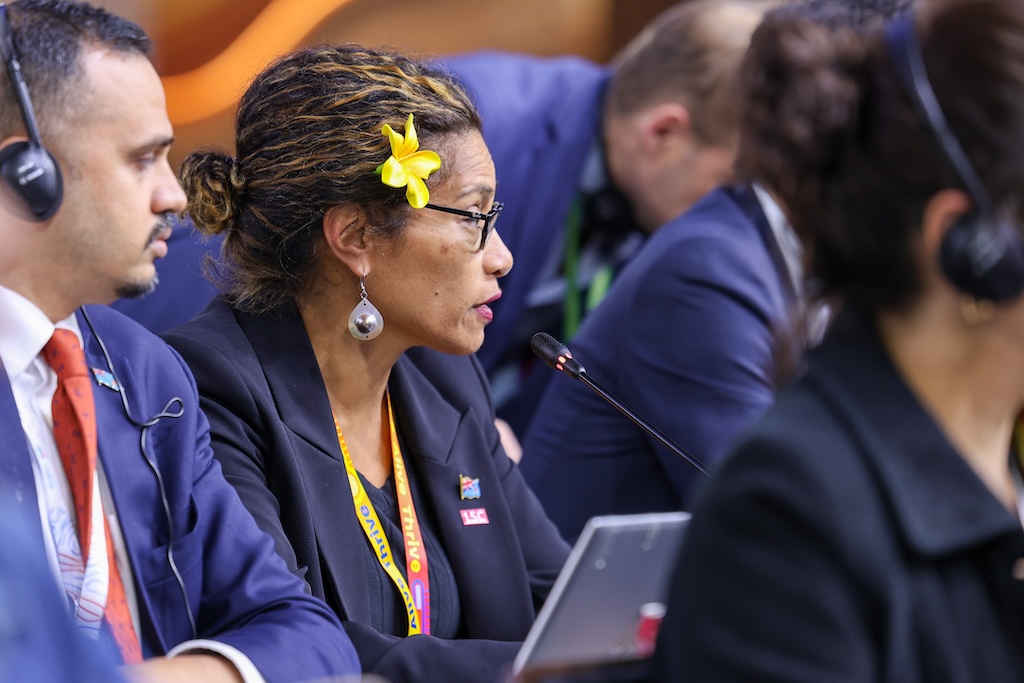
During the final plenary, Fiji’s Dr Sivendra Michael – co-chair of the ocean and climate change dialogue – appealed to the COP31 president to “humbly consolidate” the consensus on ocean as a “standalone ocean decision” and “directly submit” ten paragraphs with no objections in text as a “way to preserve” work done.
Lynda Tabuya, Fiji’s environment and climate change minister, said:
“The ocean-climate nexus is undeniable. We, the people of the Pacific, are deeply indebted, as the ocean is our home, our identity and it is what connects us. There is no climate action without ocean action. We hope this is not lost today and that parties will please consider keeping the ocean text alive.”
Other aspects of the natural world garnered significantly less attention in the cover text.
The final decision failed to mention the Brazil-led roadmap on deforestation, although it was “welcome[d]” in the initial draft. (See: Deforestation.)
Mentions of the “critical role” of forests in carbon storage, food security, biodiversity and community adaptation were also stripped from the text between the first and second iterations.
The final Antalya pact – that was rejected – did, however, retain wording on deforestation agreed by countries in the global stocktake at COP28 in Dubai.


The same draft also “recognises” the role of nature-based solutions and ecosystem-based approaches as “essential climate solutions” – although many experts reject the former term and warn that its vagueness leaves it open to deliberate misuse.
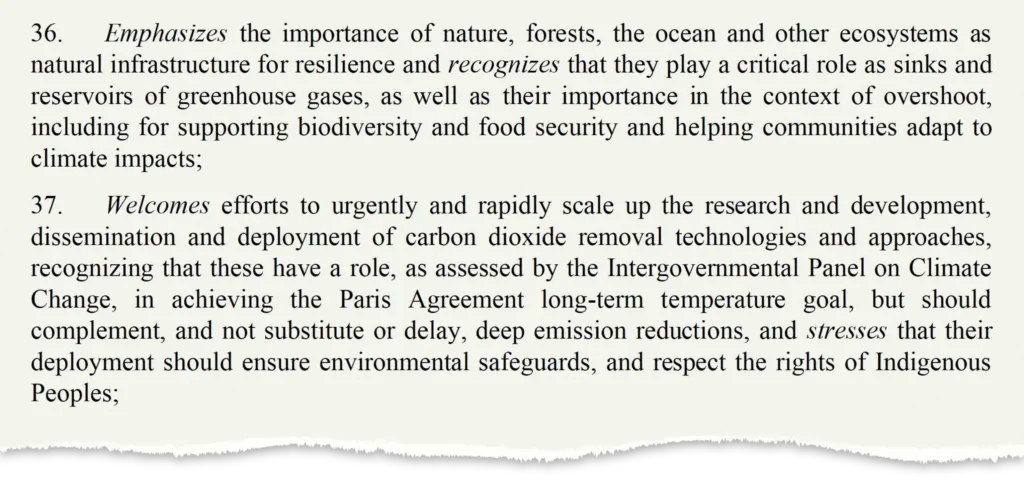
The final draft cover decision “emphasised the importance” of nature, forests, the ocean and other ecosystems as “natural infrastructure for resilience”, while “recogni[sing] that they play a critical role as sinks and reservoirs of greenhouse gases”.
Experts, however, were concerned that this language preceded a paragraph “welcoming” carbon dioxide removal, even if it “stressed” that these methods – that include tree planting – “should ensure environmental safeguards and respect the rights of Indigenous peoples”.

None of the iterations of the rejected cover decision mentioned COP17, the biodiversity summit held in Armenia, which concluded just 10 days before COP31 started. Nor did they mention the Kunming-Montreal Global Biodiversity Framework (GBF), a landmark pact sealed in 2022 to reverse biodiversity loss by 2030.
When Carbon Brief pointed this out to Guilbeault – a key architect of the GBF – in an interview on 17 November, he vowed that he would try to make the case to ministers to get these aspects added in.
One observer told Carbon Brief that the “toxic” nature of discussions over the need for closer “synergies” between climate and biodiversity summits could explain the lack of mentions in the cover decision.
Despite this, they said the rejected pact did “underline” the “urgent need to address, in a comprehensive and synergetic manner, the interlinked global crises of climate change, biodiversity loss, desertification and land and ocean degradation”.
Adopting such language would have represented positive progress, the observer added.
Although the first draft of the cover decision referenced “food” twice – in the context of food security – both of these instances were removed in the subsequent draft. The rejected final cover decision draft mentioned “food security” four times.


However, observers told Carbon Brief that a mention of “food” or “food systems” in the cover decision was not a priority for them. Teresa Anderson, global climate-justice lead at ActionAid, said:
“What we often find is that getting references or language to things in the cover decision doesn’t really play out as impacts on the ground and it’s more effective to push a meaningful agenda in a negotiation space.”
Agriculture and food security
For the second year in a row, negotiations on the Sharm el-Sheikh joint work on agriculture (SJWA) collapsed without parties reaching an agreement.
SJWA is where formal negotiations around climate change and agriculture take place under the UNFCCC.
Part of SJWA’s mandate is to synthesise information about work being done in the agricultural space – under both the UNFCCC and other international bodies – in an annual report.
SJWA also held two workshops – one on holistic approaches to agriculture and one on “means of implementation”, usually taken to mean finance – where countries and other partners could share their experiences, as captured in summary reports.
At COP31, parties were meant to discuss the conclusions of these reports and, time permitting, decide on the future of the agricultural workstream under the UNFCCC. (The four-year mandate of SJWA was set to end at COP31.)
Work “moved very slowly” in the first week, said Oliver Camp, senior policy and implementation specialist at the Global Alliance for Improved Nutrition. He added:
“It took a really long time to get into any substantive conversation.”
Ahead of the summit, many observers were hopeful of agreeing a text that recognised agroecology as beneficial for humans, climate and biodiversity.
However, in the first negotiating session, on 10 November, the Arab group expressed its view that fertilisers are vital for food security and fertiliser exports are being impacted by the EU’s carbon border adjustment mechanism (CBAM). Therefore, it said, the agriculture talks needed to discuss CBAM and other trade measures.
Teresa Anderson, global climate-justice lead at ActionAid, called this a “total curveball” in the negotiations. She told Carbon Brief:
“Everybody’s faces just dropped…Suddenly we knew that the chances of agroecology having a chance had been pretty elegantly spiked by putting in this really complicated political issue into the middle of the agriculture discussions.”
Other observers also expressed frustration to Carbon Brief that the group had brought CBAM into the negotiations, noting that trade measures are being discussed elsewhere in the COP. (In the end, trade measures were not included in any agreed elements of COP31.)
At the end of this session, parties were asked to submit their views in writing for consideration, with the like-minded developing countries (LMDCs) proposing an extension of SJWA to COP32.
Another major point of contention in the room was what, exactly, a draft text should cover.
The EU – along with Canada – said that the discussion should focus on the commonalities in countries’ positions, rather than the differences. Carbon Brief understands that opposition to this came from the G77 and China, along with the Arab group and the LMDCs, who said that areas of disagreement needed to be addressed through negotiation.
At the same time, said Camp, “there are a few fundamental rifts” around the scope of the work being done in SJWA itself. He told Carbon Brief:
“[There is] this idea that work on agriculture and food security should be primarily focused on adaptation, which is a view held generally by India [and the] G77 and China. Whereas others think it should definitely be led by adaptation, but that there are mitigation co-benefits and that we could take a more comprehensive and holistic view to seek out those co-benefits.”
A draft text circulated on 12 November – after the scheduled start of the negotiations that evening – which left many parties unsatisfied, with several stating that elements of the text crossed their “red lines”. The draft presented parties with four options, including “no text”.

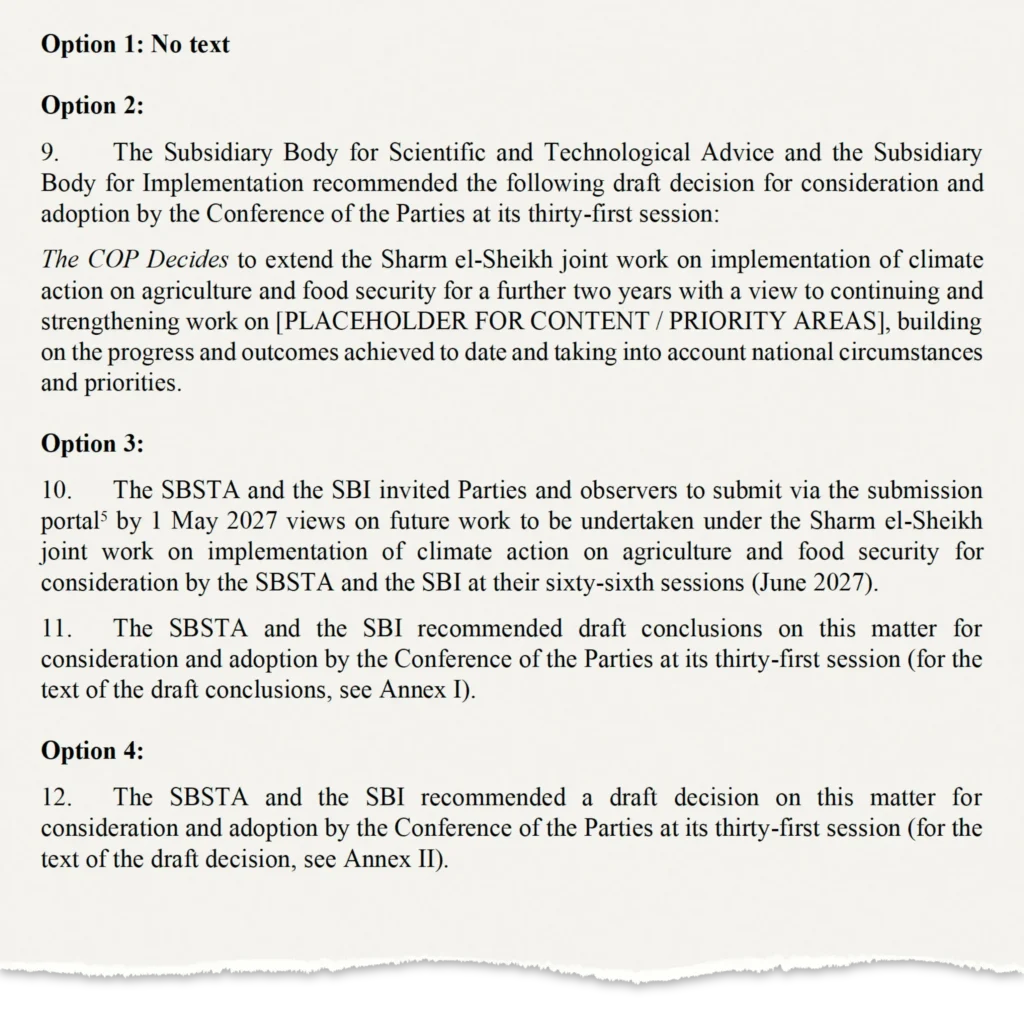
Although various parties objected to many parts of the proposed text – including agroecology (opposed by India), CBAM (opposed by the EU) and “food systems” language (opposed by the G77) – the underlying issue was a lack of finance and linking agriculture to mitigation targets, observers told Carbon Brief.
Marie Cosquer, advocacy analyst at Action Against Hunger, said:
“The main issue is not bad-faith negotiating; it’s the fact that, across the UNFCCC, the countries that have a climate debt are not paying it…Unless they move on finance, there is nothing in this negotiation for global south countries.”
With no sight of agreement on the horizon and the scheduled negotiating time drawing to a close, parties suggested that the negotiations end with a procedural text. The co-facilitators put such a text forward on 14 November.
This final text says only that parties “continued consideration” of SJWA and have “requested the subsidiary bodies to continue consideration” of SJWA at the mid-year intersessional meetings in Bonn. The subsidiary bodies are then “requested” to report back at COP32 in Ethiopia.
Camp told Carbon Brief:
“A lot of the negotiations were more at a kind of technical level about what should be discussed – mandate, scope, modalities – and so getting into anything substantive, particularly about food systems actions, took a long time. In the case of the food negotiations, that was rather problematic, because they ran out of time and ended up kicking all of the substantive discussion to Bonn next year.”
Article 6
Carbon markets – particularly those relating to forests – were not expected to be a key priority at COP31.
However, negotiations at COP31 on carbon-trading under Article 6 of the Paris Agreement reopened many familiar arguments over how tightly such activities should be regulated.
Beatriz Granziera, senior policy adviser at The Nature Conservancy (TNC), told Carbon Brief:
“Discussions repeatedly came back to familiar trade-offs: practicality versus conservativeness; flexibility versus oversight; and how to scale much-needed participation and investment while maintaining environmental integrity.”
Agreement was, ultimately, reached on both bilateral trading under Article 6.2 and the international carbon market under Article 6.4.
Carbon-trading between countries under Article 6.2 is only subject to light-touch rules, such as reporting on the use of the process and a “technical expert review” of national reports.
Across 16 national reports checked so far, these reviews found 543 “inconsistencies”,
115 of which were “significant”. None of the reports were found to be without issue.
An initial draft text at Antalya “note[d these issues] with concern”, adding that “many…are significant” and relate to “environmental integrity” – in other words, whether or not emissions are actually being cut. It asked parties to address these issues “at the earliest opportunity”.
However, this entire paragraph disappeared in the final agreed text. Instead, the decision “takes note” of the information in the technical reports, without asking for any response.
Given its confidentiality provisions, campaign groups have long described Article 6.2 as a “wild west” for carbon-trading and the COP31 outcome does nothing to tighten the rules.
Separately, parties were unable to reach agreement at COP31 on how to fund the processes needed to run Article 6.2. Instead, they agreed to continue discussions next year, requesting a technical paper on how “fees or other funding arrangements” would work.
On Article 6.4, negotiations began against a backdrop of calls for a “course correction” on the way the international carbon market is operated.
This came in an open letter from the Project Developer Forum and the International Emissions Trading Association (IETA), saying market rules were too “conservative”.
Andrea Bonzanni, senior director at IETA, told Carbon Brief that the “current version of [the market] is failing to attract investment in carbon projects”.
The requests in the open letter appeared in early draft text, after being taken up by the LMDCs and others.
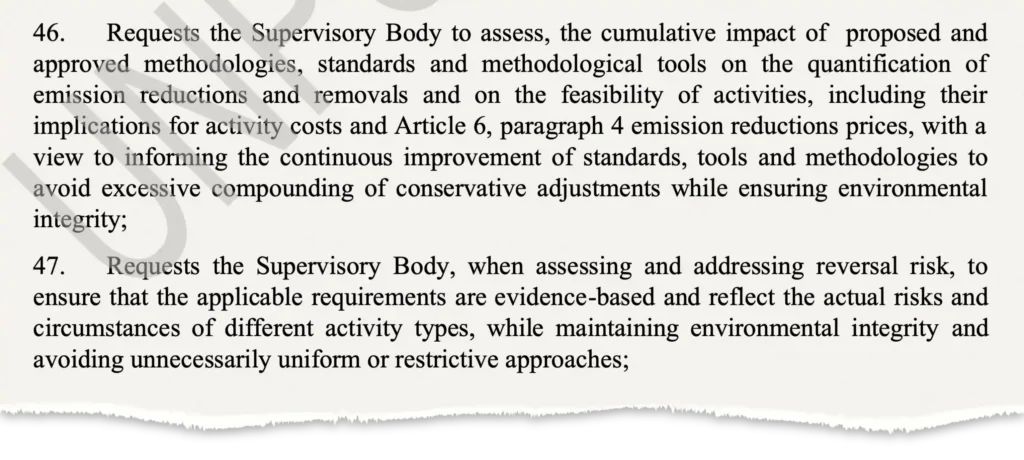
A 14 November draft “request[ed]” the supervisory body to “assess the cumulative impact” that its rules and standards have on the “feasibility” and “cost” of carbon-credit schemes.
It said this was to avoid “excessive compounding of conservative adjustments”, in what amounted to asking that the rules for the Article 6.4 market not be too stringent.

Isa Mulder, at Carbon Market Watch, told Carbon Brief that this looked like market proponents “chipping away at the standards that have been set out”. She added:
“The goal [of Article 6] was to enable higher ambition, not to enable [carbon-trading] activities.”
However, after pushback from the EU and others, the final text adopted at COP31 no longer asks for a formal assessment of the “cumulative impact” of the rules.
Instead, it asks that the supervisory body “take into account” the way different standards “operate together” when making or revising provisions.
With those rules set for a review starting in 2028, Granziera told Carbon Brief:
“Ultimately, the debate [at COP31] reflected different views on what is needed for Article 6 to deliver more effectively as a tool for achieving the goals of the Paris Agreement, which will likely come back to light in 2028.”
Despite increasing scrutiny, many countries highlighted their domestic progress on carbon markets, joined coalitions and announced deals at COP31.
Singapore, in particular, wanted to be seen as a key hub for Article 6 markets – featuring sessions on carbon markets at its pavilion and announcing bilateral Article 6.2 projects with Peru.
COP31 also held a ministerial roundtable on “growing” high-integrity carbon markets to mobilise private finance for climate action.
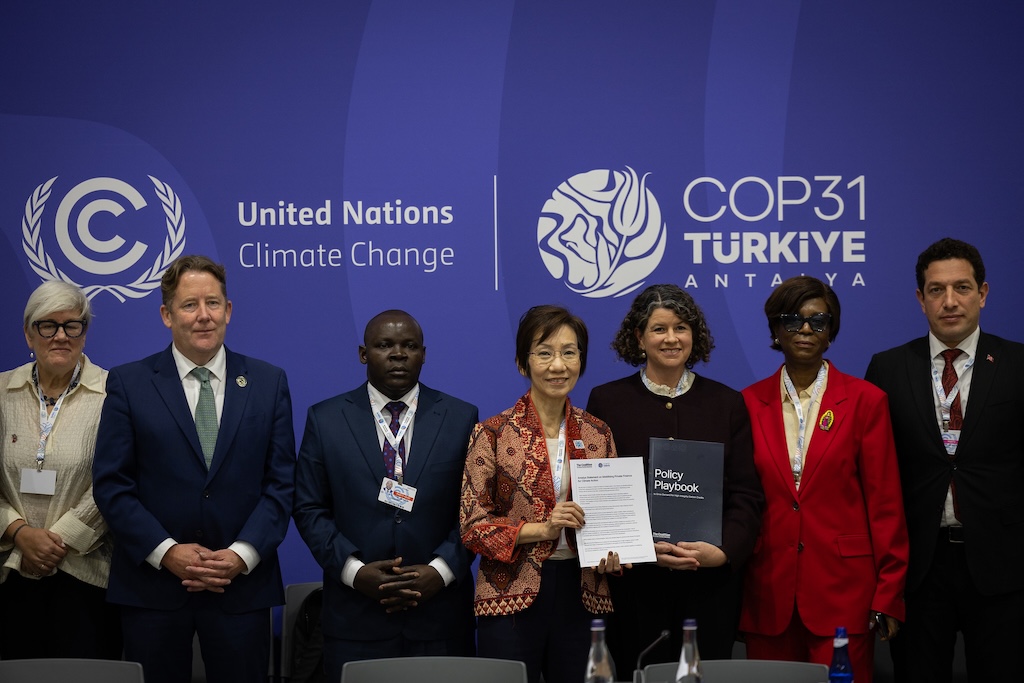
Co-chaired by Kenya and the UK, the meeting saw Colombia, Ghana and Peru sign on to the Antalya statement endorsing carbon markets and a “playbook” with “policy levers to grow demand” for them, taking the number of signatories up to 17.
Despite limited signatories, Singapore’s environment minister, Grace Fu, called the Antalya statement “a key outcome of COP31”.
(At the COP16 biodiversity summit in 2024, Peru declared that carbon offsets were “not a financial solution”. Its call for additional scrutiny of biodiversity offsets was included in the COP17 finance agreement.)
At the forest leaders’ summit on 11 November, Guyana outlined that “jurisdictional forest carbon markets” – where carbon offsets are generated at an entire national or subnational scale – are now its “principal pathway”.
Federica Dossi of Carbon Market Watch called Guyana’s approach “very problematic”, pointing to a recent Carbon Pulse investigation where a single error in a spreadsheet led to 3.9m excess credits.
Dossi told Carbon Brief it is “extremely hard” to ensure that forest-based carbon credits deliver lasting carbon removals and do not “cheat nature in the long run”.
Towards the end of the summit, 45 scientists signed an open letter saying that the Article 6 rules “must be consistent with the science” and “still fall short” of what environmental integrity requires. The statement says:
“They allow temporary carbon storage in forests, soils and other ecosystems to be credited against fossil-fuel emissions that will affect the climate for thousands of years. This undermines the critical role of ecosystems in stabilising the carbon cycle, which depends on ending both fossil fuel use and deforestation.”
Just transition work programme
Discussions on how to create a new “just transition mechanism” (JTM) proved one of the most controversial aspects of COP31 and were, ultimately, deferred to COP32.
Last year, the decision to create the just transition mechanism (JTM) – also known as the Belem-Antalya Mechanism (BAM) – was a key “legacy” of COP30.
In Antalya, parties were expected to agree on the form and functions of the mechanism under the “just transition work programme” (JTWP), to allow it to start working.
Negotiations initially got off to a constructive start, with general consensus emerging on a two-tier structure for the mechanism, as well as continuation of the JTWP.
However, a draft text prepared at the end of the first week in Antalya was roundly criticised by civil society, who labelled it “hollow” and “watered-down”.
Over the second week, there were disputes over who would set up and run the mechanism, the involvement of non-party stakeholders and how it would be financed.
Speaking in a packed press huddle on 20 November, Kirtana Chandrasekaran, from the Global Campaign to Demand Climate Justice, said that the global north had “torpedoed” work on the JTM.
As we await new draft texts for the cover decision, just transition work programme, global goal on adaptation and more at COP31, civil society has just held a hectic press huddle to condemn the lack of process here in Turkey.… 
Civil society hits out at ‘terrible COP’ that is ‘abject failure’

Late on 21 November, an unbracketed text was published. It decided that a phased approach would be taken, with a view to the mechanism being adopted at COP32 in Ethiopia in November 2027.
Beyond the mechanism, parties discussed a review of the JTWP and the key messages that emerged from the fifth and sixth dialogues held in 2026.
The fifth focused on agriculture and ocean-based climate action, with the final JTWP text noting that these are both “integral to nationally determined just transition pathways”.
Key messages from the dialogue included the role of women in agriculture and food production, the potential for agroecological and agroforestry approaches and the opportunities presented by transitions in agriculture aligned with the Paris Agreement.
In a statement, Teresa Anderson the global lead on climate justice at ActionAid, criticised the delay to the JTM, but added:
“At the same time, however, smallholder farmers around the world can celebrate that the just transition negotiations took the landmark step of endorsing agroecological farming approaches.
“Climate talks have sent a powerful signal that farmers deserve support to transition to agroecology, a people-centred climate solution that works with nature instead of against it.”
Additionally, critical minerals were referenced in a COP decision for the first time within the final JTWP agreement.
In a statement, Angela Asuncion, Asia-Pacific coordinator and transition-minerals focal point at the Resource Justice Network, welcomed this inclusion as a “notable step”, but added that the “decision by parties to eliminate human rights due diligence across critical mineral supply chains is unacceptable”.
Ultimately, the JTWP text was gavelled through during the closing plenary. Further work on the mechanism is expected over the coming year, ahead of it being launched in Ethiopia at COP32.
Adaptation
Finance dominated the negotiations on adaptation at COP31 – in particular, efforts to specify that tripling adaptation finance meant $120bn by 2035.
This followed a “call for efforts” to triple adaptation finance by 2035 that was agreed last year at COP30 with very limited detail.
It was debated in the global goal on adaptation (GGA) and the climate finance “work programme”, as well as the proposed “cover decision”.
Broadly, developing countries wanted to discuss the target under the GGA, while developed countries wanted to discuss it in the climate finance work programme. This would place the tripling goal within the broader $300bn target for 2035 – meaning adaptation finance could come from a wide variety of sources.
Despite the $120bn figure being included in early draft texts under the GGA, ultimately, it did not appear in the final decision, nor in either the climate finance work programme or the cover text.
Also within the GGA, parties worked to establish an expert task force that could refine the set of 59 “indicators” agreed at COP30 in Belém. These are the metrics that countries will use to assess their progress in adapting to climate change.
They cover topics including water, food, health, ecosystems, infrastructure, livelihoods and culture. For example, they