Ocean Acidification
Color Traditions with Munsell Soil-Color Charts
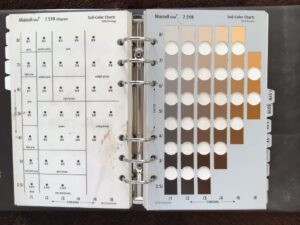

Fig. 1) an open page of the Munsell Soil-Color Chart book
The Munsell Color Chart has been the national standard and official color system for soil research in the U.S. since the 1930s. For nearly 100 years, geologists and soil scientists have taken these color chip pages into the field to better understand the Earth they are studying, so it comes as no surprise that it is the standard for recording ocean cores brought up by the JOIDES Resolution.
Upon first glance, these charts may look like a page of free paint sample strips you can find at your local hardware store, but they are critical to classifying sediment and understanding the environments they came from and can cost several hundred dollars. The Munsell Color System is a method of numerically describing colors. It specifies colors based on hue, value, and chroma and measures them in a three dimensional space. Hue refers to the dominant color of the soil, value is the lightness of the color (scaled 0-10; 0 being black and 10 being white), and chroma is the intensity or saturation of the color.
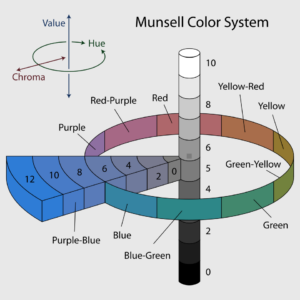

Fig. 2) A 3D model representation of the Munsell Color System
There are five primary hues, red, yellow, green, blue, and purple, and five intermediate hues, which are a combination of primary hues such as yellow-red (YR) or green-yellow (GY). The hue of a color is represented as a ring and as the rings go up and down a vertical axis, the value of the color changes. As the color moves horizontally from the vertical axis, chroma or saturation becomes stronger or weaker. A color is specified by listing the three numbers or letters for hue, value, and chroma in that order. In the soil color chart, these number letter combinations correspond with a color. For instance, in figure 1, a 7.5YR 5/6 is also called “strong brown” (seen on the left page, bottom right). The names of colors used in weekly expedition reports are not arbitrary or subjective, they are specific and can be easily and accurately charted by anyone with a Munsell Chart reading the report.
Useful or Just Tradition?
The Munsell Color System has limitations. There are a distinct number of samples and the spacing between colors are large, making it difficult to measure thresholds. This inspired new color measuring methods to develop like CIELAB. Read more about CIELAB and what it means here (blog post “Color Science and Ocean Cores”). Changes to the Munsell system were made, doubling the number of hues in Munsell’s original book from 20 to 40, but CIELAB was already on its way to mainstream.
However, it’s still true that Munsell has been the soil color standard for nearly 100 years. That’s 100 years of geological and earth science research using this method of recording color. If scientists were to change to a system like CIELAB, it would mean having to constantly convert units when comparing previous research. Scientists compare and reference previous work all the time. Comparing sediment core colors from different sites can help support their own scientific findings. So switching to a different color recording method would mean converting all previous research. But is that a good enough reason to stick to tradition?
CIELAB creates a standard observer, which is an averaging of color matching that helps set a base value for recordings. This helps create the most accurate color reading on something such as an ocean core. Using color charts opens up the possibility for disagreements as no two human eyes see colors the same. And this really happens! In 2024 while aboard the JOIDES Resolution, EXP401 sedimentologists held long discussions about shades of grey they were recording differently.
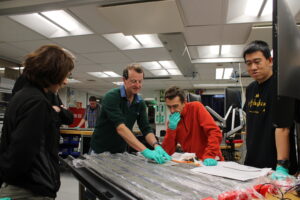
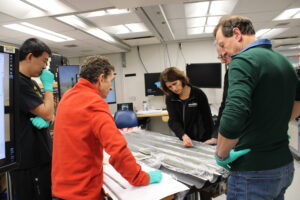

Fig. 3) Photos of “The Great Grey Debate” on EXP401 by Dr. Patty Standring
Machines can record accurately and consistently, so why not switch to CIELAB? Well, expensive machines that use CIELAB, like the Section Half Multi-Sensor Logger (SHMSL) take anywhere from seven minutes to hours, recording only one core at a time. When on a two month cruise, pulling up hundreds of meters of core, time is crucial. Cores dry out and potentially change color as they dry, so it’s important to record fresh colors.
The color of a core can tell scientists so much information so quickly.
“Gradual color changes helped us to identify where we saw facies changes on a larger scale. There were very obvious cyclical color changes at Site U1385 that helped establish that the cores preserved a really good orbitally-driven sediment record. Color differences are also really useful when looking at different grain sizes that help identify turbidites and other sedimentary structures, and burrows from bioturbating organisms,” (Standring)
It’s important that scientists record these fresh colors as quickly and efficiently as possible. Although debates about the color grey can happen, these color discussions and international collaborations are what scientific research is all about. After 100 years, Munsell will stay the golden standard, not because it’s what we’ve always done, but because it’s still the best.
Written by Kellan Moss
Thank you to Dr. Patty Standring and Natacha Fabregas for help with this research
Sources:
Berns, R. S. (2016). Color science and the visual arts a guide for conservators, curators, and the curious. Los Angeles Getty Conservation Institute.
EXP 401 Sedimentologists: Dr. Patty Standring ad Natacha Fabregas
Featured Image: MerlinOne Archive
Fig. 1 Image: Here
Fig. 2 Image: Here
Fig. 3 Images: Dr. Patty Standring from EXP401