Climate Change
Climate change exposes 580 million children to 20 extra ‘heat-stress days’ every year
More than 40% of children under the age of 10 globally are already experiencing at least 20 additional “heat-stress days” due to climate change.
This is according to a new attribution study, published in Science Advances, which combines climate models with demographic data to assess the age groups and regions that are exposed to the most hot, humid days.
The study finds that children up to the age of nine already face more additional heat-stress days globally as a result of climate change than any other age group.
It adds that south Asia and west Africa are recording the greatest childhood exposure to dangerous levels of humid heat – largely because these regions have a rapidly growing population with the highest proportion of young children.
As the climate warms, children will continue to be more exposed to heat stress than any other age group, the paper warns.
The lead author of the study tells Carbon Brief that the findings should inform discussions about climate justice, noting that children in developing countries “have contributed the least to historical greenhouse gas emissions”.
Humid heat
High temperatures can be deadly. For example, the heatwaves that swept across Europe in the summer of 2026 have been linked to tens of thousands of “excess deaths”.
A prominent 2021 study found that children born in the 21st century will be exposed to more extreme weather events in their lifetimes than their parents and grandparents.
Four years later, a study conducted by scientists from the same team found that more than half of children born in 2020 – around 62 million people – will experience “unprecedented lifetime exposure” to heatwaves, even if warming is limited to 1.5C.
Now, the latest research from the same team finds that children already face greater exposure to dangerous levels of humid heat than adults as a result of human-caused climate change.
Extreme heat is particularly dangerous when combined with high humidity. In hot weather, the human body produces sweat to cool itself down. However, as humidity increases, sweating becomes less effective.
The study uses wet-bulb globe temperature – a measure of temperature that takes humidity and wind into account – to calculate heat stress. It defines a “heat-stress day” as any day with a wet-bulb globe temperature above 28C, as this is considered the threshold for “moderate heat stress”
The authors then use climate models to simulate global temperature patterns in the present-day climate. (The authors use the climate of 2023, in which human activity has caused 1.3C of warming, to represent the “present-day”.)
They then count the number of heat-stress days that each country records on average, per year. The authors then repeat this exercise, simulating a pre-industrial climate without human-caused warming.
By comparing the number of heat-stress days in the present-day climate with the number in a pre-industrial climate, the authors can determine how many extra heat-stress days were driven by climate change. They refer to these as “extra” or “attributable” heat-stress days.
The authors find that “low-latitude” countries, located in the tropics, record the most extra heat-stress days.
For example, the paper finds that people living in Côte d’Ivoire currently face 112 heat-stress days every year. It adds that around half of these are due to human-caused climate change.
In contrast, Germany sees only 0.1 heat-stress days per year in today’s climate on average, which is largely attributable to human-caused climate change.
Rosa Pietroiusti, a PhD student at Vrije Universiteit Brussel and lead author on the study, explains why this number may seem lower than expected.
She tells Carbon Brief that the paper “really focuses on humid heat, at levels that are relatively rarely felt in Europe”. She adds:
“Our data also doesn’t capture the urban heat island effect, due to the resolution of the data we use, which also would lead to underestimations of heat stress locally, and lead to a mismatch with what people are experiencing at local scales, particularly in cities.”
Inequality
Extreme heat affects some people more severely than others. Children, people over 65 and those with pre-existing medical conditions or certain disabilities are among the most vulnerable. This is because their bodies are less able to regulate their temperature.
The authors use gridded demographic data to determine the age structure of each country. From this, they calculate how many people from each age cohort are exposed to extra heat days as a result of climate change.
The research finds that globally, 583 million children under the age of 10 already live through at least 20 attributable heat days every year. This accounts for 44% of all children in this age bracket.
In comparison, 190 million people aged 60-69 face at least 20 attributable heat days per year, accounting for 30% of this age cohort.
The authors find that children face the greatest exposure to humid heat for two main reasons.
First, there are more young people alive today than older people, with 1.3 billion children aged under 10 in the world, compared to 0.6 billion people aged 60-69.
Second, they find that countries in Africa and Asia typically have rapidly growing populations with more young children. In contrast, many countries in the northern hemisphere – which are typically cooler – have older populations.
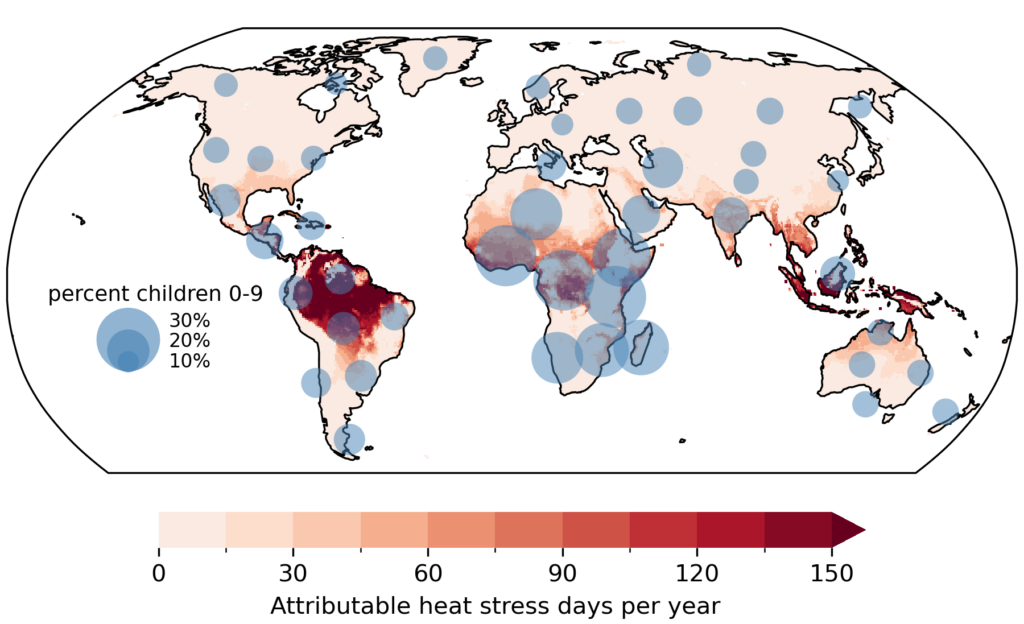
The map below shows how many extra stress heat days each country currently faces as a result of human-caused climate change. Darker reds indicate a higher number of attributable heat days. The blue circles show the percentage of the population under the age of 10, with larger circles indicating a higher percentage.

Warming world
The authors also repeat their analysis for a 1.5C and 2C warmer world. They use population estimates from the SSP2 scenario, which projects that the world’s population will peak at more than nine billion in the second half of the 21st century, with most growth occurring in low-latitude regions – especially in sub-Saharan Africa.
The research finds that, in today’s climate, 11% of all under 10s currently experience 100 or more extra heat-stress days per year due to climate change. In worlds warmed by 1.5C and 2C, the percentage rises to 13% and 23%, respectively.
In contrast, only 6% of all people aged 60-69 currently face 100 or more extra heat-stress days each year due to climate change. This number rises to 9% and 17% for 1.5C and 2C worlds, respectively.
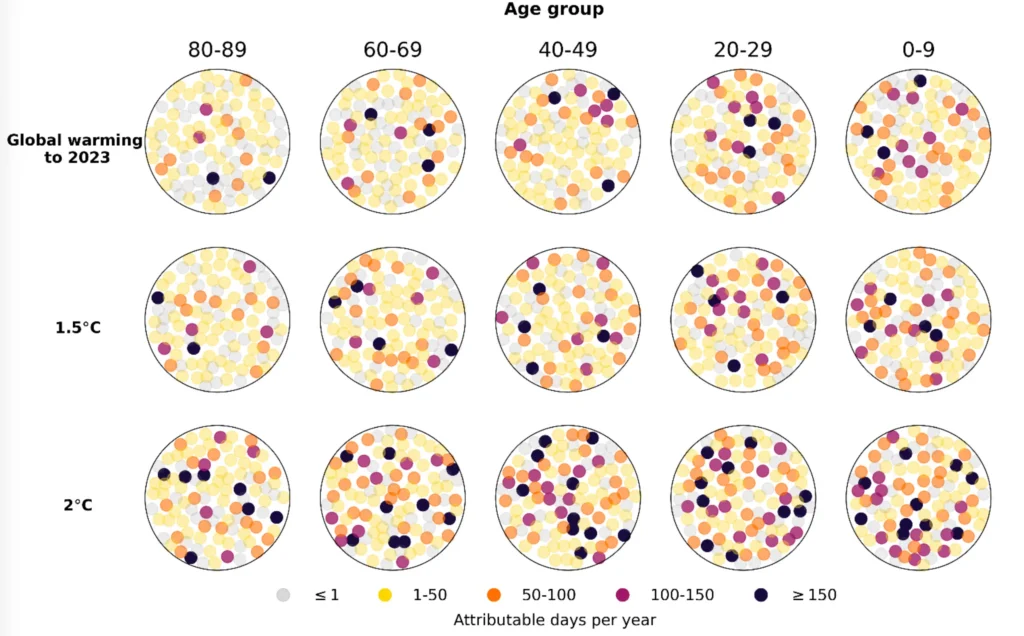
These results are shown in the plot below. The three rows represent the climates of 2023 (top), a 1.5C world (middle) and a 2C world (bottom). The columns show different age cohorts, from the oldest on the left to the youngest on the right.
Each circle contains 100 coloured dots, with each dot representing 1% of the age cohort.
The colour of the dot represents exposure to annual heat-stress day, with darker dots indicating more heat-stress days. Grey dots mean that people experience fewer than one extra heat-stress day per year due to human-caused climate change, while black dots mean more than 150 extra heat-stress days due to climate change.
The figure shows that higher warming levels expose more people to heat stress and that younger cohorts tend to be worst affected.
For example, the top-right circle represents heat stress for under 10s in the present-day climate. Three of these dots are coloured black, indicating that 3% faced at least 150 attributable heat-stress days in 2023.

Pietroiusti tells Carbon Brief the study uses wet-bulb temperature because it is a “well-established heat stress metric”. However, she notes that it was not “explicitly defined to focus on children”. She continues:
“A really important step forward in the research community would be to link up climate science and health science experts to do research on what metrics are really most representative of, for example, health impacts and educational impacts that children will be suffering.”
Vulnerability
Dr Qinqin Kong, a postdoctoral researcher at the departments of medicine and health policy at Stanford University, who was not involved in the study, praises its “robust” methodology.
He tells Carbon Brief that the research provides “a timely quantitative evidence for discussions of climate justice, children’s rights and intergenerational equity”.
However, Kong suggests that the paper “may overstate the contrast between children and the elderly and underestimate the relative burden of older adults”.
He says:
“The elderly may also be more vulnerable due to their social circumstances. Children often benefit from parental supervision and caregiving, whereas many older adults live alone, have limited mobility and face barriers to accessing cooling or emergency assistance during heat events.”
Kong also notes that “people and societies in the mid-latitudes [for example, across much of Europe and North America] are less adapted to heat”, which may make them vulnerable to its impacts.
For example, he says that Europe “shows substantially stronger relative risk of heat mortality likely due to less heat-acclimatised populations, lower air conditioning prevalence and urban designs that don’t favour heat dissipation”.
Similarly, Dr Daniel Vecellio – a researcher at the University of Nebraska, who was not involved in the study – tells Carbon Brief that children are an “understudied cohort”.
However, he says there is “reason for hope” because “children are typically pretty good behavioural adapters to extreme heat” and because people who are “chronically exposed to extreme heat” will “have a better chance at better acclimatisation”.
Pietroiusti tells Carbon Brief that global reporting on heatwaves is often skewed towards wealthier nations.
For example, she notes that large-scale databases of disasters, such as EM-DAT, often underrepresent heatwaves in Africa, due in part to a lack of news coverage and formal reporting. She adds:
“Studies like this, which start from the climate data, can start to fill some of these gaps.”
She adds that the paper should inform discussions about climate justice, noting that children in developing countries, who are most severely affected by the increase in heat-stress days, “have contributed the least to historical greenhouse gas emissions”.
Pietroiusti, R. et al. (2026) Age-specific exposure to human-induced increases in humid heat, Science Advances, doi:10.1126/sciadv.aeb3232




The post Climate change exposes 580 million children to 20 extra ‘heat-stress days’ every year appeared first on Carbon Brief.
Climate change exposes 580 million children to 20 extra ‘heat-stress days’ every year