Climate Change
Chinese EV brands woo Yemen’s wealthy elite as war prompts solar boom
Like many Yemeni farmers, Salem Abdallah first bought solar panels to power a well pump to irrigate his fruit and vegetable crops. Now, he has a new use for the surplus electricity they generate – a Chinese-made electric pickup truck.
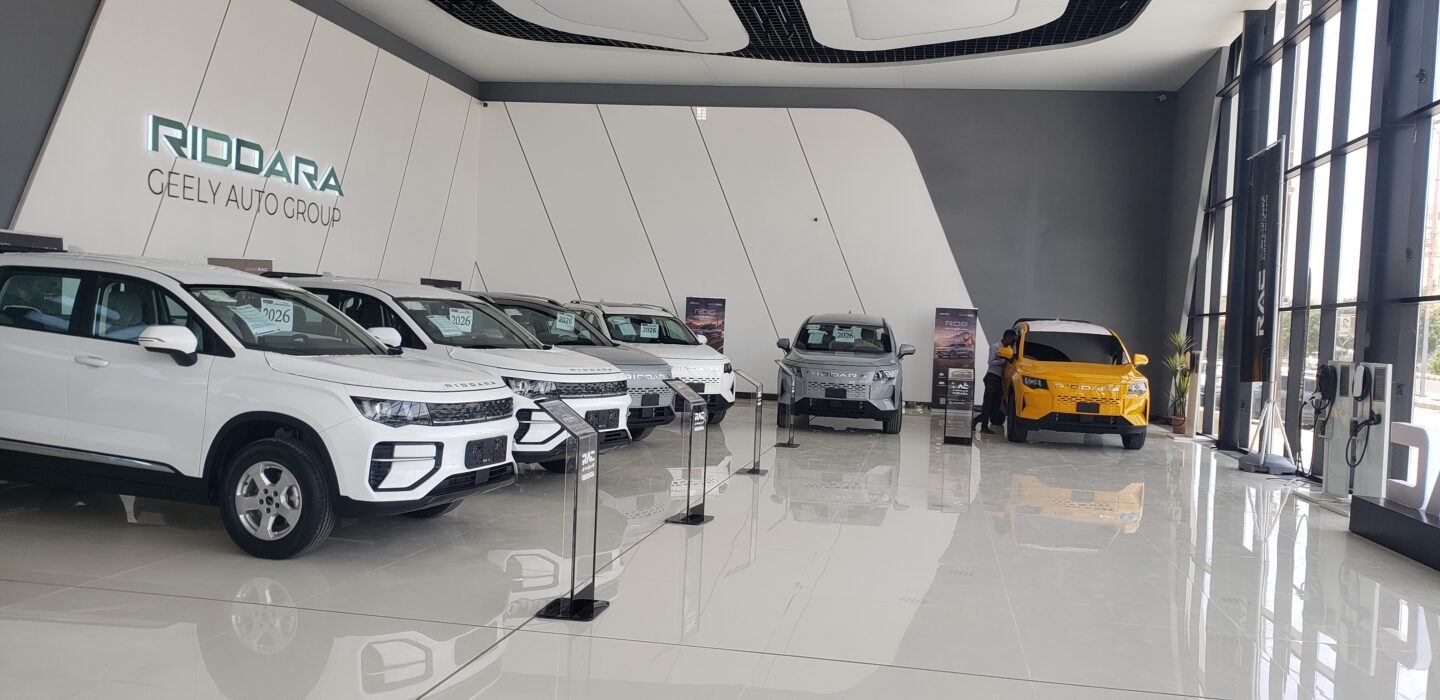
“The roads between villages are rough and my farms aren’t all in one place, so the power and height give me a real advantage,” the 60-year-old told Climate Home News as he charged his plug-in hybrid Geely Riddara in Yemen’s capital of Sanaa, where nearly a dozen charging stations have sprung up in the last two years.
Prices for Abdallah’s Riddara model run from $25,000 to $40,000 – out of reach for all but a few in the impoverished country, where more than a decade of civil war has shattered the economy and made fuel supplies unaffordable for many.
The conflict has also taken a heavy toll on the national grid, which only 12% of Yemenis rely on for electricity, according to the World Bank.
Many homes and businesses have instead installed off-grid solar systems to confront frequent blackouts and patchy coverage in rural areas, and this improbable solar boom has caught the attention of Chinese electric vehicle (EV) brands.
Solar boom stirs Chinese interest
China’s BYD, Geely and Jetour have opened dealerships in Yemen in recent years, betting that enthusiastic solar uptake, coupled with high fuel prices and shortages, will lead to rapid growth in the nation’s small and incipient EV market, at least among those able to afford the initial outlay.
At the other end of the scale, electric two-wheelers are also starting to make inroads in Yemen among delivery services and salaried employees.
Mohammed Ali, 25, an accountant at an exchange office in Sanaa, said the $1,050 he spent on a Chinese-made electric motorcycle was “the best decision I ever made”.
“I charge my electric motorcycle at work and it saves me transportation expenses and time,” he said.
-
Electric car sales race ahead in SE Asia and Latin America amid oil supply crisis
The energy squeeze caused by the Iran war is making the economics of electric cars more attractive, the International Energy Agency says -
Self-taught mechanics give second life to Jordan’s glut of spent EV batteries
As EV sales boom in Jordan, a lack of formal infrastructure for dealing with end-of-life batteries is leading to some innovative solutions -
Nepal’s EV revolution pays off as oil crisis causes pain at the pumps
Import subsidies, abundant hydropower and charging investments have spurred EV adoption, with electric vehicles now making up about three-quarters of new car sales




But even as the global energy shock caused by the Iran war spurs the shift to electric transport in some lower-income countries, buying an EV still remains an impossible dream for most of Yemen’s 40 million people, said Mustafa Nasr, head of the Yemen-based Centre for Economic Studies and Media.
“Most Yemenis can barely secure their basic needs,” Nasr said.
Shrinking incomes, rising prices
Yemen has been gripped by civil war since 2014, plunging it into one of the world’s worst humanitarian crises.
Gross domestic product (GDP) per capita is projected to fall to about $384 this year, according to estimates from the International Monetary Fund – less than a quarter of what it was when the war began.
At the same time, petrol and diesel for transport and to power generators have become increasingly out of reach. A litre of petrol in Sanaa costs the equivalent of $0.94 – close to what many Yemenis earn in a day.

Charging stations spring up
But for those able to buy them, EVs are proving a revolutionary solution to Yemen’s road transport woes. Sustained fuel price rises and solar adoption could push a gradual widening of the market, particularly if EV and battery prices continue to fall, Nasr said.
For large-scale farmers like Abdallah who already own solar installations generating between 60 and 80 kilowatts, built to run irrigation systems, charging an EV at night is a no-brainer.
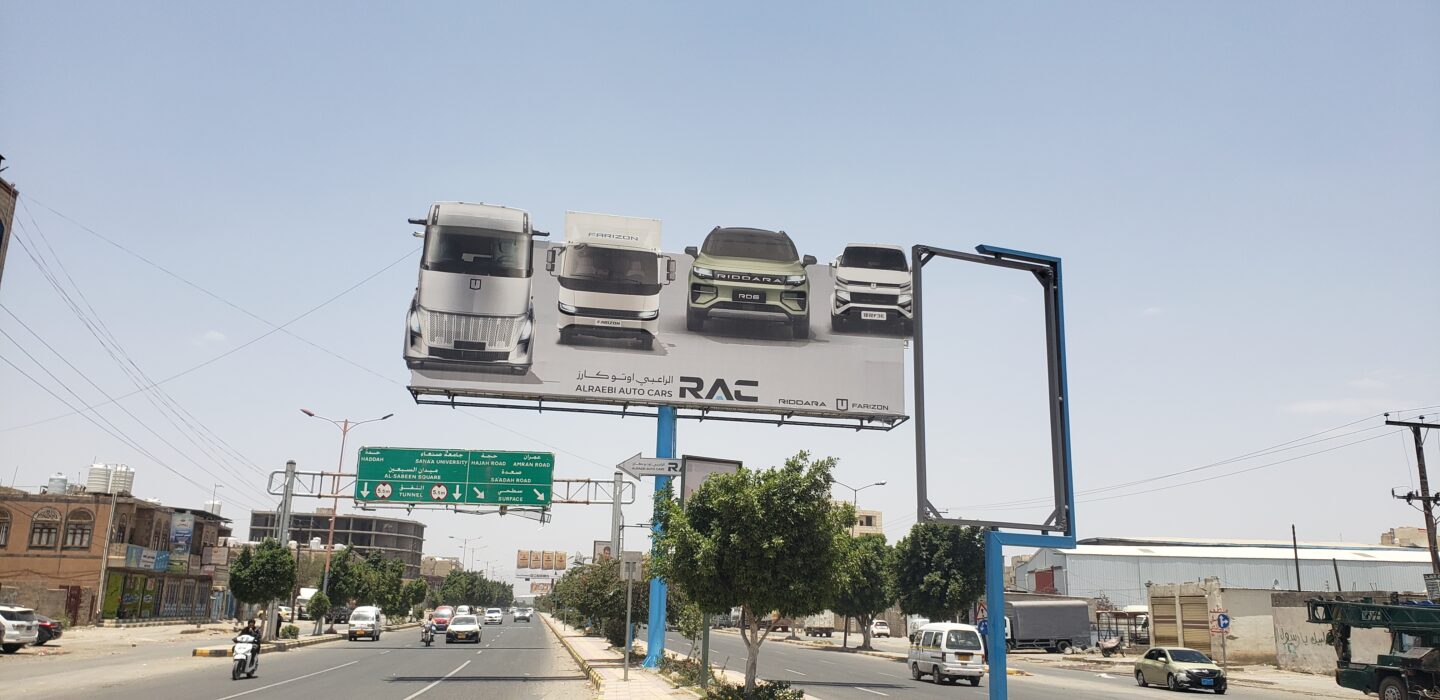
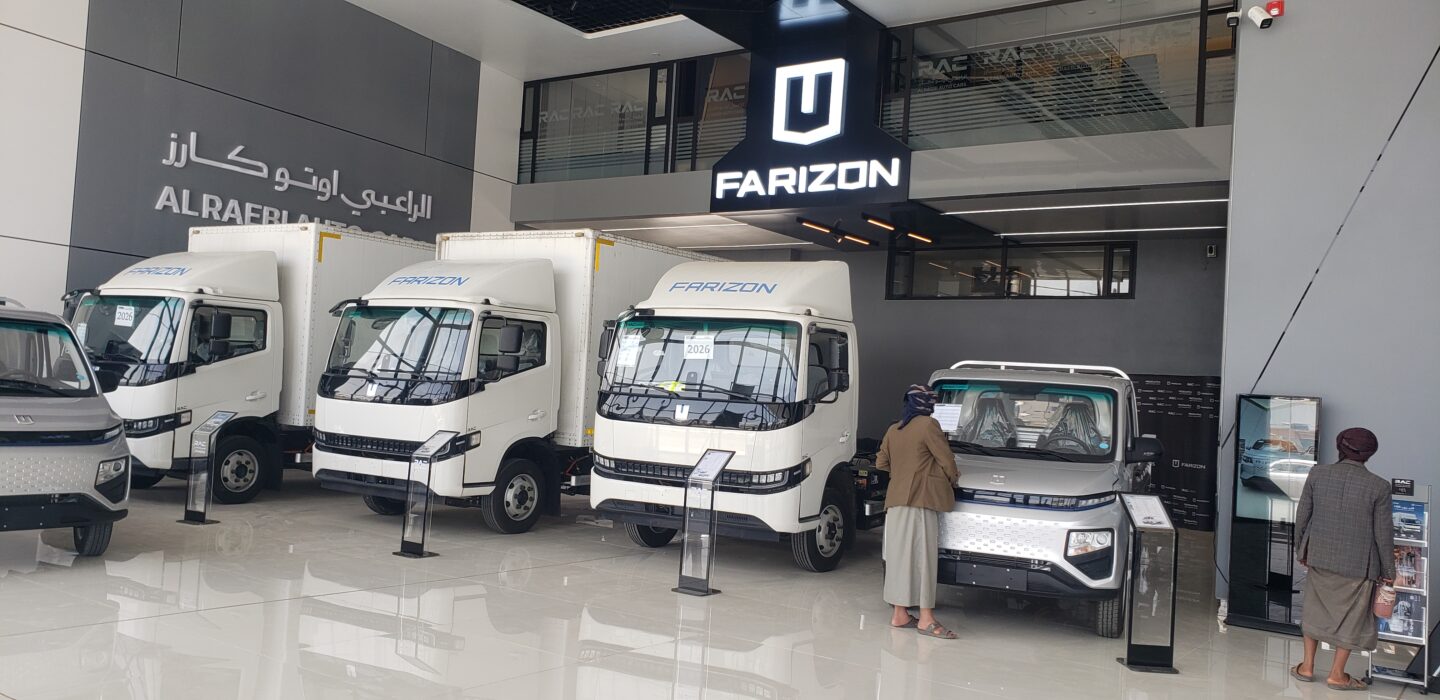
EVs started appearing on the streets of Sanaa and the southern port city of Aden in late 2024, when the first charging point was installed by Al-Raebi Company, which holds the concession to build charging infrastructure in Sanaa and several other provinces and also sells electric Farizon trucks and Riddara pickups.
Al-Raebi’s sales manager, engineer Mundhar al-Farran, said the company has sold hundreds of electric vehicles this year to farmers, traders and institutions. Like Abdallah, many of them say EVs’ simpler construction reduces breakdowns, while the immediate torque of electric motors suits Yemen’s mountainous terrain, he said.
There are now 11 charging stations in Sanaa, and one each in Aden, Dhamar, Ibb and Hodeidah. On long inter-provincial routes there is one station per corridor, al-Farran said.
The price per kilowatt at a public charging station is 120 Yemeni rials ($0.22). According to economic expert Ali al-Tuwaiti, this translates to a per-kilometre cost of about 18 rials for an EV – two and a half times less than for a fuel-efficient petrol car.
“The absence of charging infrastructure was the biggest obstacle at the start,” al-Tuwaiti said. “Al-Raebi’s initiative was the first turning point in this sector.”
Al-Raebi is also working to bring fuel station operators into the transition, offering to cover half the cost of installing solar-powered charging equipment and financing the rest, al-Farran said.
Solar power backbone
Such efforts seek to leverage the country’s investments in solar generation. Over recent years, the country has imported solar systems totalling more than 1,000 megawatts of capacity, representing an estimated investment of about $250 million, al-Tuwaiti said.
That accounts for almost a quarter of Yemen’s current electricity needs of 4,500 megawatts, he added.
It has also given an unexpected boost to the climate-vulnerable country’s efforts to further shrink its tiny carbon emissions. Al-Tuwaiti estimates that solar generation now displaces the equivalent of 7,800 barrels of oil and more than 1.2 million litres of diesel per day.
Recent estimates show Yemen contributes only around 0.03%-0.06% of global emissions, with most energy-related emissions coming from transport and power generation.
China’s BYD starts with hybrids
Yemen’s nascent EV market comes amid faster-than-expected transport electrification in some emerging countries, where Chinese manufacturers are seeking to attract buyers with lower prices in markets seen as having unlocked potential.
China’s EV giant BYD mostly sales hybrid models at its dealership in Aden for now, but it also offers repayment plans for its popular battery electric Seagull car model, which retails for about $13,000.
The dealer also sells several other models that are available as plug-in hybrids, which tend to be popular in places with limited charging infrastructure and erratic power supplies.
One recent buyer, food trader Amin, 50, paid $50,000 for his new BYD model.
“It’s powerful, has four-wheel drive, and a better launch than modern conventional cars,” he told Climate Home News outside his home, adding that the air conditioning runs efficiently even when stationary – a serious consideration in Aden’s sometimes sweltering heat.
“It’s wonderful … it has all that I want in a car,” he said.
This story was published in collaboration with Egab.
The post Chinese EV brands woo Yemen’s wealthy elite as war prompts solar boom appeared first on Climate Home News.
Chinese EV brands woo Yemen’s wealthy elite as war prompts solar boom