Climate Change
China Briefing 19 March 2026: China joins nuclear pledge | Energy approach ‘vindicated’ | New ecological code
Welcome to Carbon Brief’s China Briefing.
China Briefing handpicks and explains the most important climate and energy stories from China over the past fortnight. Subscribe for free here.
Key developments
Carbon target locked into final five-year plan
FEW CHANGES: The final version of China’s 15th five-year plan, published on 13 March, placed renewable energy “centre stage” in China’s energy supply, reported economic news outlet Jiemian. There were few changes related to energy and climate issues from the draft published at the beginning of the “two sessions” meeting in Beijing earlier this month. The final version was updated to include a reference to China’s new ecological and environmental code (see spotlight below) and a call to “actively promote” use of geothermal energy, found analysis by Carbon Brief. Policymakers also passed a new law on drafting “long-term national development plans”, such as five-year plans, specifying that research on “environmental constraints” must be factored into future documents, said business news outlet Caixin.
CLIMATE ‘BOON’: China’s five-year plans stand in contrast to other countries’ “short-term political-cycle promises”, said an editorial by state-run newspaper China Daily, with the climate targets in the plan providing a “boon to the entire world” and “influenc[ing] whether global emissions targets are achievable”. An editorial in the state-supporting Global Times argued that the plan shows that China is a “stable” geopolitical force, with its “active participation in global climate governance” showing China is “trustworthy”. [See Carbon Brief‘s coverage for further comment.]
NEA COMMENT: National Energy Administration head Wang Hongzhi published an article in political theory newspaper Study Times on the same day as the plan’s final version was released. He stated that the 15th five-year plan period (2026-2030) is “not only the decisive phase for achieving the carbon peak target, but also a critical period for building a new energy system”. He added that China must “fully leverage” market-based pricing reforms to “promote the safe, reliable and orderly replacement of fossil fuels” and “safeguard” energy security.
China endorsed nuclear target
TRIPLING NUCLEAR: China signed up to an international pledge to “triple global nuclear energy capacity between 2020 and 2050”, reported Climate Home News. Chinese vice-premier Zhang Guoqing stated that China viewed the pledge as useful both for climate change and energy security, it added. Industry news outlet China Electric Power News quoted China Atomic Energy Authority director Shan Zhongde saying China is open to nuclear cooperation with other countries on “technological innovation, safety governance [and] industrial collaboration”.
MISSED TARGETS: State-run newspaper China Daily said in an editorial responding to the pledge that nuclear power “must be part” of China’s energy transition, as “[solar and wind] alone will not suffice”. However, Bloomberg reported that China has missed several recent domestic nuclear targets, meeting neither its goal for 58 gigawatts (GW) of capacity by 2020 nor its 70GW by 2025 target. [China’s nuclear capacity totalled 62GW at the end of 2025.] It cited Francois Morin, China director for the World Nuclear Association, saying the country would also likely miss the target set in its latest five-year plan to develop 110GW of capacity by 2030.
Middle East turmoil ‘vindicates’ China’s energy approach
STOCKPILE SUPPORT: China has “ordered an immediate ban” on exports of petrol, diesel, aviation fuel and other refined fuel products in March to “pre-empt a potential domestic fuel shortage” caused by the US-Israel war on Iran, according to Reuters. The country had been stockpiling crude oil ahead of the war, Reuters also reported, with data showing the country had a surplus of “1.2m barrels per day” in the first two months of 2026. China may be “close to tapping” this stockpile, said Bloomberg, which is estimated at 1.4bn barrels in total.
CLEAN-ENERGY CUSHION: The war and the subsequent spike in oil prices have highlighted the “national security benefits of clean power” for China, said Politico, with renewable additions “cushioning” it from gas market volatility. Crude stockpiles and renewable energy mean China is “less sensitive to a prolonged closure” of the Strait of Hormuz, reported CNBC. Kate Logan, director at the Asia Society Policy Institute’s China climate hub, told Inside Climate News that the war “vindicates” China’s clean-energy push, although she added that coal will likely act as a provider of flexibility in the power sector – a role occupied by gas in other countries – and be used as a fuel and chemical feedstock. Meanwhile, the war may make relative “reliance” on Chinese clean-energy technologies “appear less like a strategic liability and more like a manageable trade-off” for other countries, argued Columbia University’s Jason Bordoff and Erica Downs in Foreign Policy.
SWITCHING SNAG: However, oil does play an “irreplaceable” role in China’s economy despite electrification, particularly as a feedstock, the Stimson Center’s China programme director Yun Sun wrote in War on the Rocks. The impact of the war on prices and availability of oil will fall hardest on industries such as “chemicals, ammonia and methanol[, as well as] advanced materials”, wrote Michal Meidan, head of China energy research at the Oxford Institute for Energy Studies, in a briefing. She added that it may also affect light industries that switched to using gas to “comply with air-quality and carbon-intensity targets”. Columnist David Fickling noted in Bloomberg that lessons from Iran are layered on top of a gas heating “crisis” seen in northern China last winter, which exposed the mistake of “treating gas as a cheap option”.
More China news
- HYDROGEN PILOT: China launched a pilot programme aiming to bring the price of hydrogen “below 25 yuan ($3.6) per kilogram by 2030”, reported Bloomberg.
- HFC QUOTA: The Ministry for Ecology and Environment issued a notice on “further strengthening” regulations on ozone-depleting substances and hydrofluorocarbons, a group of potent greenhouse gases, said Xinhua.
- MARINE ECONOMY: President Xi Jinping wrote in the theory journal Qiushi that China must promote an “orderly” construction of offshore wind, exploration for oil and gas and development of “marine energy”.
- WIND DOMINANCE: Chinese companies now occupy the “top six spots” for global wind turbine manufacturing, according to Jiemian.
Captured

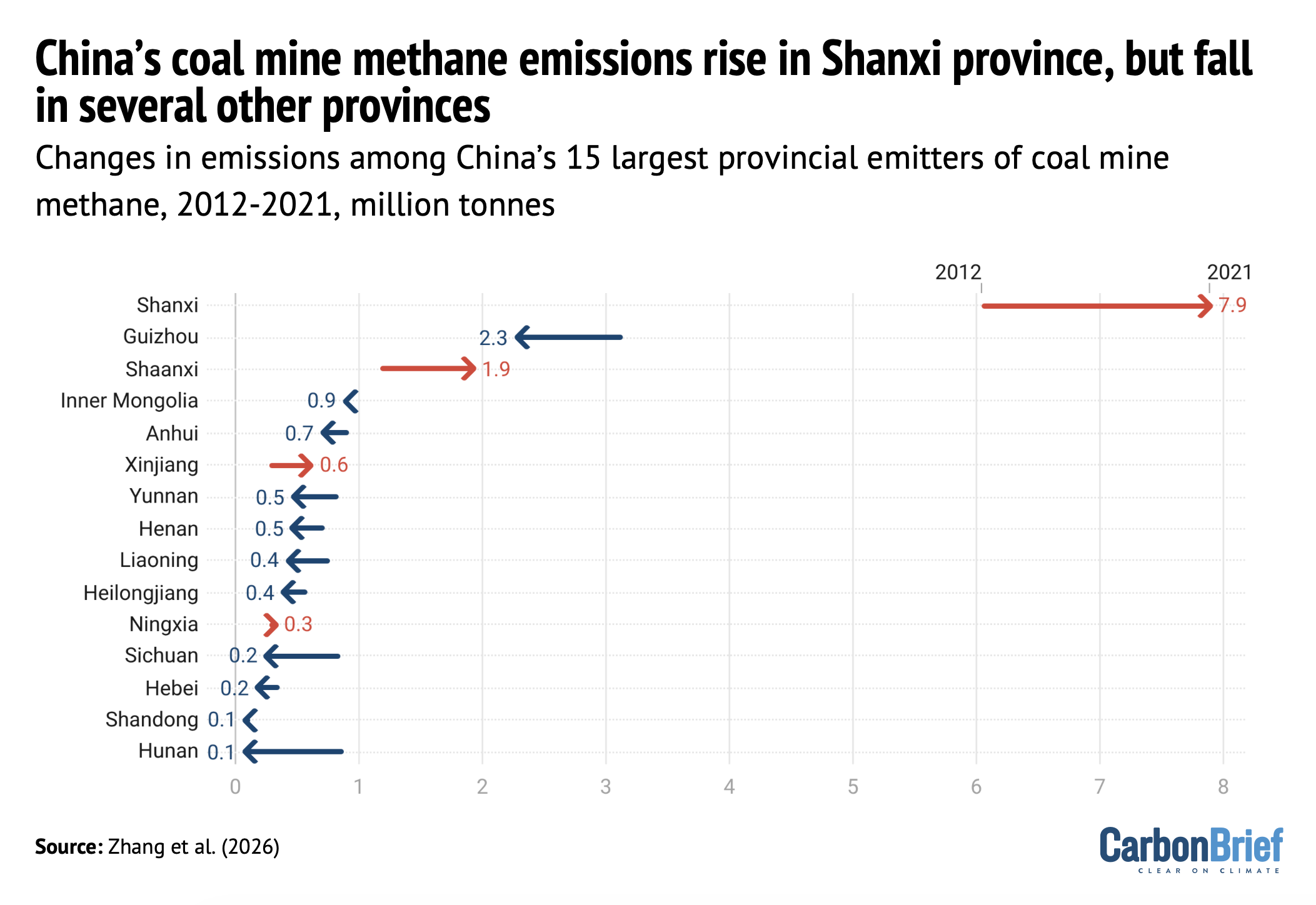
Coal production in China is shifting away from regions in the south-west of the country, where mining is associated with high methane emissions, towards lower-gas mines in the north and north-west, new research found. This, one report author wrote in Carbon Brief, is helping to “limit” the rise of China’s coal-mine methane emissions.
Spotlight
Experts: What does China’s new environmental code mean for climate change?
At the close of the two sessions (see above) China passed the final version of the ecological and environmental code, only the second code on any topic passed by China’s legislature since the Chinese Communist party (CCP) came to power.
The code includes a chapter on the “green and low-carbon transition”, which the government-supported Sino-German Cooperation on Climate Change said would introduce “foundational principles to guide future legislation and practices in areas such as carbon peaking and neutrality, green transition and climate adaptation”.
Carbon Brief has asked leading experts what impact the code will have on China’s efforts to reduce greenhouse gas emissions. Their comments have been edited for length and clarity.
Dimitri de Boer, director for China, Client Earth, and Boya Jiang, nature and climate lawyer for China, Client Earth
Think of the code as a guarantee for China’s long-term decarbonisation.
As only the second statutory code adopted in China, it provides a high-level legal foundation for the country’s climate governance as it strives towards carbon neutrality by 2060. It requires control over both the total volume and the intensity of carbon emissions, plus establishes a legal basis for key instruments, such as the national carbon market. It also mandates the government to actively participate and to play a leading role in global climate governance.
The code marks a shift from policy-led climate action to a more systematic, law-based approach, which is supported by a strong enforcement infrastructure of specialised environmental courts and public interest prosecutors. It sends a clear signal that environmental governance will remain a national priority, providing greater predictability for China’s low-carbon transition. Next steps may include revising energy-related laws, drafting further implementing regulations, and developing a dedicated climate change law.
Tianbao Qin, director, Wuhan University Research Institute of Environmental Law
China’s new ecological and environmental code marks a pivotal step in institutionalising its climate commitments. By formally enshrining the “dual-carbon” goals – peaking emissions by 2030 and achieving neutrality by 2060 – into statutory law, the code moves beyond short-term policy experiments to create a stable, long-term legal foundation.
For international observers, the most significant aspect is the establishment of legally-binding mechanisms. The codification of carbon-intensity controls, total emission caps, and a national carbon trading system provides the regulatory certainty that businesses and investors require. This legal framework ensures that emissions reductions are not just aspirational, but are backed by enforceable compliance mechanisms.
Furthermore, by integrating climate goals into broader environmental governance, China is aligning its domestic legal system with global norms, demonstrating that economic modernisation and ecological responsibility can advance in tandem under a rules-based approach.
Gu Gong, associate professor with tenure, Peking University
The ecological and environmental code has established a systematic legal framework for reducing greenhouse gas emissions. The code for the first time [provides a legal basis for] the “dual-carbon” goals, clarifies the control system for the total amount and intensity of carbon emissions, and improves the rules for carbon footprint management, the national carbon-emission trading market and carbon-emission statistics and accounting.
At the same time, separate carbon-reduction pathways – such as the green and low-carbon transformation of energy, energy conservation and carbon reduction in key industries, and clean production – have been coordinated, and the carbon-reduction responsibilities of multiple entities [such as local governments and enterprises] have been clearly defined.
Overall, the code promotes the normalisation and standardisation of greenhouse gas governance, provides a clear legal basis for the “dual carbon” goals, and makes greenhouse gas reduction work more regulated and rule-based.
Watch, read, listen
‘OPENCLAW AI’: BJX News analysed how much power is being used by the AI agent tool OpenClaw, which it says the “entire internet” in China has been using, in a trend referred to as “raising lobsters”.
‘INTENSE UPHEAVAL’: The Center for Strategic and International Studies assessed whether China’s solar overcapacity would “erode China’s leadership in solar”, or further entrench it.
STORM IN A TEAPOT: Bloomberg’s Odd Lots programme spoke with Columbia University’s Erica Downs about how tensions in the Middle East are affecting China’s “teapot” oil refiners.
FOLLOW THE MONEY: A new report by Climate Energy Finance tracked $120bn in Chinese investment in critical minerals needed for the energy transition since 2023.
55-60%
The share of total vehicle sales that new-energy vehicles (NEVs) will hold in 2026, according to estimates by the Oxford Institute for Energy Studies. The research institute also noted that plug-in hybrid electric vehicles lost share to battery electric vehicles in 2025.
New science
- Implementing China’s net-zero climate policies by 2050 “reduces global CO2 emissions to 13bn tonnes (Gt), compared with 23Gt without such policies” and could “partially offset insufficient ambition elsewhere” | Nature Communications
- China has more than 3,000 petrochemical plants, which together produced 0.8Gt of CO2 in 2021 | Science Advances
- Analysis into the power shortages that “plagued” China over 2020-22 highlights “the rigidity of existing institutional arrangements”, such as capped electricity prices, in adapting to a decarbonising energy system | Energy Policy
Recently published on WeChat
China Briefing is written by Anika Patel and edited by Simon Evans. Please send tips and feedback to china@carbonbrief.org
The post China Briefing 19 March 2026: China joins nuclear pledge | Energy approach ‘vindicated’ | New ecological code appeared first on Carbon Brief.