Climate Change
As Paris Agreement enters tougher era, new alliances urged to step up

Ten years after the adoption of the Paris Agreement, as geopolitical tensions slow climate action, leading experts have urged ambitious countries to forge new coalitions that can drive forward efforts to limit global warming without waiting for consensus.
As the implementation of the landmark Paris accord enters a “more difficult phase”, French economist Laurence Tubiana, one of the pact’s key architects, said some countries could go ahead “with more speed and more ambition” than others.
“[The Paris Agreement] is not a Bible – it has to evolve with time,” she said. Tubiana, a former diplomat, added that the framework needs to grapple with a “much more fragmented” landscape as countries are sharply divided over the pace of the transition away from fossil fuels.
Why the Paris Agreement worked – and what it needs to do to survive
At COP30, more than 80 countries wanted a global roadmap for phasing down coal, oil and gas to be formally included in the main political outcome of the Belém summit. But strong opposition from most fossil-fuel producing nations pushed such a plan out of the final Global Mutirao decision which had to be agreed by consensus.
Instead, the Brazilian presidency promised to create voluntary roadmaps on tackling fossil fuels and deforestation outside of the UN climate process over the next year.
Move faster than global consensus
Tubiana suggested that the “next wave” of climate action could be unleashed through enforcing Article 6.1 of the Paris Agreement, which recognises that some countries “choose to pursue voluntary cooperation” in implementing their national climate plans (NDCs) “to allow for higher ambition”.
That, she added, could provide “the hook” to link initiatives led by external alliances to the official framework guided by the Paris Agreement, and make them more effective and accountable.
-
Government attendance at COP30 was lowest in 10 years
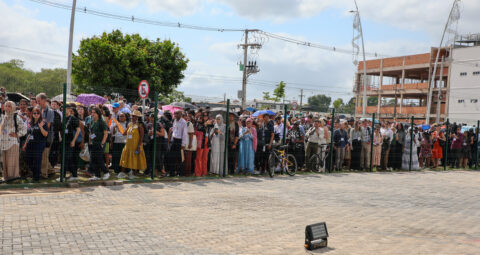
With a shortage of affordable accommodation on COP30’s official platform, just 7,500 people attended the summit with official government badges

Echoing Tubiana’s words, Rachel Kyte, the UK’s special representative for climate, argued for building “ever more interesting coalitions within countries and across countries” among those that “continue to be inspired by Paris”.
So-called coalitions of the willing have been useful before “for some countries to move further, faster when the global consensus was not there”, she added.
Bernice Lee, a distinguished fellow at Chatham House, said countries that have already invested political and economic capital in implementing the Paris Agreement – such as China – have “skin in the game” in a way that sets them apart from those that have yet to do so. It’s a “coalition of the doing rather than just the willingness”, she added.
Climate action slows in recent years
As the United States, led by climate change–denying President Donald Trump, prepares to formally exit the Paris Agreement in January, nations in Belém “strongly” reaffirmed their unity and commitment to the accord’s goals. That came as UN Secretary-General António Guterres conceded for the first time that global temperatures will rise, at least temporarily, above the 1.5C threshold set in the Paris deal.

But even if the most ambitious target is missed, the projected global temperature increase by the end of the century has fallen by at least 1C in the decade since the landmark agreement was struck.
“That means Paris has already reduced future risks for people and ecosystems: fewer extreme heat events, lower sea-level rise, and less pressure on vulnerable communities than in a 3–4C world,” Bill Hare, CEO of Climate Analytics, said in a statement.
But he warned that climate action “has slowed in the last four years”. Now, he emphasised, “our future depends on the political will to move forward fast enough to finish the job”.
Need for “pragmatic” partnerships
Kyte advised developed countries “still in the mix”, like the UK and European Union member states, to find a different way to forge partnerships with more humility. “What we saw in Belém is that a decade of over-promising and under-delivering in many dimensions has grown old,” she said, singling out the provision of money by wealthy governments to help vulnerable countries cope with escalating climate impacts.
At COP30, a demand from the world’s poorest nations to triple adaptation finance given by rich countries was agreed, but only by a deadline of 2035 rather than 2030, and within the strict contours of the $300-billion-a-year UN climate finance goal, which covers all kinds of public funding including loans and private finance mobilised by governments.
Comment: Why the Paris Agreement worked – and what it needs to do to survive
In tackling thorny issues such as transitioning away from fossil fuels, as agreed at COP28 in Dubai, Kyte said that, while some countries are actively trying to “weaponise” this tension, others are “just fearful of a world where there is going to be some kind of diktat on how to manage their transitions”.
Once work gets underway on the roadmaps for phasing down fossil fuels and halting deforestation, “I hope we can recapture the spirit of Paris, which was about pragmatic partnership in pursuit of things which are really difficult,” Kyte added.
The post As Paris Agreement enters tougher era, new alliances urged to step up appeared first on Climate Home News.
As Paris Agreement enters tougher era, new alliances urged to step up