Climate Change
AI governance debate silent on risks to nature, campaigners warn
As countries gathered in Geneva this week for the first UN dialogue on the governance of artificial intelligence, campaigners said the debate around the fast-evolving technology has overlooked the potential harm it could cause to nature and biodiversity.
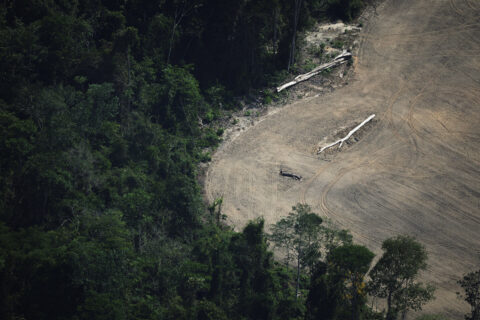
Not only has nature been absent from discussions on the environmental impacts of AI data centres, which focus mainly on carbon emissions and water use, there has also been no consideration of how AI deployment by industry could gobble up more natural resources, activists warned.
Brian O’Donnell, director of the Campaign for Nature, said that while AI can help protect wildlife and forests, the broader boost it will give to economic growth poses a far bigger threat than expected benefits.
“We’ve seen over $250 billion of private capital go into AI in 2024 alone – and almost all of that is seeking an economic return, and the money follows commercial value,” he told journalists. “Extraction, industrial farming, resource logistics, and the engines that drive ever more consumption are all activities that contribute to biodiversity loss.”
-
Tropical forest protection fund at risk after UK stalls on pledge
The Brazil-led TFFF was launched at COP30 as an innovative financial model to keep rainforests standing, but is still short on startup cash -
Mombasa ocean summit drives progress on marine protection, but threats persist
At the 11th Our Ocean conference in Kenya, its founder John Kerry says the ocean must become central to climate solutions and needs to be looked after -
UN adopts first-ever resolution on AI and environment, but omits lifecycle
The UN Environment Assembly in Nairobi gavelled the resolution on artificial intelligence and environment, but removed mentions to AI’s water and power use




The leading conservationist added that the policy documents produced by leading AI companies do not address the downstream effects of their technology for nature and biodiversity, focusing more on employment and other social issues.
Some have firms have put small sums towards projects that support conservation, he noted, but none are addressing the issue in a serious way or have included nature in the safety rules for their models.
“The living world that all of this rests upon – nature being the foundation of our economies, our societies, all life on earth – is not a primary concern in the governance of AI, as proposed by the corporates of AI,” O’Donnell said.
Positive uses steal the show
Last month, UN chief António Guterres launched an initiative to hold major AI firms accountable for their exploding environmental impacts, including carbon emissions, the amount of water and land used for data centres, and the energy they consume.
The UN boss also wants big players to commit to power all data centres with renewable energy by 2030. On Monday in Geneva, in a wide-ranging speech, he again raised his proposed “AI Environmental Transparency Initiative”. But nature has not featured in his comments on the issue.
In addition, the preliminary report of the newly formed Independent International Scientific Panel on AI – which assesses the opportunities, risks and impacts of AI – mentions environmental concerns only briefly.
The report, which examines available scientific evidence and was presented to governments at the Geneva dialogue, does not highlight any threats to nature and biodiversity but cites a study showing how AI has been used to track and reduce conflict between humans and wildlife.
O’Donnell pointed to “some really important technological uses of AI for biodiversity” such as monitoring species, forest damage and tree cover and using camera traps to see what kind of wildlife migrates in a particular area. But, he added, these get a disproportionate amount of attention compared with the threat from more rapacious resource extraction which he perceives as far greater.
By making commercial operations cheaper, quicker and more efficient, and opening access to untapped areas of land and sea, AI could drive biodiversity loss through increased over-exploitation of fish, wildlife and timber, worsening pollution and spreading invasive species on faster trade networks, he added.
Indigenous concerns
Indigenous peoples are also worried that their lands, critical mineral reserves and knowledge will be appropriated by AI and the accelerated economic development it fuels, said Hindou Oumarou Ibrahim, a leading global environmental activist and Indigenous leader from Chad.
Ibrahim, who produced a report on Indigenous peoples and AI for the UN in April, told journalists that before Indigenous peoples share their know-how on managing forests and stewarding nature, companies and governments must put in place principles to ensure this can happen in a fair way that prevents it being abused by bad actors.
Warning against ‘consumer club’ as G7 forms critical minerals alliance
Her report also points to positive ways that AI can support Indigenous culture and rights, such as tackling their lack of access to digital tools, preserving their languages and knowledge and mapping their territories to detect threats and better protect biodiversity.
Efforts such as those by the UN to shape the future of AI governance should look not only at what AI can do, but also ask who benefits and how it safeguards the planet, Ibrahim said.
“If we answer those questions together with Indigenous peoples as equal partners, we can build AI that serves humanity, protects biodiversity and help restore the balance between peoples and planet in an equitable and just way,” she added.
Policy processes lag AI development
Both O’Donnell and Ibrahim said they would lobby countries, the UN and AI firms themselves to put nature and biodiversity on the political agenda, including at the UN biodiversity summit in Armenia in October.
O’Donnell told Climate Home News that when the Global Biodiversity Framework, the world’s main treaty to protect nature, was agreed in 2022, AI was still nascent but has since exploded in terms of investment and its influence on economies.
The vote that stopped a data center: US communities query resource-hungry AI
He pointed to the mismatch between the timeline of the UN’s efforts to develop governance guidelines and the speed with which AI is being developed in the real world.
“Nature can’t be sidelined in these discussions,” he said, calling for a faster and more comprehensive response from policymakers, business and the environmental community.
“We have a very short window to embed nature both into the governance constitutions of the companies themselves and into the formal regulatory [system] going forward,” he added.
The post AI governance debate silent on risks to nature, campaigners warn appeared first on Climate Home News.
AI governance debate silent on risks to nature, campaigners warn