Ocean Acidification
A tiny but remarkable visitor in Vejle Fjord-Denmark?

A small jellyfish-like animal recently reported from Vejle Fjord has attracted attention. Clear photographs suggest that it belongs to the genus Gonionemus and may possibly be the clinging jellyfish, Gonionemus vertens (Picture courtesy to Jonas Bøgelund Poulsen)
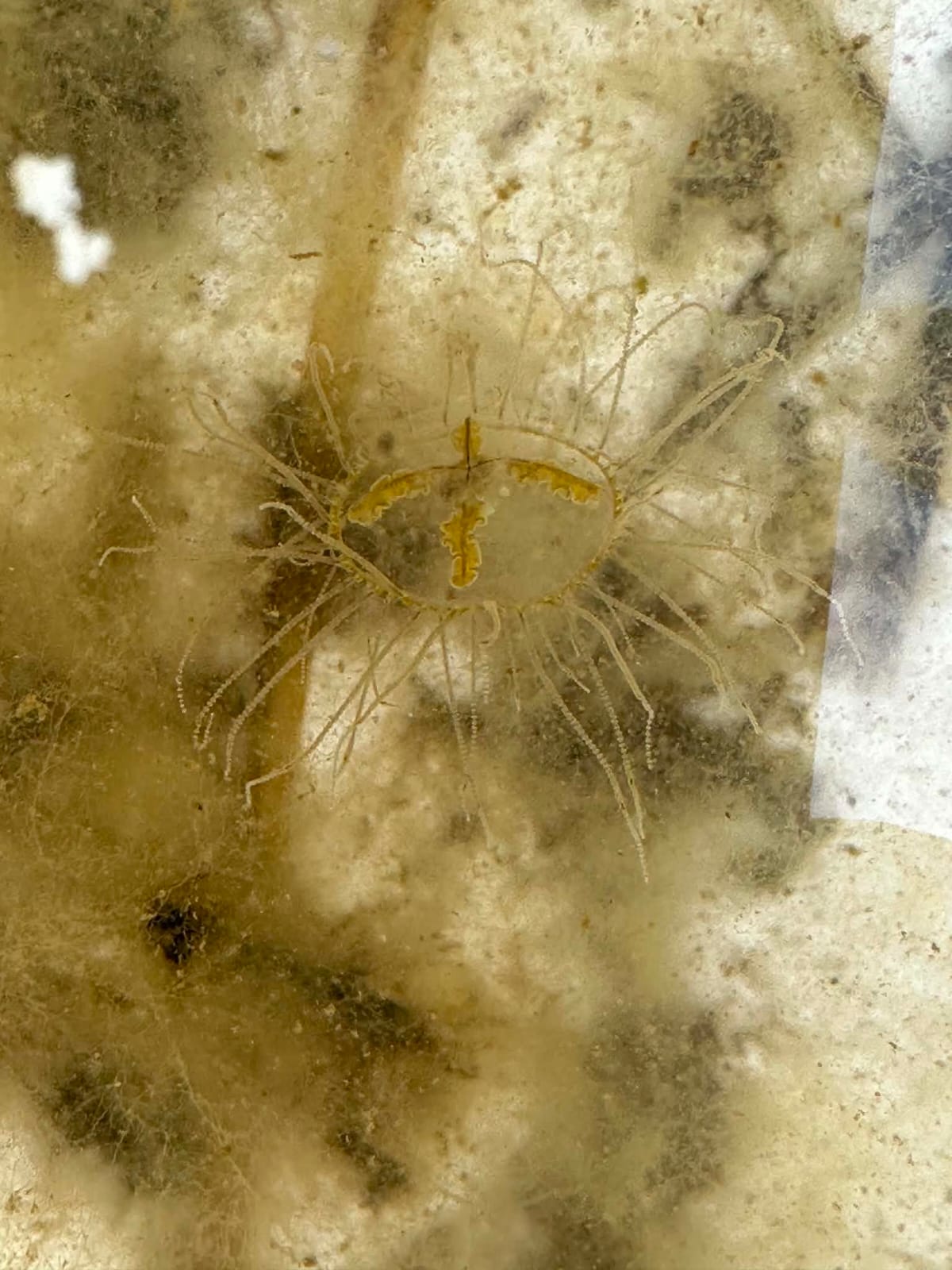
Unlike the large jellyfish commonly encountered along Danish coasts, Gonionemus vertens is a small hydromedusa, usually only around 1.5–2.5 centimetres across. Its transparent bell reveals four coloured reproductive structures arranged like a cross. Numerous fine tentacles surround the bell, often appearing bent or angled. Small adhesive pads near the ends of the tentacles allow the animal to attach itself to eelgrass, seaweed and other submerged vegetation.
This unusual behaviour explains its English name: the clinging jellyfish. During the day, it often remains attached to vegetation rather than drifting freely with the current. At night, it becomes more active and swims into the water column to feed on zooplankton and small crustaceans. Consequently, it can easily remain unnoticed even in places where it is already established. Another reason the species can be difficult to detect is its life cycle. The visible medusa is only one stage. For much of its life, the animal may persist as a minute polyp attached to a hard surface, shell or vegetation. These inconspicuous polyps can reproduce asexually and later release new medusae when environmental conditions become favourable.
Gonionemus vertens is generally considered native to the northern Pacific but has been introduced into several parts of Europe and the Atlantic. Transport on ship hulls, in ballast water or with movements of oysters and other marine organisms has been suggested as possible pathways, although the pathway responsible for any particular occurrence is rarely known with certainty.
Despite its delicate appearance, the animal should not be touched. Some populations possess powerful stinging cells and have caused intense pain, swelling, muscle cramps and, in rare cases, serious allergic reactions. Sting severity differs considerably among regions, which is one reason researchers suspect that animals currently grouped under the name G. vertens may represent a complex of closely related forms.
The Vejle Fjord observation is therefore scientifically interesting, but it should not yet be presented as a confirmed record of G. vertens. Anyone encountering a similar animal should photograph it without handling it and record the date, exact location, approximate size, number observed and surrounding habitat. Observations can be submitted to Denmark’s national species portal, Arter, where they can be evaluated and contribute to tracking changes in Danish marine biodiversity. Please use either my App: GoJelly JellySpotter or reprot to the Arter.dk: Gonionemus taxon page and Danish species-reporting portal.
References:
Edwards, C. (1977). A study in erratic distribution: The occurrence of the medusa Gonionemus in relation to the distribution of oysters. Advances in Marine Biology, 14, 251–284. DOI: 10.1016/S0065-2881(08)60448-4.
Govindarajan, A. F., Källström, B., Selander, E., Östman, C., & Dahlgren, T. G. (2019). The highly toxic and cryptogenic clinging jellyfish Gonionemus sp. (Hydrozoa, Limnomedusae) on the Swedish west coast. PeerJ, 7, e6883. DOI: 10.7717/peerj.6883.