Carbon Footprint
2026 Could Redefine Voluntary and Compliance Carbon Market Convergence, with Japan Leading the Way



The voluntary carbon market (VCM) enters 2026 with stronger foundations than a year ago. Despite political headwinds in 2025, investment, contracting, and integrity standards advanced.
According to Abatable’s 2026 market report, forward carbon credit contracts rose 58% year-on-year to $5.8 billion in 2025. This surge shows that buyers are locking in future supply rather than relying on spot purchases.
Funding for carbon credit projects reached $15.8 billion in 2025, even after a slowdown in engineered removal investments. Notably, nature-based funding hit a record $9 billion, signaling strong demand for high-integrity supply.
At the same time, compliance markets are reshaping demand patterns. CORSIA, the Carbon Offsetting and Reduction Scheme for International Aviation, is set to create an extra 78 million tonnes of demand by 2026. This is in addition to the 58 million tonnes needed for 2024 emissions.
But the most significant structural shift may come from Japan.
GX-ETS: From Voluntary Signal to Compliance Engine
Japan’s new GX-ETS (Green Transformation Emissions Trading Scheme) becomes mandatory in April 2026. The Asian country emits roughly 1 billion tonnes of CO₂ per year. The GX-ETS will initially cover 500–600 million tonnes annually, more than half of national emissions.
- Between 300 and 400 companies will be regulated under the scheme.
Companies will be allowed to meet up to 10% of their compliance obligations using carbon credits. That creates potential demand of 50–60 million tonnes of credits per year.

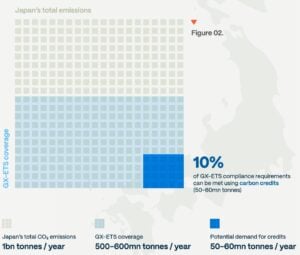
For comparison, total voluntary carbon market retirements across major registries were 163 million tonnes in 2025. Japan alone could represent roughly one-third of that volume in compliance-driven demand.
This is not incremental; it is structural.
Convergence in Practice: J-Credits and JCM
Japan’s design shows how compliance and voluntary systems are merging. Companies can use two credit routes under GX-ETS:
- J-Credits – Japan’s domestic carbon credit scheme
- Joint Crediting Mechanism (JCM) – An Article 6.2 international crediting system with 29 partner countries
J-Credits cover nature-based solutions, renewable energy, and industrial efficiency. Engineered removals such as BECCS (bioenergy with carbon capture and storage) and DAC(direct air capture) are expected to be added in future phases.
The JCM focuses largely on avoidance projects, including renewable energy and efficiency measures. This structure links Japan’s domestic compliance market directly to international carbon trading under the Paris Agreement. It effectively blends compliance demand with voluntary market infrastructure.
Why This Matters for the VCM: From Optional Offsets to Structured Demand
The voluntary market has long relied on corporate net-zero commitments. Yet, that driver is evolving.
The Science Based Targets initiative (SBTi) remains the most influential corporate demand-side framework. Its new Corporate Net Zero Standard V2 draft introduces the concept of Ongoing Emissions Responsibility (OER). Companies may be recognized for addressing ongoing emissions using carbon credits.
This shifts the narrative. Credits are no longer seen only as optional compensation tools. They may become structured components of transition plans.
Meanwhile, integrity has become central.
The Integrity Council for the Voluntary Carbon Market (ICVCM) has approved 40 CCP methodologies across eight programs. CCP-approved methods might create 865 million more credits by 2035. That’s a ninefold rise from current levels.
Even so, CCP-eligible credits are projected to represent only 12.7% of cumulative voluntary supply by 2035. In this context, Japan’s GX-ETS creates guaranteed, regulated demand for credits that meet compliance rules.
This may increase price discipline and quality screening.
Asia Emerges as the Carbon Pricing Growth Hub
Japan is not acting alone. China is expanding its national ETS and moving toward absolute emissions caps. India plans to launch its Carbon Credit Trading Scheme in mid-2026.
Across Asia, carbon pricing systems now cover hundreds of millions of tonnes of emissions. Globally, carbon pricing instruments cover about 28% of global greenhouse gas emissions, according to the World Bank.
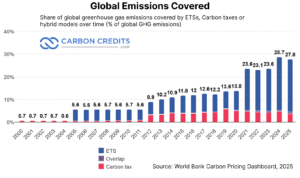

Japan’s GX-ETS will become Asia’s second-largest carbon market.
This regional shift is important. Asia makes up a big part of global emissions and industrial output. When compliance systems in big economies allow some use of carbon credits, they connect voluntary methods to formal rules.
Several other Asian countries already run, or are building, carbon pricing systems.
South Korea operates the Korea Emissions Trading System (K-ETS), launched in 2015. It is one of the largest ETS programs in the region. The International Energy Agency reports that K-ETS includes nearly 80% of Korea’s domestic greenhouse gas emissions. It also targets around 800 of the country’s largest emitters.
Singapore uses a national carbon tax instead of an ETS. The National Environment Agency says Singapore raised its carbon tax to S$25 per tonne in 2024 and 2025, and it will rise to S$45 per tonne in 2026 and 2027. Starting in 2024, Singapore allowed companies to offset up to 5% of taxable emissions. They can use eligible international carbon credits for this.
Indonesia has moved into carbon trading through a formal exchange. The Indonesia Stock Exchange’s carbon platform, IDXCarbon, launched in September 2023, after the country’s financial regulator granted the operator a license. Indonesia’s wider system is expected to evolve into a hybrid model that links trading with a carbon tax-style backstop.
Vietnam has also set a clear roadmap. The International Carbon Action Partnership states that Vietnam updated its carbon market rules in June 2025. It also mandated a pilot ETS starting in August 2025. A fully functioning carbon market is expected by 2029.
These programs show how carbon markets are spreading across Asia through different policy designs. Some countries use cap-and-trade systems. Others use carbon taxes with limited credit use. These models can boost cross-border linkages over time. As Article 6 systems grow, buyers will look for credits that fit both voluntary and compliance needs.
Tightening Supply, Rising Quality Premiums
Supply dynamics are also shifting. Following the 2021 issuance peak, the 2025 supply continued to decline. The net surplus of credits fell to Abatable’s 2026 market report, down from 123 million in 2024.
Avoidance projects still dominate supply. Cookstoves, industrial efficiency, renewable energy, and REDD+ accounted for 222 million tonnes, or 83% of supply in 2025.

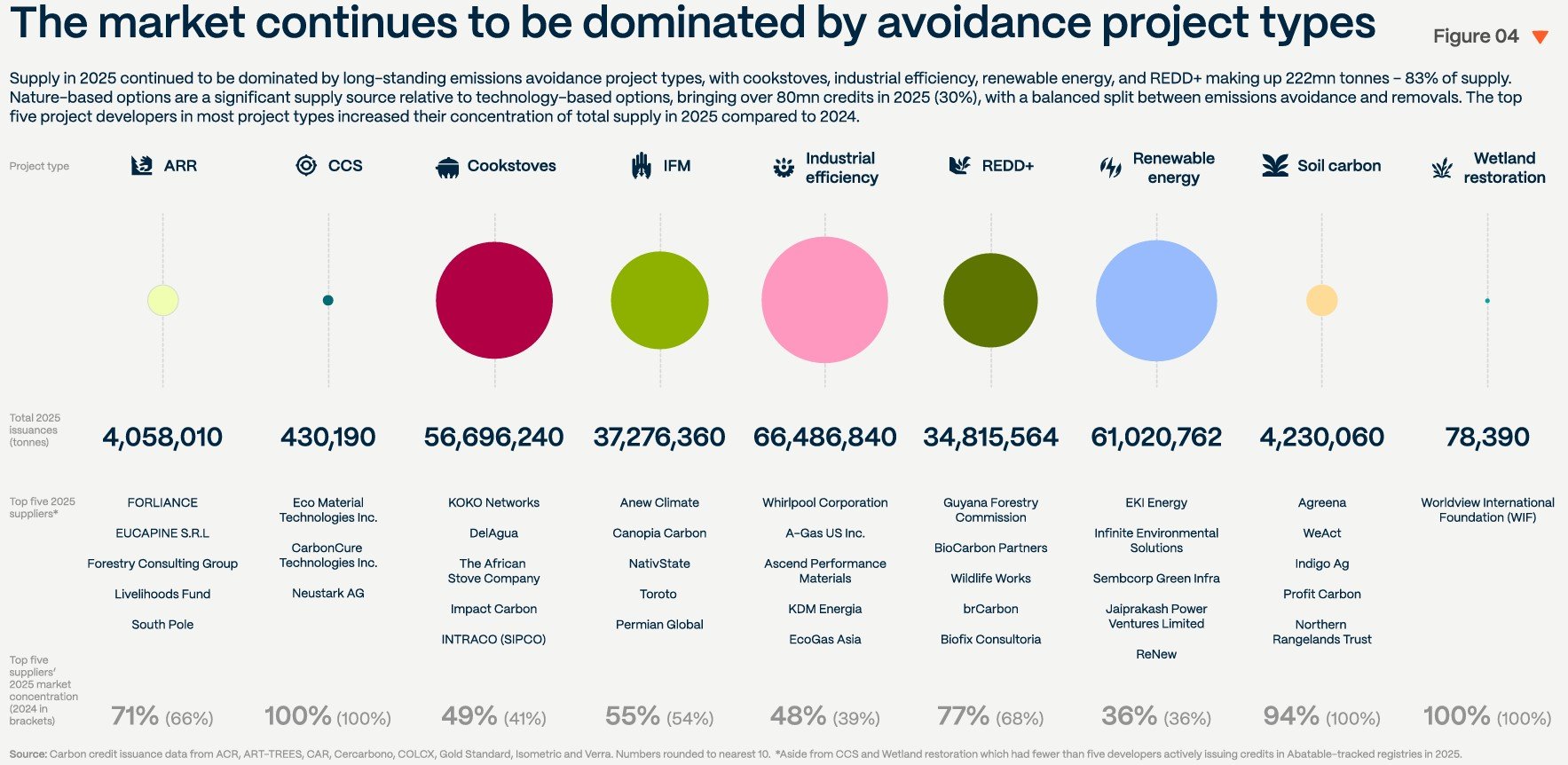
Notably, forward pricing data show buyers paying premiums for higher-integrity methodologies, especially CCP-approved projects. Meanwhile, engineered removals remain scarce and expensive. Biochar leads in engineered supply offers. Other removal types mainly use forward contracts for trading.
As compliance markets such as GX-ETS and CORSIA expand, demand for eligible units may tighten supply and lift prices. For CORSIA alone, total First Phase demand is projected at 200–220 million tonnes.

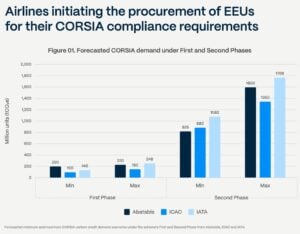
Adding potential GX-ETS demand of 50–60 million tonnes per year changes the scale of market expectations.
2026: A Structural Realignment, Compliance and VCM Begin to Merge
The convergence between compliance and voluntary markets is no longer theoretical. Japan’s GX-ETS demonstrates a model where:
- A large national ETS covers over half of emissions
- Companies can use carbon credits for 10% of compliance
- Domestic and international credit systems integrate
- Integrity standards increasingly define eligibility
This integration creates predictable demand. It may also reduce reputational risk for buyers. Credits used in compliance systems face higher scrutiny.
For voluntary buyers, this strengthens signals around quality and durability, while for project developers, it offers more stable forward revenue. For policymakers, it creates flexibility without abandoning emissions caps.
The VCM deployed 55 million tonnes of high-quality credits through Abatable’s platform alone, across more than 200 companies
In 2026, the market looks more institutional. Forward contracting is rising, integrity standards are tightening, and compliance systems are opening to credit use.
Japan’s GX-ETS may prove to be the clearest sign yet that carbon markets are moving toward structured integration. If 2025 was about resilience, 2026 may be about alignment. And Japan is leading that shift.
- READ MORE: The Carbon Credit Market in 2025 is A Turning Point: What Comes Next for 2026 and Beyond?
The post 2026 Could Redefine Voluntary and Compliance Carbon Market Convergence, with Japan Leading the Way appeared first on Carbon Credits.