

The voluntary carbon market has matured quickly, but with that growth comes increasing scrutiny. Organisations looking for high-quality carbon credits are recognising that not all credits deliver the same environmental outcomes. Quality is shaped upstream, through rigorous project design, conservative accounting, and long-term management of environmental risk.


Carbon Footprint
Fusion Breakthrough: Google Venture-Backed Inertia Raises $450M to Build World’s Most Powerful Clean Energy Laser

Inertia Enterprises, a fusion energy startup, has raised $450 million in a Series A funding round. The capital will help the company build the world’s most powerful laser and advance its fusion power technology.
The funding round was led by Bessemer Venture Partners. Other investors include GV (formerly Google Ventures), Modern Capital, Threshold Ventures, Long Journey Ventures, and others.
Inertia was founded in 2024. The company’s mission is to make fusion energy a practical and clean power source for the grid. It plans to use its new funds to build key parts of its fusion system and to scale components that are essential for commercial power plants.
Fusion energy has long been viewed as a potential source of abundant, clean power. Inertia’s recent funding round is one of the largest for any fusion startup. It reflects growing investor interest in bringing fusion out of the lab and into real-world use.
What Fusion Energy Is and How Inertia’s Approach Works
Fusion is the process that powers the sun. It happens when light elements such as hydrogen combine to form a heavier element. This process releases a large amount of energy. Fusion does not produce carbon emissions, and it generates much less long-lived radiation than fission nuclear power.
Inertia’s technology is based on a fusion method called inertial confinement fusion (ICF). ICF uses powerful lasers to compress tiny fuel pellets. When the pellets reach high temperature and pressure, fusion reactions occur.
The company plans to build a laser system called Thunderwall. This system is designed to deliver powerful beams at a rapid rate. The laser will fire repeated pulses into fuel targets, generating the conditions needed for fusion.
Inertia’s founders include leaders with experience in fusion science and large-scale research facilities. This includes scientists from the Lawrence Livermore National Laboratory’s National Ignition Facility (NIF). Their experiments showed fusion ignition, which produced more energy than they used on the target.
The company’s CEO and co-founder, Jeff Lawson, previously led Twilio, a technology company that grew into a major communications platform. He now leads Inertia’s effort to translate fusion science into clean energy technology. He said,
“Our plan is clear: build on proven science to develop the technology and supply chain required to deliver the world’s highest average power laser, the first fusion target assembly plant, and the first gigawatt, utility-scale fusion power plant to the grid. Inertia is building the team, partnerships, and capabilities to make this real within the next decade.”
Inside the $450M Bet on Commercial Fusion
The $450 million funding round is considered one of the largest for a fusion startup in its early phase. The money will support several major activities, including:
- Building Thunderwall, the powerful average-power laser system.
- Developing manufacturing lines for fusion fuel targets.
- Creating the first pilot plant and laying the groundwork for future commercial plants.
- Scaling supply chains for components like laser diodes and fuel pellets.
Investors say Inertia’s technology has the potential to reach commercial-scale fusion energy faster than other approaches. They cite the company’s focus on proven physics from earlier lab experiments.
Co-founder, Dr. Annie Kritcher, remarked,
“In just three years, we’ve gone from the first experiment to ever produce more fusion energy than was delivered to the target, to repeating that result many times and pushing the target gain higher. We’re now focused on translating physics we know works into a pathway toward commercial-scale fusion energy, and the real benefits it can deliver for people and the planet.”
From Lab Ignition to Grid Ambition: Inertia’s Fusion Roadmap
Inertia’s approach relies on key breakthroughs made at the NIF in Lawrence Livermore National Laboratory. In December 2022, researchers reported a major breakthrough. They conducted the first controlled fusion experiment that generated more energy than it received.
The NIF success provided proof of concept. It showed that inertial confinement fusion could technically produce net energy in a single experiment. Inertia’s team includes some of the scientists from that effort.
- Inertia’s long-term goal is to build a fusion power plant with 1.5 gigawatts (GW) of capacity. A plant of this size could supply electricity for about 1 million homes.
The next challenge is to make the fusion process repeatable and efficient enough to produce continuous power. Inertia plans to use advanced diode lasers. These lasers are expected to be about 10x more efficient than older technologies. The company believes this will significantly lower the cost of fusion energy production.
Fusion Joins the Clean Energy Investment Surge
Fusion energy investment has grown quickly in recent years. Both governments and private companies are putting large sums into the sector. It is now part of a broader clean energy funding trend that includes startups pursuing both fusion and fission technologies.
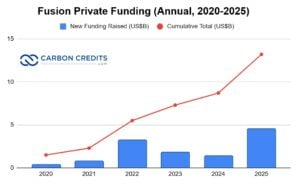
Private fusion funding has exploded over the past five years. Total investment reached $13.2 billion by the end of 2025. That amount is up 8x from 2020, when just 15 companies raised $400 million.
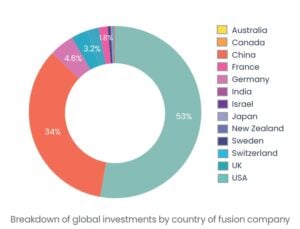
The US leads with 53% (~$7B) while China holds 34%. Active companies surged 400% from 15 to 77, reflecting broader investor diversification across ICF, tokamaks, and stellarators. Inertia’s $450M sits atop this record-breaking year.
Some other fusion startups that have attracted significant capital include:
- Commonwealth Fusion Systems, with roughly $2.86 billion raised to date.
- Helion Energy, with more than $1 billion in funding and commitments.
- Pacific Fusion, reported to have raised about $900 million.
- General Fusion, with about $357 million raised.
Private capital flows into fusion are increasing as the global demand for clean energy rises. Many countries are moving to reduce carbon emissions and to invest in technologies that can provide large amounts of clean power with minimal environmental impact.
In the United States, the Department of Energy (DOE) awarded $134 million for fusion research programs. These include the Fusion Innovative Research Engine (FIRE) and the INFUSE program. The DOE said it could invest up to $220 million over four years in the FIRE initiative. The goal is to link national labs, universities, and private firms to speed up fusion development.
The DOE has also partnered with companies such as Kyoto Fusioneering to test fusion fuel cycle systems at Oak Ridge National Laboratory. These efforts aim to prepare key technologies for future fusion plants.
Private capital is also rising, as shown in the chart.
Italian energy major Eni signed a more than $1 billion power purchase agreement (PPA) with Commonwealth Fusion Systems (CFS). The deal covers electricity from CFS’s planned 400-megawatt ARC fusion plant in Virginia. The plant is expected to connect to the grid in the early 2030s.
CFS has also signed a deal with Google for 200 megawatts of future fusion power. These agreements show that large energy buyers are planning for fusion in long-term clean energy strategies.
- READ MORE: Google Backs Fusion Energy: Signs 200MW Offtake Agreement with Commonwealth Fusion Systems
Governments and corporations now see fusion as a long-term clean energy option backed by serious funding and market commitments. That is because fusion energy does not emit carbon during power generation and uses fuel that is abundant in nature, such as isotopes of hydrogen. This makes it attractive as a long-term clean energy option alongside renewables such as wind and solar.
Could Fusion Become the Ultimate Baseload Power?
Inertia’s $450 million funding round is a landmark moment for the fusion industry. It shows that investors are willing to back ambitious clean energy technologies with long-term horizons.
Fusion has the potential to provide baseload clean power — power that is stable and available around the clock. This could complement intermittent renewables like solar and wind.
If commercial fusion is achieved, it could transform the global energy landscape. Countries could reduce dependence on fossil fuels. Power systems could become cleaner and more resilient.
However, fusion still needs major technological breakthroughs before it becomes a practical energy source. Inertia and other fusion companies are working to solve the remaining scientific, engineering, and supply chain challenges.
The next few years will be critical for measuring progress. Successful fusion commercialization could mark a turning point in the global effort to achieve deep decarbonization and sustainable energy systems.
The post Fusion Breakthrough: Google Venture-Backed Inertia Raises $450M to Build World’s Most Powerful Clean Energy Laser appeared first on Carbon Credits.
Carbon Footprint
India’s Solar and Renewable Energy Outlook to 2030: Impact of the US-India 18% Tariff Cut on Exports

In February 2026, the United States and India reached a landmark trade deal that reshaped clean energy trade between the two nations. The agreement lowered reciprocal tariffs on Indian goods from 25% to 18% and removed a 25% penalty tariff imposed due to India’s Russian oil imports. For Indian solar exports, this effectively cut total tariffs from roughly 50% to 18%, immediately lifting optimism across the renewable energy sector and providing relief to developers.
This deal marked a reset in US-India trade relations. In return, India committed to purchasing $500 billion in American energy, technology, and agricultural products over five years. Moreover, the agreement encourages India to shift energy imports from Russia to the US and Venezuela, further aligning trade with energy security goals.
Solar Exports and Market Reaction
The impact on solar exports was immediate and significant. In the first nine months of 2025, India exported 10.4 GW of solar modules to the US, nearly 97% of total solar exports, according to JMK Research and Mercom Capital.
This surge was further boosted by strong demand from Europe, where India shipped an additional 1.6 GW, bringing the first nine months’ total to 15 GW. Consequently, Indian manufacturers are consolidating their position as reliable global suppliers.
Waaree Energies, Adani Solar, and RenewSys led the expansion. Their success is underpinned by growing domestic production capacity, which reached 52 GW for solar cells and 55 GW for modules by Q3 2025. At the same time, India’s dependence on imported components is declining.
Module imports fell 39% from the previous quarter, although China still supplies nearly 75% of imports. This shift signals India’s strengthening self-reliance and growing manufacturing sophistication.

Solar Stocks Rally After US-India Trade Deal
Several media resources reported that the stock market responded promptly after the trade deal. Solar-focused firms, including Insolation Energy Ltd. and Oriana Power Ltd., surged over 24% in February 2026, recovering from losses in January. Investors expect that lower tariffs will not only improve profit margins but also accelerate orders and speed up US project pipelines. If the deal is formally ratified in March, analysts predict this momentum will continue.
Additionally, the tariff cut supports supply chain diversification. As the US reduces reliance on Chinese suppliers, Indian manufacturers are emerging as reliable alternatives. In particular, Vikram Solar and Waaree Energies are well-positioned to capture growing shares in utility-scale and commercial solar projects.
Inside India’s Solar Growth Story
Domestic solar development has mirrored export growth. JMK Research further highlighted that in 2025, India added:
- A record 37.9 GW of solar capacity, representing a 54.7% increase from 2024. Of this, utility-scale projects contributed 28.6 GW. Furthermore, the open access segment accounted for more than 38% of utility-scale additions, showing the increasing role of private buyers.
- Rooftop solar also expanded rapidly, with 7.9 GW added in 2025—a 72% rise from the previous year. Programs such as PM Surya Ghar: Muft Bijli Yojana supported this growth by incentivizing households to adopt solar systems.
- Off-grid and distributed solar contributed 1.35 GW, slightly below 2024 levels, but remained an important segment for decentralized power solutions.
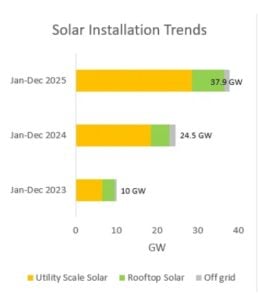
Quite evidently, India’s strong domestic manufacturing is the reason for installation growth. By December 2025, cumulative module and cell capacity crossed 200 GW. The market remains concentrated, with the top five cell manufacturers—Waaree, Adani, Vikram, REC, and Rayzon—holding 71% of capacity. In the module segment, Waaree, Adani, Vikram, REC, and RenewSys account for 58%. By mastering efficient production and securing a stable supply of raw materials, these firms continue to strengthen India’s global competitiveness.
Electricity Demand and Renewable Energy Milestones
While exports attract attention, domestic electricity demand is equally critical. IEA’s latest electricity report shows that in 2025, demand rose only 1.4%, the slowest pace since 1972 outside the pandemic. Mild weather reduced cooling needs, early monsoon rains eased peak loads, and industrial activity slowed slightly.
However, this slowdown is temporary. Demand is expected to rebound 6.9% in 2026 and grow at an average of 6.4% annually through 2030. Rising incomes will drive greater air conditioner and appliance use, industrial output is expanding steadily, and electricity use in agriculture and transport continues to rise. As a result, combined with strong exports, India is set to strengthen its position as a key player in global renewable energy.
Government Programs Boost Solar Adoption Nationwide
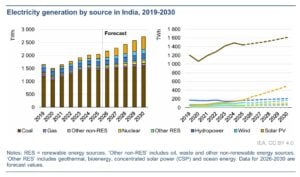
The IEA report further says that renewable electricity generation reached record levels in 2025, increasing 20% over 2024. Solar PV led the expansion with 24% growth, benefiting from falling module costs and sustained policy support. Consequently, total operational renewable energy capacity surpassed the 200 GW mark, with solar accounting for 53% of total renewable capacity.
Looking ahead, India now draws around 50% of its installed capacity from non-fossil sources, ahead of its 2030 Paris Agreement target.
Government programs continue to encourage adoption. PM-KUSUM promotes solar-powered agricultural pumps, while PM Surya Ghar incentivizes rooftop installations. Furthermore, the launch of India’s first National Policy on Geothermal Energy in 2025 expands the country’s clean energy options, complementing solar development.
Between 2026 and 2030, the country plans to add nearly 300 GW of renewable capacity, with solar leading the way. Domestic manufacturing will support this growth, with 100 GW of ALMM-certified capacity ensuring a self-reliant supply chain.
Grid Modernization and Reliability
As the sector grows, India is shifting focus from capacity addition to reliable operation. In 2025, the Central Electricity Authority mandated Automatic Weather Stations at large solar projects to improve forecasting and ensure stable integration into the grid.
Additionally, the Ministry of Power launched the India Energy Stack to build a digital infrastructure for the power sector. A Utility Intelligence Platform integrates data from distribution companies, improving operations and enabling better planning.
Meanwhile, the Revamped Distribution Sector Scheme continues to roll out, including 203 million smart meters. States that implement reforms efficiently receive additional financial incentives. Together, these measures ensure that India’s growing renewable fleet can operate smoothly alongside coal, gas, and nuclear power.
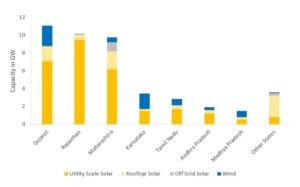
State-wise Solar and wind capacity addition in India from January-December 2025
Implications of the US-India Deal
Ultimately, the US-India solar tariff cut is more than a trade story. It strengthens India’s renewable energy exports, improves project economics in the US, and enhances the competitiveness of Indian manufacturers.
Moreover, combined with rising domestic demand, record solar expansion, nuclear development, and grid modernization, India’s energy sector is entering a transformative decade. By 2030, the country could lead global clean energy exports while maintaining a diverse and reliable power system.
In short, the tariff cut boosts short-term exports and creates long-term advantages. It strengthens US-India trade ties and aligns closely with India’s renewable energy ambitions through 2030, positioning India as a global solar powerhouse.
- READ MORE: Renewables 2025: How China, the US, Europe, and India Are Leading the World’s Clean Energy Growth
The post India’s Solar and Renewable Energy Outlook to 2030: Impact of the US-India 18% Tariff Cut on Exports appeared first on Carbon Credits.
Carbon Footprint
TotalEnergies Hits Record $73 Million Carbon Credit Spend as 2025 Profits Stay Strong

TotalEnergies spent a record $73 million on carbon credits in 2025. This was up 49% compared with 2024. The figure was disclosed alongside the company’s full-year financial results.
Carbon credits allow companies to offset emissions by funding projects that reduce or remove carbon dioxide. These projects include forest protection, reforestation, and other verified climate initiatives.
The higher spending shows that TotalEnergies is expanding its carbon portfolio. The company uses carbon credits to manage emissions that are hard to cut quickly. This includes emissions from oil and gas production and from the use of its products.
The $73 million figure marks the company’s highest annual carbon credit spend to date.
Strong Profits Hold Firm in a Softer Oil Market
TotalEnergies reported strong 2025 financial results even as oil prices softened. For the full year 2025:
- Adjusted net income reached $15.6 billion, down about 15% from 2024.
- IFRS net income totaled $13.1 billion, down around 17% year-on-year.
- The company generated nearly $28 billion in cash flow from operations, about 7% lower than 2024.
- Return on average capital employed stood at 12.6%, among the highest for major energy companies.
- Net debt remained low, with a gearing ratio of around 15% at year-end.
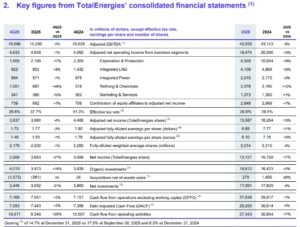
These results show that TotalEnergies maintained strong profitability and balance sheet discipline. Upstream oil and gas production rose by about 4% in 2025, helping offset weaker oil prices. LNG sales also supported earnings.
The company continued to reward shareholders while investing in future growth.
Billions Flow Into Renewables and Power Growth
TotalEnergies invested $17.1 billion in capital expenditures in 2025. About 37% went to new oil and gas projects while around $3.5 billion went to low-carbon energies. Of that, nearly $3 billion was directed to electricity and renewables.
The company added 8 gigawatts (GW) of renewable capacity in 2025. This matches its goal of adding about 8 GW per year through 2030.
Electricity production continues to grow as part of the company’s strategy. In 2024, TotalEnergies reported a 23% rise in net electricity generation compared with the previous year.
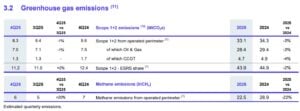
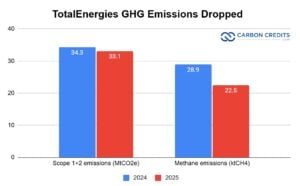
Methane reduction also advanced. In 2025, TotalEnergies reported a 65% cut in methane emissions compared with 2020 levels. The company aims for near-zero methane by 2030.
These steps support its broader climate strategy while keeping traditional energy operations active.
Offsets as a Bridge in the Net-Zero Plan
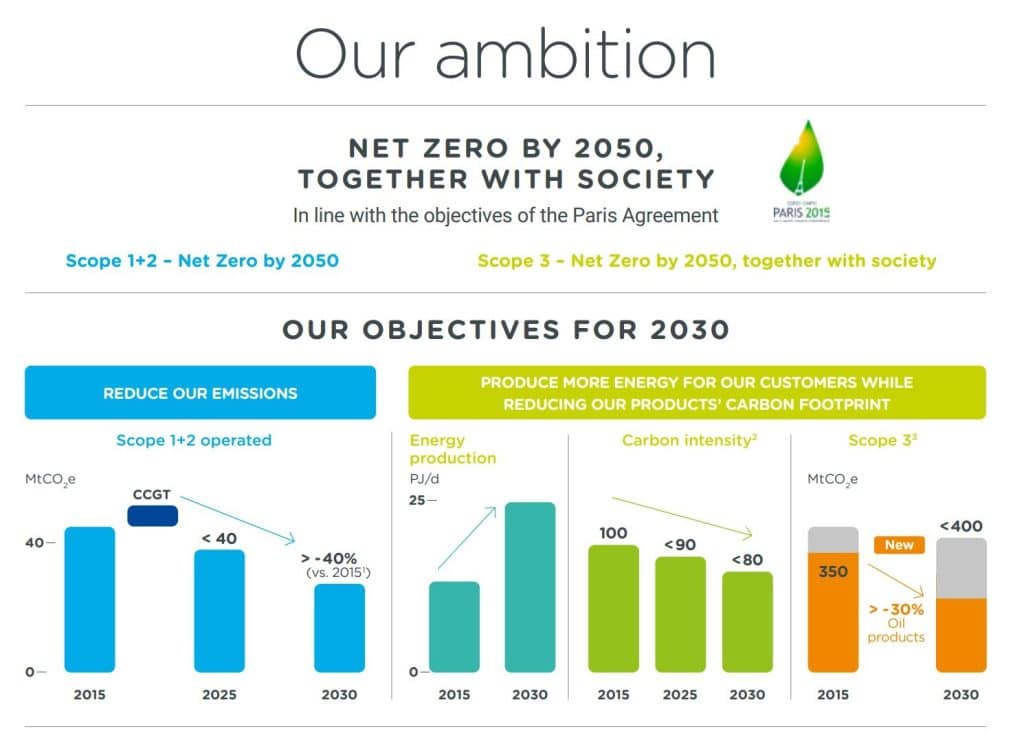
Carbon credits play a defined role in TotalEnergies’ climate plan. The company has stated that it plans to invest about $100 million per year in carbon projects over time. These projects aim to build a large portfolio of credits to offset residual emissions by 2030.
Carbon credits help cover emissions that cannot yet be eliminated through technology or operational changes. For oil and gas companies, this often includes emissions from product use, also known as Scope 3 emissions.
TotalEnergies aims to reach net-zero emissions by 2050 across its operations and energy products. This includes reducing direct emissions and lowering the carbon intensity of the energy it sells.
In 2024, the energy company reported a 16.5% reduction in lifecycle carbon intensity compared with 2015, exceeding its initial 14% target.
Carbon credits serve as a bridge. They support climate projects while the company expands renewables and reduces operational emissions. The oil major reduced its Scope 1 and 2 GHG emissions from 34.3 Mt CO₂e in 2024 to 33.1 Mt CO₂e in 2025, a drop of 1.2 Mt or ~3.5%.
How Big Oil Is Leveraging the Carbon Credit Market
TotalEnergies is not alone in using carbon credits. Many large oil and gas companies use credits as part of their climate plans. For example:
- Shell has invested in nature-based carbon projects and operates a large carbon credit portfolio to offset customer emissions.
- BP has also used carbon credits in voluntary carbon markets as part of its net-zero ambition.
- Equinor invests in carbon capture and storage and has supported carbon market mechanisms.
Oil majors face unique challenges. Their products release emissions when burned. Cutting these emissions fully will take decades and large-scale changes in global energy systems. This is where carbon credits come in. It allows companies to support emission reductions elsewhere while they shift their energy mix.
The voluntary carbon market has grown in recent years. Companies across sectors use credits to meet climate commitments. However, the market has also faced scrutiny over credit quality and verification standards, and thus, the declining transaction volume.
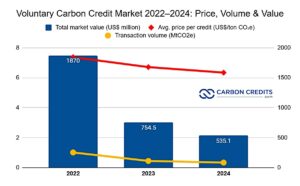
As a result, many large companies now focus on high-quality, verified projects. These include forest conservation, reforestation, and technology-based carbon removal.
For oil majors, carbon credits are often a small share of total spending. But they signal engagement with climate tools and frameworks. TotalEnergies’ record $73 million spend in 2025 reflects both climate strategy and market conditions.
Balancing Cash Flow and Climate Goals
TotalEnergies continues to operate as a diversified energy company. Oil and gas remain core revenue drivers. At the same time, renewables, electricity, and low-carbon investments are growing.
The oil major also plans to keep expanding renewable capacity while maintaining upstream strength.
In 2025, TotalEnergies signed and advanced major electricity projects totaling more than 14 GW of capacity in Europe. It also recycled capital through asset sales to fund further clean energy investments. This dual strategy allows the company to generate cash from traditional energy while investing in transition pathways.
The record carbon credit spending fits into this broader balance. It complements operational emission cuts and renewable expansion.
For instance, TotalEnergies has partnered with Google on large renewable energy deals. The company has signed two 15-year solar PPAs in Texas. These agreements will provide 1 GW of solar capacity. That’s about 28 TWh for Google’s data centers in Texas over the contract period.
These deals reflect TotalEnergies’ expanding role in corporate renewable supply and its growing electricity portfolio across the United States.
2026 Outlook: Profitability Meets Transition Pressure
The French multinational integrated energy company enters 2026 with strong finances and a defined climate path. The company plans to continue investing in oil and gas projects that generate stable returns. At the same time, it aims to grow electricity production and low-carbon assets. Carbon credits will likely remain part of its strategy, especially as voluntary carbon markets mature and standards improve.
The $73 million record in 2025 shows increased use of carbon market tools. It also highlights how energy companies are combining financial performance with climate commitments.
TotalEnergies’ results suggest that profitability and climate investment can move in parallel, even in a changing energy landscape.
- READ MORE: TotalEnergies and Google’s 1 GW Solar Deal Signals a New Phase in the Data Center Energy Race
The post TotalEnergies Hits Record $73 Million Carbon Credit Spend as 2025 Profits Stay Strong appeared first on Carbon Credits.

Fusion Breakthrough: Google Venture-Backed Inertia Raises $450M to Build World’s Most Powerful Clean Energy Laser
India’s Solar and Renewable Energy Outlook to 2030: Impact of the US-India 18% Tariff Cut on Exports

UN head calls for platform for “honest dialogue” on fossil fuel transition
Guest post: Why China is still building new coal – and when it might stop
Guest post: Why China is still building new coal – and when it might stop
Bill Discounting Climate Change in Florida’s Energy Policy Awaits DeSantis’ Approval
-
Climate Change6 months ago
Guest post: Why China is still building new coal – and when it might stop
-
Greenhouse Gases6 months ago
Guest post: Why China is still building new coal – and when it might stop
-
Climate Change2 years ago
Bill Discounting Climate Change in Florida’s Energy Policy Awaits DeSantis’ Approval
-

 Greenhouse Gases2 years ago
嘉宾来稿:满足中国增长的用电需求 光伏加储能“比新建煤电更实惠”
-
Climate Change2 years ago
Spanish-language misinformation on renewable energy spreads online, report shows
-

 Climate Change2 years ago
嘉宾来稿:满足中国增长的用电需求 光伏加储能“比新建煤电更实惠”
-
Climate Change Videos2 years ago
The toxic gas flares fuelling Nigeria’s climate change – BBC News
-

 Carbon Footprint2 years ago
US SEC’s Climate Disclosure Rules Spur Renewed Interest in Carbon Credits