Carbon Footprint
Climate Reality Check: Only 12% of Global Companies Align With 1.5°C Goal, MSCI Reports



A new report from MSCI shows that many listed companies are still not aligned with the world’s most ambitious climate goal. The findings suggest that progress is uneven. Some companies are moving in the right direction. Many are not yet cutting emissions fast enough.
According to MSCI’s latest Transition Finance Tracker, about 38% of companies in the MSCI All Country World Investable Market Index (ACWI IMI) have emissions trajectories that are aligned with limiting global warming to 2°C or below. This includes 12% aligned with 1.5°C or less and 26% aligned between 1.5°C and 2°C.
However, only about 12% of companies are aligned with the stricter 1.5°C goal set under the Paris Agreement. The remaining companies are on pathways that imply warming above 2°C.
In fact, 36% of companies fall in the range above 2°C but below 3.2°C, while 26% exceed 3.2°C. Overall, the median listed company trajectory implies 3°C (5.4°F) of warming above preindustrial levels this century.

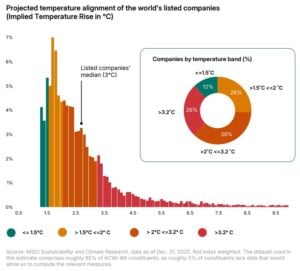
MSCI uses a tool called the Implied Temperature Rise (ITR) metric. This tool estimates how much global temperatures would rise if the whole economy followed the same emissions pathway as a given company. It looks at aggregate emissions, sector-specific carbon budgets, and corporate climate targets.
Inside the ITR: Measuring Corporate Warming Impact
MSCI’s ITR metric helps investors understand climate risk. It compares a company’s projected emissions with global carbon budgets that align with temperature goals. The dataset used in this estimate covers roughly 95% of ACWI IMI constituents, as about 5% lack sufficient data for the calculation.
If a company’s emissions plan fits within a 1.5°C carbon budget, it is considered aligned with the most ambitious Paris goal. If it fits within a 2°C budget, it is considered moderately aligned. If not, it implies higher warming.
- The Paris Agreement aims to limit global warming to well below 2°C, and preferably to 1.5°C, compared with pre-industrial levels.
The Intergovernmental Panel on Climate Change (IPCC) has warned that global emissions must fall by about 43% by 2030, compared with 2019 levels, to keep 1.5°C within reach.
MSCI’s data shows that most companies are not reducing emissions at that pace. The report also notes that its latest warming estimate is three-tenths of a degree higher than the previous quarter due to a methodological update that removed a cap on how much companies could exceed their carbon budgets.
This gap matters because corporate emissions play a major role in global totals. The MSCI ACWI IMI includes 8,225 companies and captures about 99% of the global equity investment opportunity set as of Dec. 31, 2025.
Winners and Laggards: How Sectors Stack Up on Climate
The Transition Pathway Initiative (TPI) gives a clear look at how corporate climate performance differs by industry.
The TPI report looked at more than 2,000 major companies. These companies have a total market value of about US$87 trillion. The focus was on their climate governance and progress on emissions. It found that 98% of companies lack credible plans to shift capital away from carbon-intensive assets.

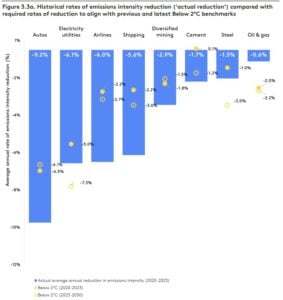
The report warns that 554 companies in 12 high-emitting sectors are on a dangerous path. Their current emissions are on track to overshoot the 1.5°C carbon budget by 61% between 2020 and 2050. These same pathways will also likely exceed the 2°C budget by 13% during that same period.
The analysis suggests that many firms consider climate issues in daily decisions. However, few have solid long-term transition plans.
TPI also shows clear differences in sector progress. For example, automotive and electricity companies reduced emissions intensity nearly five times faster between 2020 and 2023 than cement and steel firms. Conversely, sectors such as oil & gas, aluminum, and coal mining remain among the most misaligned with Paris goals.
This highlights that while some industries are beginning to cut emissions and improve governance, most still need stronger transition plans and clearer capital alignment to meet global climate targets.
Climate Alignment Is Now a Financial Risk Indicator
Findings reveal that climate alignment is not only an environmental issue. It is also a financial one.
Governments are tightening climate policies. Carbon pricing systems now cover about 23% of global greenhouse gas emissions, according to the World Bank’s State and Trends of Carbon Pricing report.
More countries are setting net-zero targets. Regulations are increasing disclosure requirements. Investors face growing pressure to measure climate risk in portfolios.
The MSCI report also shows that 19% of listed companies had a climate target validated by the Science Based Targets initiative (SBTi) as of Dec. 31, 2025, up from 14% a year earlier. Meanwhile, 32% of companies have set a companywide net-zero target, and 60% have published some form of climate commitment.
Companies that are not aligned with global climate goals may face higher regulatory costs, stranded assets, or weaker demand in the future. On the other hand, companies aligned with 1.5°C or 2°C pathways may benefit from new markets and lower transition risk.
MSCI’s data helps investors compare companies on this basis. The 38% alignment figure gives a broad snapshot of progress across global markets.
Progress, But Not Fast Enough
The fact that 38% of companies align with 2°C or below shows improvement compared with past years. Corporate climate reporting has expanded. More companies now set net-zero targets, and many publish science-based targets.
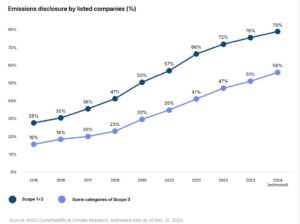
Disclosure rates have also improved. As of Dec. 31, 2024, 79% of listed companies disclosed Scope 1 and/or Scope 2 emissions, up from 76% a year earlier. A majority, 56%, reported at least some Scope 3 emissions, up from 51%.

Still, MSCI’s findings show that ambition and action are not always the same. Some companies set long-term targets but delay near-term reductions. Others rely heavily on carbon offsets instead of direct emissions cuts. In some cases, emissions intensity improves while absolute emissions remain high.
The IPCC has made clear that global emissions must fall sharply this decade. Delayed action increases future costs and transition risks.
A Fossil-Fuel-Heavy World Complicates the Shift
Global energy-related CO₂ emissions reached a record 37.8 billion tonnes in 2023, according to the International Energy Agency. While renewable energy growth has accelerated, fossil fuels still account for around 80% of global primary energy supply.
These global figures explain why corporate alignment remains challenging. Many companies operate in economies that still depend on fossil energy.
MSCI’s report reflects this broader reality. Corporate alignment depends on system-wide change, not just company-level pledges. Moreover, the report’s findings come as corporate climate pledges continue to rise sharply.
According to the SBTi, the number of companies setting both near-term and net-zero science-based targets surged 227% between late 2023 and mid-2025. Companies setting near-term targets alone grew by nearly 97% over the same period.


By the end of 2023, only 17% of companies with validated targets had both near-term and net-zero commitments. That share rose to 33% in 2024 and reached 38% by mid-2025.
The figures show that more companies are formalizing climate commitments. However, MSCI’s data indicates that only 12% of listed firms align with 1.5°C, while 38% align with 2°C or below — highlighting a gap between target-setting and full emissions alignment.
The Road Ahead: Bridging the 1.5°C Gap
The headline figure shows that more than one-third of listed firms are moving in a direction consistent with global climate goals. That gap is significant.
To meet the Paris Agreement’s goals, alignment will need to increase quickly across all sectors. This means faster emissions cuts, clearer short-term targets, and stronger capital allocation toward low-carbon technologies. Today’s alignment rate suggests progress is underway, but it also shows that most companies still have to work harder to be on track to a 1.5°C path.
The post Climate Reality Check: Only 12% of Global Companies Align With 1.5°C Goal, MSCI Reports appeared first on Carbon Credits.