

Welcome to Carbon Brief’s China Briefing.
Carbon Brief handpicks and explains the most important climate and energy stories from China over the past fortnight. Subscribe for free here.
Key developments
China’s top climate negotiator interviewed
COAL STANCE: China News Weekly recently interviewed Su Wei, China’s lead climate negotiator, about China’s stance at COP28 and its energy transition. Su affirmed China’s position on fossil fuels, saying that it is “impossible to completely phase out fossil fuels, given limitations of the resources China possesses”. He argued that countries did not have to “be utterly opposed” to fossil fuels as long as the central question of emissions is solved, through technologies such as carbon capture, utilisation and storage (CCUS). Substituting fossil fuels with renewable energy should follow the principle of “establish [new rules] before breaking [old ones]”, he added. This means a “process” needs to be followed – namely, after “large-scale development” of renewable energy and non-fossil fuel energy, “coal power will be gradually reduced and the proportion of coal stock will also decline”.
DEVELOPED VS DEVELOPING: Su also highlighted the role of developed countries as a key debate at COP28. He described the current international environment as the “biggest challenge to realising the goal of tripling renewable energy capacity globally”, with some developed countries imposing tariffs on or launching investigations into Chinese products. He also criticised developed countries’ failure to provide the $100bn in climate finance they committed to in 2009, describing it as a “muddled account”.
US-CHINA OPTIMISM: Nevertheless, Su was relatively optimistic about the potential for US-China climate cooperation. He raised how US-China alignment at COP28 “made an important contribution” to its success, with the Sunnylands statement jointly released by the two countries allowing them to “propose wording for the text and help[ing] to unlock difficult issues in the negotiation”. Climate change, Su said, “remains one of the few positive elements that China and the US can mobilise to promote the stable development of their relationship”, allowing the two countries to “talk” despite other tensions. (In a recent issue of the Pekingnology newsletter, noted international relations scholar Da Wei concurred, saying the US and China “have some agreements on the climate change issue”. He added: “I believe that the two sides will declare more on climate change in the following months.”)
China ‘needs 324tn yuan’ to meet climate goals
‘ENORMOUS AMOUNT’: China needs to “spend about 324tn yuan” ($45.5tn), which is equal to 2.7 times its 2022 GDP, between 2021 and 2060 to achieve its goals of peaking carbon emissions by 2030 and reaching carbon neutrality by 2060, reported state-run newspaper the China Daily. The figures were included in China’s fourth national communication on climate change, which was submitted to the United Nations Framework Convention on Climate Change in December 2023. China “will need to spend far more to reach carbon neutrality than to achieve carbon peaking”, the document added. China’s previous national communication was submitted more than four years ago in 2019.
GROWING INVESTMENT: Meanwhile, China’s annual national economic work conference – held in December 2023 – announced “promotion of…green and low-carbon development” as one of nine key economic tasks in 2024, with “green” development becoming the “driving force for China’s high-quality development”, according to China News. The 2024 national energy work conference, also held in December, established that China aims to build 200 gigawatts (GW) of wind and solar capacity in 2024, as well as 5GW of nuclear energy, the newspaper added. China5E reported that China’s top economic planner, the national development and reform commission (NDRC) said in its first meeting of 2024 that it would develop “tangible policies” to attract private capital to invest in nuclear power and other major energy projects, as well as environmental protection schemes. Investment in renewable energy in China “seems increasingly to be driven by the profit motive”, a Financial Times editorial argued, adding that this trend is accelerated by increasing adoption of “cleantech” by China’s state-owned enterprises.
MARKET FORCES: China is also developing financial platforms to boost “green” and low-carbon investment in the new year. On 2 January, it launched a stock index to encourage “investment products that grant greater weightings for sectors such as renewables”, reported the Financial Times. Meanwhile, should China’s voluntary carbon market, the China Certified Emissions Reduction (CCER) program, relaunch this year, it could encourage finance to flow to projects that, together, could reduce carbon emissions by tens or even hundreds of millions of tonnes, Jiemian noted.
Updated industry guidelines to ‘encourage green tech’
INDUSTRY CATALOGUE: China’s top economic planner, the national development and reform commission (NDRC), released an updated 2024 version of its catalogue for guiding industry restructuring, designed to “promote high-end, intelligent and green manufacturing”, Xinhua reported. The catalogue divides industries into three categories: encouraged; restricted; and eliminated, reported China Environment. The “restricted” category refers to technologies, equipment and products that, among other things, “are not conducive to the realisation of the goals of carbon peaking and carbon neutrality”, it explained. The “eliminated” category contains technologies that “seriously waste resources, cause pollution…[or] impede the realisation of the goals of carbon peaking and carbon neutrality”, the outlet added. China Environment also reported that the catalogue said it would “encourage green technology innovation and the development of green environmental protection industry, promote energy saving…and resolutely curb the blind development of high-energy-consuming, high-emission and low-level projects”. (The phrase on curbing “blind development” has been in use for several years.)
NEW ADDITIONS: The “encouraged” category adds a “detailed explanation of carbon capture and application”, reported BJX News. The category also adds “green” hydrogen produced by electrolysis of water and synthesis of “green methanol” from carbon dioxide, as well as new solar materials for use in the construction industry, reported the news outlet. The “restricted” category has raised and added limitations for the power sector, such as new coal power units that cannot meet “ultra-low emission” requirements, said the report. Under the “elimination” category, thermal power plants will be phased out in accordance with the principle of “establish first, then modify” (先立后改) with plants eliminated “in an orderly manner, in accordance with an “annual phase-out plan”, added the report. The least efficient coal-fired boilers will be phased out in air pollution priority areas, the outlet added.
OFFICIAL REACTION: Officials from the NDRC told Jiemian that the new edition of the catalogue aims to promote “high-end, intelligent, and green manufacturing industry” in China, they added. The updated catalogue “will encourage green technology innovation and the development of green environmental protection industries, promote energy conservation, carbon reduction and green transformation in key areas”, they told the outlet.
BYD surpassed Tesla, claiming the top spot in EV sales
BYD VS TESLA: Chinese firm BYD’s sales of battery-only vehicles “outpaced” its US rival Tesla in the final quarter of 2023 for the first time, according to BBC News. BYD sold 526,000 units while Tesla delivered 484,000 units. However, for the whole of 2023, Tesla still sold more with 1.8m compared to nearly 1.6m for BYD, the broadcaster added.
SUCCESS STORY: CNN said that China’s fast transition to electric vehicles (EVs) is “thanks to strong government support”. The article quoted analysts from investment bank Natixis Asia saying “first-mover advantage and government support through infrastructure investment and subsidies have made it easy for Chinese EV makers to expand domestically and internationally”. (Consultant David Fishman noted on Twitter that domestic EV sales grew by 36% in 2023, “despite the end of the supporting subsidies”.) According to Bernstein research, “BYD batteries are among the lowest cost in the world”, reported the Financial Times. Michael Dunne, chief executive of Asia-focused car consultancy Dunne Insights, told the FT: “No one can match BYD on price. Period.” In his Bloomberg column, David Fickling attributed BYD’s edge to its in-house battery supply chain and cheaper cells. “More importantly”, he said, “on almost every financial metric, [BYD] is either advancing on, or overtaking [Tesla] — with its gaze already set on the wider car industry.”
FORECAST FOR 2024: Looking ahead to this year, S&P Global Mobility predicted battery electric vehicles (BEVs) sales would reach 13.3m units globally in 2024, accounting for 16.2% of total global passenger vehicle sales, with China’s BEV sales growing 28.6% year-on-year. BloombergNEF’s outlook forecast a milestone will be achieved by the end of 2024 – it will see the first quarter in which consumers buy more than five million electric or plug-in hybrid vehicles, with China being the main contributor.
Spotlight
What to watch in 2024
In 2023, several significant energy and climate stories came out of China. Global carbon dioxide (CO2) emissions rose, driven by increases in China, but analysis for Carbon Brief found that renewable energy growth could cause a “structural decline” of emissions from 2024. New coal “capacity payments” continue policy support for the fuel.
Meanwhile, the US and China issued the Sunnylands statement, which signalled a turning point in bilateral relations and played a part in theCOP28 outcome.
For the first China Briefing of 2024, Carbon Brief asks leading experts what they are watching for in China in the year ahead. Responses have been edited for length and clarity.
Joanna Lewis, provost’s distinguished associate professor of energy and environment, and director of the science, technology and international affairs program, Georgetown University:
The key thing I will be watching is the development of China’s new nationally determined contribution (NDC) and associated 2035 climate goals. Given the Sunnylands statement and COP28 decisions, we can expect that China’s next NDC will include the country’s first economy-wide target covering all greenhouse gases. As China’s emissions are slated to peak before 2030, it will also likely be China’s first absolute emissions target.
Beyond the NDC, I will also be watching China’s coal consumption. While consumption increased in 2023, many predict a slowing in 2024 and possible peaking by 2025 (or earlier). So watching trends over the coming year may signal what is to come. Also important to determining coal trends will be the rate of renewable energy growth. With an estimated 230GW of new wind and solar power installed in China last year – twice that of the US and Europe combined – and major advances in energy storage that are helping address the curtailment issue, China’s renewables sector is poised for continued rapid growth, which can help offset the demand for coal in the power sector.
David Fishman, senior manager, the Lantau Group:
China spent 2023 implementing incremental reforms to its power sector and energy policy – still trending in the right direction for power market decarbonisation and liberalisation, but taking smaller steps than in the previous few years. This is a return to normalcy for China, which has typically adopted a measured approach to policy reforms: preferring to make small changes and observe the outcomes of limited pilots, rather than big changes all at once.
I expect 2024 to be more of the same, with spot-trading in the power exchanges becoming more common and renewable consumption quotas expanding to more sectors. At the same time, the surging growth in renewable capacity, especially from desert mega-bases, should allow renewable generation growth to exceed power consumption growth. This will cap coal consumption in the power sector and send China’s carbon emissions into long-term structural decline from 2024 onward.
Ryna Cui, research director, Center for Global Sustainability, University of Maryland:
It is crucial to watch how coal plants will be utilised in the power system, whether as expected to back up an increasing share of intermittent renewables or to continue as “baseload” generation, where the emissions impact can be significant. It is also critical to watch whether and how China moves from a continued preference for coal to other solutions for grid stabilisation, such as cross-region grid balancing, demand-side management, battery and other storage technologies.
Methane is an emerging area that is finally receiving the policy attention it requires – both in China and globally. China’s methane action plan is the first published national policy targeting methane as a greenhouse gas (GHG). The document is brief, setting up overall guidelines and main task areas. So it is important to watch how more detailed policies and targets will continue to develop.
Internationally, the US-China Sunnylands statement set up the expectation for the next round of NDCs to cover all GHGs and all economic sectors. It will be exciting to watch how Sunnylands and the previous joint Glasgow declaration will be implemented.
Yan Qin, lead carbon analyst at the London Stock Exchange Group:
This will be an exciting year for China’s national carbon market and the newly relaunched offset market. The national emissions trading scheme (ETS) has just completed its second compliance period, with allowance prices rising to as high as 80 yuan per tonne ($11.25/t) due to tightening of benchmarks.
The scheme will see more progress this year, both on the regulatory side, with the newly released state council regulation on national carbon trading, and on the expansion to more industry sectors, with the first new batch possibly including the cement and aluminium sectors. We might also see more clarity on the role of the carbon market in China’s “dual carbon” targets against the backdrop of moving from energy dual control to carbon dual control. The revamped China Certified Emissions Reduction (CCER) offset market will also see issuance of new credits resume this year.
Tu Le, founder and managing director, Sino Auto Insights:
It was another record year for “new energy vehicle” (NEV, mainly electric vehicle) sales in China, largely on the back of a serious price war ignited by Tesla in January 2023. I’ll be watching to see whether the market can keep it up – and who will blink first this year. Will there continue to be foreign direct investment by Chinese electric vehicle and battery companies outside of China and, if so, where?
Chinese automakers exported a record number of vehicles in 2023, catching many observers’ attention. With the Inflation Reduction Act making the US market unattractive for now, the EU is the most attractive major market to Chinese EV firms. EU automakers will also begin shipping Chinese-built vehicles to their home markets. How the EU will ultimately react to this – and the growth of Chinese EV exports more widely – remains uncertain.
Watch, read, listen
BIG READ: China submitted its fourth national communication on climate change to the UNFCCC in December 2023 – the first since June 2019 – with sections on China’s greenhouse gas emissions by sector, “key objectives” and financial needs.
DE-RISKING RISKS: Henry Sanderson argued in Foreign Affairs that western countries must prioritise in order to compete with China on “clean energy” technologies.
WASTE UNREST: The New Books in East Asian Studies podcast interviewed Dr Jean Yen-chun Lin on research into environmental protests against waste incineration in Beijing.
CLIMATE ADAPTATION: China and Africa will “jointly promote climate resilience”, ministry of ecology and environment minister Huang Runqiu said in remarks, recently posted on YouTube, made at the September 2023 Africa Climate Summit.
New science
Hotter days, dirtier air: The impact of extreme heat on energy and pollution intensity in China
Energy Economics
Researchers have identified a “causal impact from ‘local temperature shocks’ on pollution intensity” in China between 2008 and 2017, finding that extreme heat increases energy demand, diminishes energy efficiency and increases consumption of coal, which leads to a rise in pollution intensity. The researchers said that this shows that extreme weather caused by climate change “will perpetuate an adverse impact on pollution intensity” across China.
Methane mitigation potentials and related costs of China’s coal mines
Fundamental Research
A new study estimated that “through continuous coal cuts and available…mitigation measures, China’s [coal mine methane] emissions can be reduced by 65%-78% [from 2021 levels] in 2060”. The study also found that methane emissions from abandoned coal mines “will far exceed those from coal mining under the 2060 carbon-neutral scenario, especially in northeastern China”. While coal mine methane mitigation may not currently be economically feasible, it added, it could become “the most cost-effective solution as [carbon dioxide] prices increase”.
Who is most affected by carbon tax? Evidence from Chinese residents in the context of ageing
Energy Policy
New research has discovered “significant differences” in the rate by which different age groups in China are affected by carbon taxation, with the “vulnerable elderly” being particularly affected. The results show that the “indirect carbon payment burden rate on the elderly…is 1.2 times that of the general population”, with low-income seniors facing a slightly higher than average rate at 1.4 times that of the general population.
China Briefing is compiled by Anika Patel and edited by Wanyuan Song and Simon Evans. Please send tips and feedback to china@carbonbrief.org
The post China Briefing 11 January: Expectations for 2024; Top climate negotiator interviewed; NDRC promotes ‘green’ industry appeared first on Carbon Brief.

In 2026, the dangers of fossil fuel dependence have been laid bare like never before. The illegal invasion of Iran has brought pain and destruction to millions across the Middle East and triggered a global energy crisis impacting us all. Communities in the Pacific have been hit especially hard by rising fuel prices, and Australians have seen their cost-of-living woes deepen.
Such moments of crisis and upheaval can lead to positive transformation. But only when leaders act with courage and foresight.
There is no clearer statement of a government’s plans and priorities for the nation than its budget — how it plans to raise money, and what services, communities, and industries it will invest in.
As we count down the days to the 2026-27 Federal Budget, will the Albanese Government deliver a budget for our times? One that starts breaking the shackles of fossil fuels, accelerates the shift to clean energy, protects nature, and sees us work together with other countries towards a safer future for all? Or one that doubles down on coal and gas, locks in more climate chaos, and keeps us beholden to the whims of tyrants and billionaires.
Here’s what we think the moment demands, and what we’ll be looking out for when Treasurer Jim Chalmers steps up to the dispatch box on 12 May.
1. Stop fuelling the fire
2. Make big polluters pay
3. Support everyone to be part of the solution
4. Build the industries of the future
5. Build community resilience
6. Be a better neighbour
7. Protect nature
1. Stop fuelling the fire
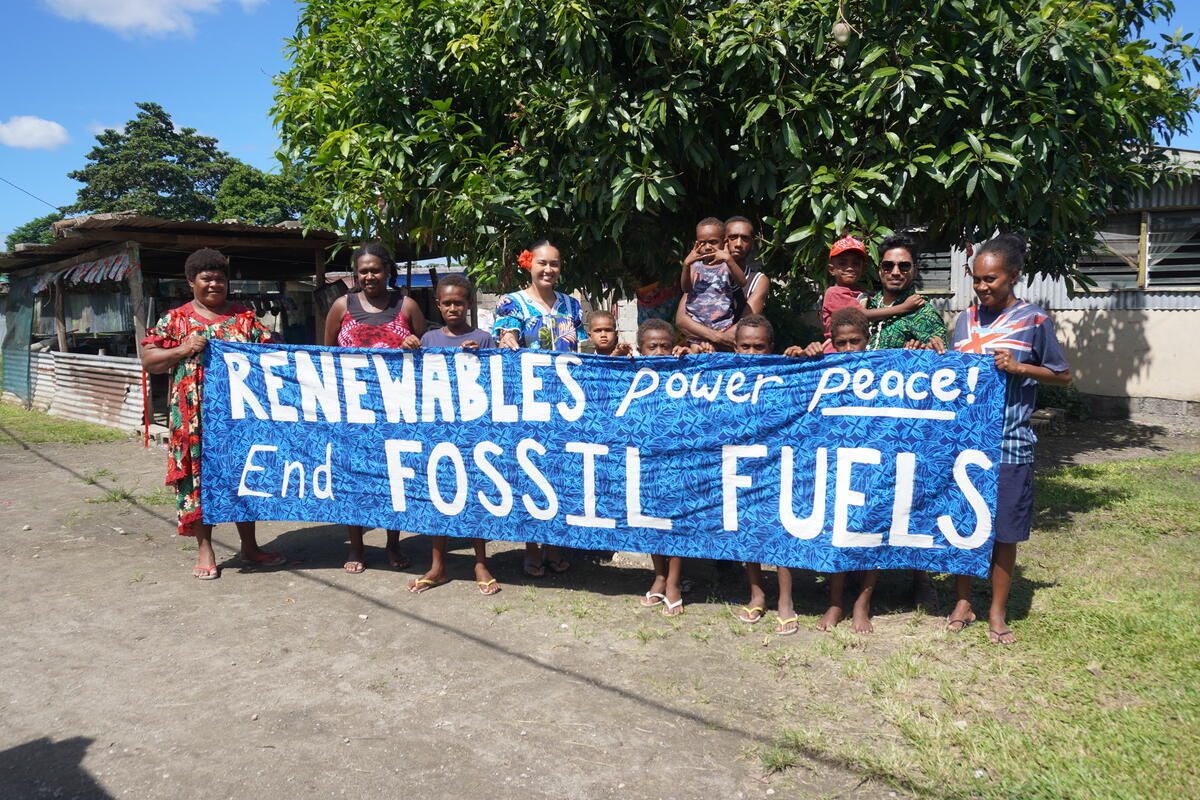
In mid-April, Pacific governments and civil society met to redouble their efforts towards a Fossil Fuel Free Pacific. Moving beyond coal, oil and gas is fundamental to limiting warming to 1.5°C — a survival line for vulnerable communities and ecosystems. And as our Head of Pacific, Shiva Gounden, explained, it is “also a path of liberation that frees us from expensive, extractive and polluting fossil fuel imports and uplifts our communities”.
Pacific countries are at the forefront of growing global momentum towards a just transition away from fossil fuels, and it is way past time for Australia to get with the program. It is no longer a question of whether fossil fuel extraction will end, but whether that end will be appropriately managed and see communities supported through the transition, or whether it will be chaotic and disruptive.
So will this budget support the transition away from fossil fuels, or will it continue to prop up coal and gas?
When it comes to sensible moves the government can make right now, one stands out as a genuine low hanging fruit. Mining companies get a full rebate of the excise (or tax) that the rest of us pay on diesel fuel. This lowers their operating costs and acts as a large, ongoing subsidy on fossil fuel production — to the tune of $11 billion a year!
Greenpeace has long called for coal and gas companies to be removed from this outdated scheme, and for the billions in savings to be used to support the clean energy transition and to assist communities with adapting to the impacts of climate change. Will we see the government finally make this long overdue change, or will it once again cave to the fossil fuel lobby?
2. Make big polluters pay
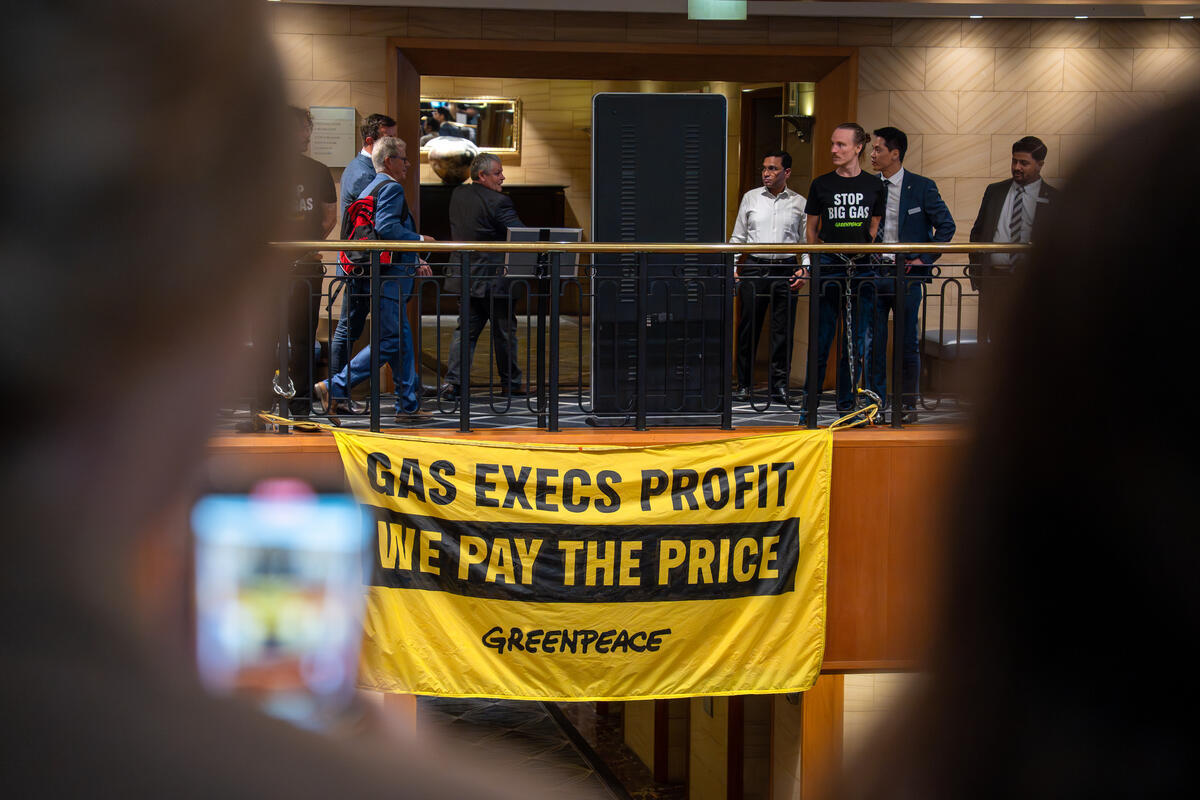
While our communities continue to suffer the escalating costs of climate-fuelled disasters, our Government continues to support a massive expansion of Australia’s export gas industry. Gas is a dangerous fossil fuel, with every tonne of Australian gas adding to the global heating that endangers us all.
Moreover, companies like Santos and Woodside pay very little tax for the privilege of digging up and selling Australians’ natural endowment of fossil gas. Remarkably, the Government currently raises more tax from beer than from the Petroleum Resource Rent Tax (PRRT) — the main tax on gas profits.
Momentum has been building to replace or supplement the PRRT with a 25% tax on gas exports. This could raise up to $17 billion a year — funds that, like savings from removing the diesel tax rebate for coal and gas companies, could be spent on supporting the clean energy transition and assisting communities with adapting to worsening fires, floods, heatwaves and other impacts of climate change.
As politicians arrive in Canberra for budget week, they will be confronted by billboards calling for a fair tax on gas exports. The push now has the support of dozens of organisations and a growing number of politicians. Let’s hope the Treasurer seizes this rare window for reform.
3. Support everyone to be part of the solution
As the price of petrol and diesel rises, electric vehicles (EVs) are helping people cut fuel use and save money. However, while EV sales have jumped since the invasion of Iran sent fuel prices rising, they still only make up a fraction of total new car sales. This budget should help more Australians switch to electric vehicles and, even more importantly, enable more Australians to get around by bike, on foot, and on public transport. This means maintaining the EV discount, investing in public and active transport, and removing tax breaks for fuel-hungry utes and vans.
Millions of Australians already enjoy the cost-saving benefits of rooftop solar, batteries, and getting off gas. This budget should enable more households, and in particular those on lower incomes, to access these benefits. This means maintaining the Cheaper Home Batteries Program, and building on the Household Energy Upgrades Fund.
4. Build the industries of the future
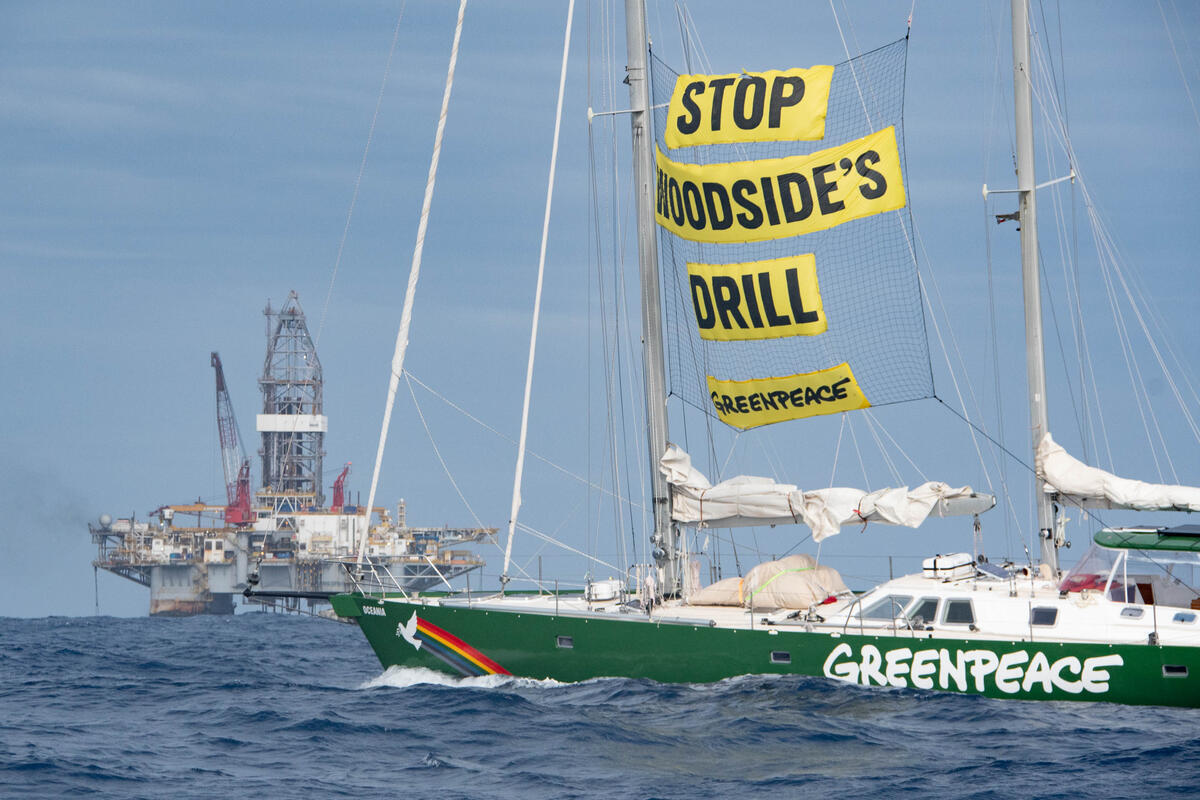
If we’re to transition away from fossil fuels, we need to be building the clean industries of the future.
No state is more pivotal to Australia’s energy and industrial transformation than Western Australia. The state has unrivaled potential for renewable energy development and for replacing fossil fuel exports with clean exports like green iron. Such industries offer Western Australia the promise of a vibrant economic future, and for Australia to play an outsized positive role in the world’s efforts to reduce emissions.
However, realising this potential will require focussed support from the Federal Government. Among other measures, Greenpeace has recommended establishing the Australasian Green Iron Corporation as a joint venture between the Australian and Western Australian governments, a key trading partner, a major iron ore miner and steel makers. This would unite these central players around the complex task of building a large-scale green iron industry, and unleash Western Australia’s potential as a green industrial powerhouse.
5. Build community resilience
Believe it or not, our Government continues to spend far more on subsidising fossil fuel production — and on clearing up after climate-fuelled disasters — than it does on helping communities and industries reduce disaster costs through practical, proven methods for building their resilience.
Last year, the Government estimated that the cost of recovery from disasters like the devastating 2022 east coast floods on 2019-20 fires will rise to $13.5 billion. For contrast, the Government’s Disaster Ready Fund – the main national source of funding for disaster resilience – invests just $200 million a year in grants to support disaster preparedness and resilience building. This is despite the Government’s own National Emergency Management Agency (NEMA) estimating that for every dollar spent on disaster risk reduction, there is a $9.60 return on investment.
By redirecting funds currently spent on subsidising fossil fuel production, the Government can both stop incentivising climate destruction in the first place, and ensure that Australian communities and industries are better protected from worsening climate extremes.
No communities have more to lose from climate damage, or carry more knowledge of practical solutions, than Aboriginal and Torres Strait Islander peoples. The budget should include a dedicated First Nations climate adaptation fund, ensuring First Nations communities can develop solutions on their own terms, and access the support they need with adapting to extreme heat, coastal erosion and other escalating challenges.
6. Be a better neighbour
The global response to climate change depends on the adequate flow of support from developed economies like Australia to lower income nations with shifting to clean energy, adapting to the impacts of climate change, and addressing loss and damage.
Such support is vital to building trust and cooperation, reducing global emissions, and supporting regional and global security by enabling countries to transition away from fossil fuels and build greater resilience.
Despite its central leadership role in this year’s global climate negotiations, our Government is yet to announce its contribution to international climate finance for 2025-2030. Greenpeace recommends a commitment of $11 billion for this five year period, which is aligned with the global goal under the Paris Agreement to triple international climate finance from current levels.
This new commitment should include additional funding to address loss and damage from climate change and a substantial contribution to the Pacific Resilience Facility, ensuring support is accessible to countries and communities that need it most. It should also see Australia get firmly behind the vision of a Fossil Fuel Free Pacific.
7. Protect nature

There is no safe planet without protection of the ecosystems and biodiversity that sustain us and regulate our climate.
Last year the Parliament passed important and long overdue reforms to our national environment laws to ensure better protection for our forests and other critical ecosystems. However, the Government will need to provide sufficient funding to ensure the effective implementation of these reforms.
Greenpeace has recommended $500 million over four years to establish the National Environment Agency — the body responsible for enforcing and monitoring the new laws — and a further $50 million to Environment Information Australia for providing critical information and tools.
Further resourcing will also be required to fulfil the crucial goal of fully protecting 30% of Australian land and seas by 2030. This should include $1 billion towards ending deforestation by enabling farmers and loggers to retool away from destructive practices, $2 billion a year for restoring degraded lands, $5 billion for purchasing and creating new protected areas, and $200 million for expanding domestic and international marine protected areas.
Conclusion
This is not the first time that conflict overseas has triggered an energy crisis, or that a budget has been preceded by a summer of extreme weather disasters, highlighting the urgent need to phase out fossil fuels. What’s different in 2026 is the availability of solutions. Renewable energy is now cheaper and more accessible than ever before. Global momentum is firmly behind the transition away from fossil fuels. The Albanese Government, with its overwhelming majority, has the chance to set our nation up for the future, or keep us stranded in the past. Let’s hope it makes some smart choices.
The 2026 budget test: Will Australia break free from fossil fuels?
Anne Jellema is Executive Director of 350.org.
The war on Iran and Lebanon is a deeply unjust and devastating conflict, killing civilians at home, destroying lives, and at the same time sending shockwaves through the global economy. We, at 350.org, have calculated, drawing on price forecasts from the International Monetary Fund (IMF) and Goldman Sachs, just how much that volatility is costing us.
Even under the IMF’s baseline scenario – a de facto “best case” scenario with a near-term end to the war and related supply chain disruptions – oil and gas price spikes are projected to cost households and businesses globally more than $600 billion by the end of the year. Under the IMF’s “adverse scenario”, with prolonged conflict and sustained price pressures, we estimate those additional costs could exceed $1 trillion, even after accounting for reduced demand.
Which is why we urgently need a power shift. Governments are under growing pressure to respond to rising fuel and food costs and deepening energy poverty. And it’s becoming clearer to both voters and elected officials that fossil dependence is not only expensive and risky, but unnecessary.
People who can are voting with their wallets: sales of solar panels and electric vehicles are increasing sharply in many countries. But the working people who have nothing to spare, ironically, are the ones stuck with using oil and gas that is either exorbitantly expensive or simply impossible to get.
Drain on households and economies
In India, street food vendors can’t get cooking gas and in the Philippines, fishermen can’t afford to take their boats to sea. A quarter of British people say that rising energy tariffs will leave them completely unable to pay their bills. This is the moment for a global push to bring abundant and affordable clean energy to all.
In April, we released Out of Pocket, our new research report on how fossil fuels are draining households and economies. We were surprised by the scale of what we found. For decades, governments have reassured people that energy price spikes are unfortunate but unavoidable – the result of distant conflicts, market forces or geopolitical shocks beyond anyone’s control. But the numbers tell a different story.
-
Santa Marta: Ministers grapple with practicalities of fossil fuel phase-out
Around 60 governments that want to make progress on transitioning away from coal, oil and gas are meeting in Colombia to work out how they can do it an equitable way -
Why the transition beyond fossil fuels depends on cities and collective action
Cities will help identify concrete pathways for an equitable shift to clean energy at the Santa Marta conference, with C40 members aiming to halve their fossil fuel use by 2030


What we are living through today is not an energy crisis. It is a fossil fuel crisis. In just the first 50 days of the Middle East conflict, soaring oil and gas prices have siphoned an estimated $158 billion–$166 billion from households and businesses worldwide. That is money extracted directly from people’s pockets and transferred, almost instantly, into fossil fuel company balance sheets. And this figure only captures the immediate impact of price spikes, not the permanent economic drain of fossil dependence. Fossil fuels don’t just cost us once, they cost us over and over again.
First, through our bills. Every time there is a war, an embargo or a supply disruption, fossil fuel prices surge. For ordinary people, this means higher costs for energy, transport and food. Many Global South countries have little or no fiscal space to buffer the shock; instead, workers and families pay the price.
Second, through our taxes. Governments around the world continue to pour vast sums of public money into fossil fuel subsidies. These are often justified as a way to protect the most vulnerable at the petrol pump or in their homes. But in reality, the benefits are overwhelmingly captured by wealthier households and corporations. The poorest 20% receive just a fraction of this support, while public finances are drained.
Third, through climate impacts. New research across more than 24,000 global locations gives a granular account of the true costs of extreme heat, sea level rise and falling agricultural yields. Using this data to update IMF modelling of the social cost of carbon, we found that fossil fuel impacts on health and livelihoods amount to over $9 trillion a year. This is the biggest subsidy of all, because these massive and mounting costs are not charged to Big Oil – they are paid for by governments and households, with the poorest shouldering the lion’s share.
Massive transfer of wealth to fossil fuel industry
Adding up direct subsidies, tax breaks and the unpaid bill for climate damages, the total transfer of wealth from the public to the fossil fuel industry amounts to $12 trillion even in a “normal” year without a global oil shock. That’s more than 50% higher than the IMF has previously estimated, and equivalent to a staggering $23 million a minute.
The fossil fuel industry has become extraordinarily adept at profiting from instability. When conflict drives up prices, companies do not lose, they gain. In the current crisis, oil producers and commodity traders are on track to secure tens of billions of dollars in additional windfall profits, even as households face rising bills and governments struggle to manage the fallout.
Fossil fuel crisis offers chance to speed up energy transition, ministers say
This growing disconnect is impossible to ignore. Investors are advised to buy into fossil fuel firms precisely because of their ability to generate profits in times of crisis. Meanwhile, ordinary people are told to tighten their belts.
In 2026, unlike during the oil shocks of the 1970s, clean energy is no longer a distant alternative. Now, even more than when gas prices spiked due to Russia’s invasion of Ukraine in 2022, renewables are often the cheapest option available. Solar and wind can be deployed quickly, at scale, and without the volatility that defines fossil fuel markets.
How to transition from dirty to clean energy
The solutions are clear. Governments must implement permanent windfall taxes on fossil fuel companies to ensure that extraordinary profits generated during crises are redirected to support households. These revenues can be used to reduce energy bills, invest in public services, and accelerate the rollout of clean energy.
Second, we must shift subsidies away from fossil fuels and towards renewable solutions, particularly those that can be deployed quickly and equitably, such as rooftop and community solar. This is not just about cutting emissions. It is about building a more stable, fair and resilient energy system.
Finally, we need binding plans to phase out fossil fuels altogether, replacing them with homegrown renewable energy that can shield economies from future shocks. Because what the current crisis has made clear is this: as long as we remain dependent on fossil fuels, we remain vulnerable – to conflict, to price volatility and to the escalating impacts of climate change.
The true price of fossil fuels is no longer hidden. It is visible in rising bills, strained public finances and communities pushed to the brink. And it is being paid, every day, by ordinary people around the world.
It’s time for the great power shift.
Full details on the methodology used for this report are available here.
The Great Power Shift is a new campaign by 350.org global campaign to pressure governments to bring down energy bills for good by ending fossil fuel dependence and investing in clean, affordable energy for all

The post What fossil fuels really cost us in a world at war appeared first on Climate Home News.
Computer models that use artificial intelligence (AI) cannot forecast record-breaking weather as well as traditional climate models, according to a new study.
It is well established that AI climate models have surpassed traditional, physics-based climate models for some aspects of weather forecasting.
However, new research published in Science Advances finds that AI models still “underperform” in forecasting record-breaking extreme weather events.
The authors tested how well both AI and traditional weather models could simulate thousands of record-breaking hot, cold and windy events that were recorded in 2018 and 2020.
They find that AI models underestimate both the frequency and intensity of record-breaking events.
A study author tells Carbon Brief that the analysis is a “warning shot” against replacing traditional models with AI models for weather forecasting “too quickly”.
AI weather forecasts
Extreme weather events, such as floods, heatwaves and storms, drive hundreds of billions of dollars in damages every year through the destruction of cropland, impacts on infrastructure and the loss of human life.
Many governments have developed early warning systems to prepare the general public and mobilise disaster response teams for imminent extreme weather events. These systems have been shown to minimise damages and save lives.
For decades, scientists have used numerical weather prediction models to simulate the weather days, or weeks, in advance.
These models rely on a series of complex equations that reproduce processes in the atmosphere and ocean. The equations are rooted in fundamental laws of physics, based on decades of research by climate scientists. As a result, these models are referred to as “physics-based” models.
However, AI-based climate models are gaining popularity as an alternative for weather forecasting.
Instead of using physics, these models use a statistical approach. Scientists present AI models with a large batch of historical weather data, known as training data, which teaches the model to recognise patterns and make predictions.
To produce a new forecast, the AI model draws on this bank of knowledge and follows the patterns that it knows.
There are many advantages to AI weather forecasts. For example, they use less computing power than physics-based models, because they do not have to run thousands of mathematical equations.
Furthermore, many AI models have been found to perform better than traditional physics-based models at weather forecasts.
However, these models also have drawbacks.
Study author Prof Sebastian Engelke, a professor at the research institute for statistics and information science at the University of Geneva, tells Carbon Brief that AI models “depend strongly on the training data” and are “relatively constrained to the range of this dataset”.
In other words, AI models struggle to simulate brand new weather patterns, instead tending forecast events of a similar strength to those seen before. As a result, it is unclear whether AI models can simulate unprecedented, record-breaking extreme events that, by definition, have never been seen before.
Record-breaking extremes
Extreme weather events are becoming more intense and frequent as the climate warms. Record-shattering extremes – those that break existing records by large margins – are also becoming more regular.
For example, during a 2021 heatwave in north-western US and Canada, local temperature records were broken by up to 5C. According to one study, the heatwave would have been “impossible” without human-caused climate change.
The new study explores how accurately AI and physics-based models can forecast such record-breaking extremes.
First, the authors identified every heat, cold and wind event in 2018 and 2020 that broke a record previously set between 1979 and 2017. (They chose these years due to data availability.) The authors use ERA5 reanalysis data to identify these records.
This produced a large sample size of record-breaking events. For the year 2020, the authors identified around 160,000 heat, 33,000 cold and 53,000 wind records, spread across different seasons and world regions.
For their traditional, physics-based model, the authors selected the High RESolution forecast model from the Integrated Forecasting System of the European Centre for Medium-Range Weather Forecasts. This is “widely considered as the leading physics-based numerical weather prediction model”, according to the paper.
They also selected three “leading” AI weather models – the GraphCast model from Google Deepmind, Pangu-Weather developed by Huawei Cloud and the Fuxi model, developed by a team from Shanghai.
The authors then assessed how accurately each model could forecast the extremes observed in the year 2020.
Dr Zhongwei Zhang is the lead author on the study and a researcher at Karlsruhe Institute of Technology. He tells Carbon Brief that many AI weather forecast models were built for “general weather conditions”, as they use all historical weather data to train the models. Meanwhile, forecasting extremes is considered a “secondary task” by the models.
The authors explored a range of different “lead times” – in other words, how far into the future the model is forecasting. For example, a lead time of two days could mean the model uses the weather conditions at midnight on 1 January to simulate weather conditions at midnight on 3 January.
The plot below shows how accurately the models forecasted all extreme events (left) and heat extremes (right) under different lead times. This is measured using “root mean square error” – a metric of how accurate a model is, where a lower value indicates lower error and higher accuracy.
The chart on the left shows how two of the AI models (blue and green) performed better than the physics-based model (black) when forecasting all weather across the year 2020.
However, the chart on the right illustrates how the physics-based model (black) performed better than all three AI models (blue, red and green) when it came to forecasting heat extremes.
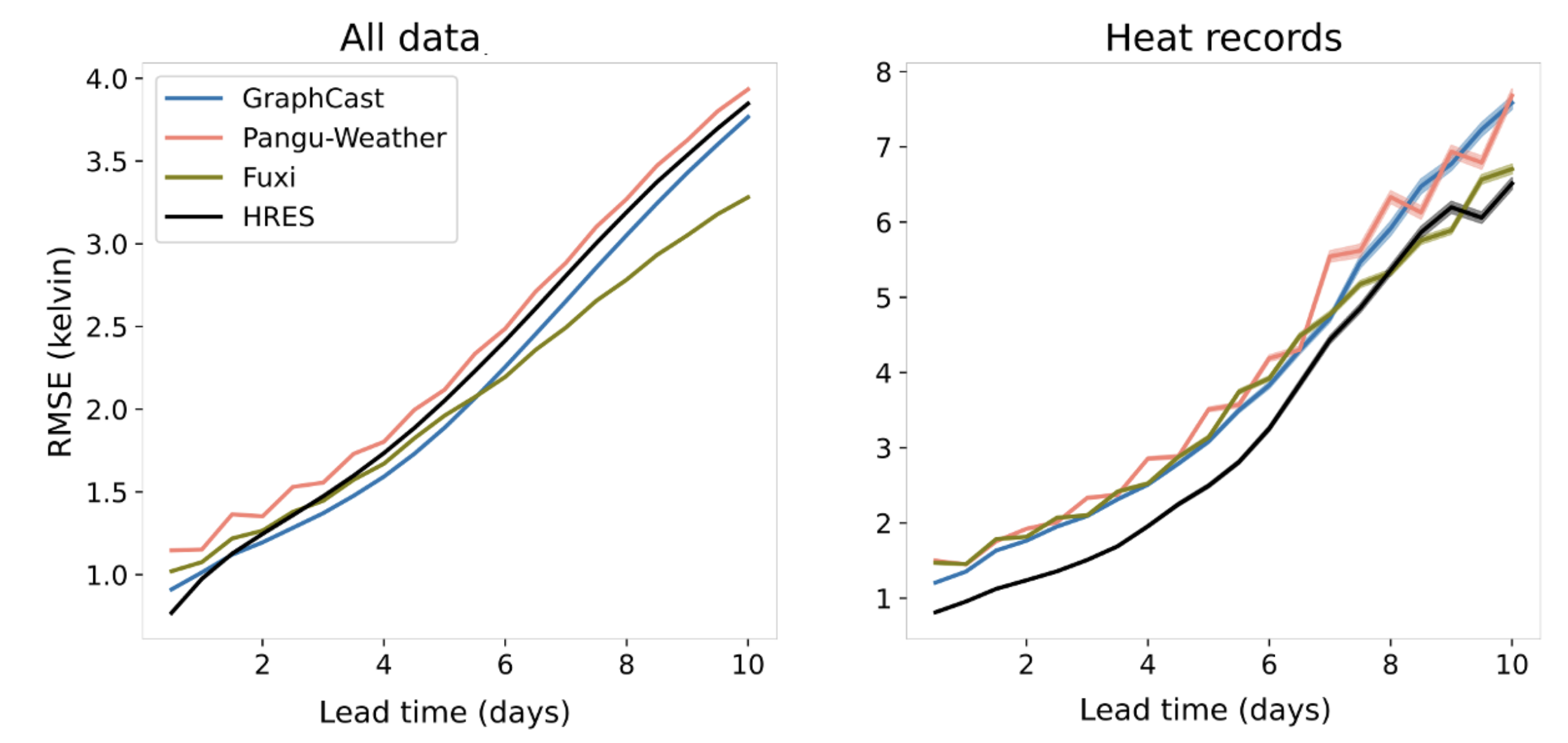
The authors note that the performance gap between AI and physics-based models is widest for lower lead times, indicating that AI models have greater difficulty making predictions in the near future.
They find similar results for cold and wind records.
In addition, the authors find that AI models generally “underpredict” temperature during heat records and “overpredict” during cold records.
The study finds that the larger the margin that the record is broken by, the less well the AI model predicts the intensity of the event.
‘Warning shot’
Study author Prof Erich Fischer is a climate scientist at ETH Zurich and a Carbon Brief contributing editor. He tells Carbon Brief that the result is “not unexpected”.
He adds that the analysis is a “warning shot” against replacing traditional models with AI models for weather forecasting “too quickly”.
The analysis, he continues, is a “warning shot” against replacing traditional models with AI models for weather forecasting “too quickly”.
AI models are likely to continue to improve, but scientists should “not yet” fully replace traditional forecasting models with AI ones, according to Fischer.
He explains that accurate forecasts are “most needed” in the runup to potential record-breaking extremes, because they are the trigger for early warning systems that help minimise damages caused by extreme weather.
Leonardo Olivetti is a PhD student at Uppsala University, who has published work on AI weather forecasting and was not involved in the study.
He tells Carbon Brief that “many other studies” have identified issues with using AI models for “extremes”, but this paper is novel for its specific focus on extremes.
Olivetti notes that AI models are already used alongside physics-based models at “some of the major weather forecasting centres around the world”. However, the study results suggest “caution against relying too heavily on these [AI] models”, he says.
Prof Martin Schultz, a professor in computational earth system science at the University of Cologne who was not involved in the study, tells Carbon Brief that the results of the analysis are “very interesting, but not too surprising”.
He adds that the study “justifies the continued use of classical numerical weather models in operational forecasts, in spite of their tremendous computational costs”.
Advances in forecasting
The field of AI weather forecasting is evolving rapidly.
Olivetti notes that the three AI models tested in the study are an “older generation” of AI models. In the last two years, newer “probabilistic” forecast models have emerged that “claim to better capture extremes”, he explains.
The three AI models used in the analysis are “deterministic”, meaning that they only simulate one possible future outcome.
In contrast, study author Engelke tells Carbon Brief that probabilistic models “create several possible future states of the weather” and are therefore more likely to capture record-breaking extremes.
Engelke says it is “important” to evaluate the newer generation of models for their ability to forecast weather extremes.
He adds that this paper has set out a “protocol” for testing the ability of AI models to predict unprecedented extreme events, which he hopes other researchers will go on to use.
The study says that another “promising direction” for future research is to develop models that combine aspects of traditional, physics-based weather forecasts with AI models.
Engelke says this approach would be “best of both worlds”, as it would combine the ability of physics-based models to simulate record-breaking weather with the computational efficiency of AI models.
Dr Kyle Hilburn, a research scientist at Colorado State University, notes that the study does not address extreme rainfall, which he says “presents challenges for both modelling and observing”. This, he says, is an “important” area for future research.




The post Traditional models still ‘outperform AI’ for extreme weather forecasts appeared first on Carbon Brief.
Traditional models still ‘outperform AI’ for extreme weather forecasts



-
Greenhouse Gases9 months ago
Guest post: Why China is still building new coal – and when it might stop
-
Climate Change9 months ago
Guest post: Why China is still building new coal – and when it might stop
-

 Greenhouse Gases2 years ago
嘉宾来稿:满足中国增长的用电需求 光伏加储能“比新建煤电更实惠”
-
Climate Change2 years ago
Bill Discounting Climate Change in Florida’s Energy Policy Awaits DeSantis’ Approval
-

 Climate Change2 years ago
嘉宾来稿:满足中国增长的用电需求 光伏加储能“比新建煤电更实惠”
-

 Renewable Energy7 months ago
Sending Progressive Philanthropist George Soros to Prison?
-

 Carbon Footprint2 years ago
US SEC’s Climate Disclosure Rules Spur Renewed Interest in Carbon Credits
-
Greenhouse Gases10 months ago
嘉宾来稿:探究火山喷发如何影响气候预测